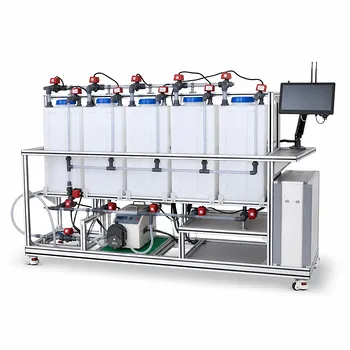
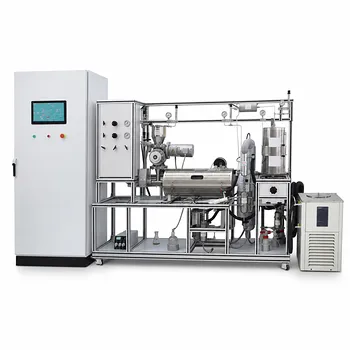
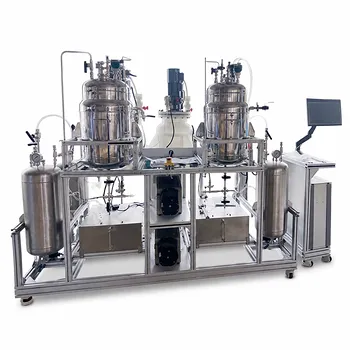
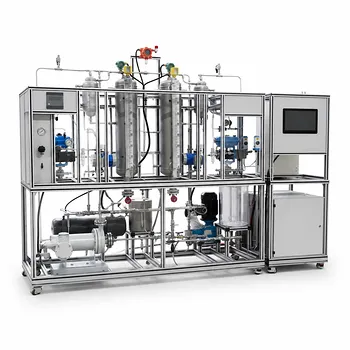
Hands-on operation of a chemical engineering unit operations pilot plant is the most direct way to translate textbook equations into a defensible business case for copper electrolytic refining. By physically running the process, you can measure the exact mass of anode sludge that settles, track the deposition rate of high-purity copper, and close a real material balance. This data—not theoretical assumptions—becomes the foundation for calculating the recovery value of precious metals like silver and gold, proving whether the process is economically viable.
A copper electrolytic refining pilot plant acts as a verifiable economic calculator. It lets you move from “the reaction says we should get this” to “we actually collected this much sludge and deposited this much 99.9% copper.” The critical insight is that validating the full material balance—especially the often-overlooked anode sludge stream—is what transforms a classroom stoichiometry exercise into a credible small-scale profitability assessment.
Capturing Material Balance Data in a Pilot Plant
Your first step in proving economic viability is to prove you can account for every gram of material. A pilot plant makes this possible.
The Core: Tracking Inputs and Outputs in Real Time
A properly instrumented pilot plant lets you collect flow rates, temperatures, electrolyte concentrations, and the physical mass of all streams. At this scale, you can precisely weigh the impure copper anode before the run and the refined cathode after. This direct measurement replaces theoretical yield calculations with empirical data, immediately revealing any discrepancy between predicted and actual mass.
Closing the Balance on the Anode Sludge
The primary reference highlights that the anode sludge contains silver, gold, platinum, and palladium. In a pilot cell, after a timed run at a controlled voltage, you drain the cell, carefully collect the settled sludge, dry it, and weigh it. This mass, along with a compositional assay, is the missing piece in a textbook balance. It proves exactly how much precious metal is recoverable per kilogram of copper refined, enabling a real revenue projection.
Identifying and Quantifying Hidden Losses
Any discrepancy in your material balance—where the weighed outputs don't match the weighed inputs—signals unaccounted waste, side reactions, or measurement errors. The pilot plant forces you to confront this reality. You might discover a fine sludge suspension lost during electrolyte draining, or an unexpected co-dissolution of nickel that increases electrolyte treatment costs. Pinpointing these losses is essential for an accurate cost model.
Quantifying Economic Feasibility Through Byproduct Recovery
Once your material balance accounts for the anode sludge, you can run the numbers. The economic question is not just “can we make pure copper?” but “what is the net profit after capturing all value streams?”
The Net Benefit Calculation for Anode Sludge
The economic model from the supplementary references applies directly: net benefit = (byproduct sales revenue + avoided waste treatment cost) – total recovery cost. Your pilot plant run provides the exact mass of sludge and its precious metal content, giving you the revenue figure. It also lets you measure the extra processing time or chemicals needed to fully separate and rinse the sludge, which feeds the recovery cost side of the equation.
Using Incremental ROI for Process Upgrades
When you test an improvement—like a novel electrode design, a filtration add-on to capture sludge more efficiently, or an automated voltage controller—don't just look at the new copper purity. Calculate the Incremental ROI: (Incremental Profit / Incremental Investment) x 100%. For instance, if adding a sensor system reduces energy consumption by 15% during your pilot runs, you can project that saving against the sensor's capital cost and justify the upgrade with hard data.
Validating Scale-Up Economics with Pilot Run Data
Material consumption rates per kilogram of refined copper, measured in your pilot runs, are the basis for sizing commercial equipment. You will know exactly how much electrolyte is lost to drag-out, how quickly the anode erodes, and the real energy demand at a specific current density. This data replaces generic design factors, de-risking the economic projections for a full-scale plant.
Understanding the Trade-offs and Pitfalls
Pilot plants are powerful, but they can mislead if you ignore their limitations. Trust is built on honest assessment.
Purity Versus Throughput
You can easily achieve 99.9% pure copper at a low current density in a well-controlled pilot cell. However, pushing for higher production rates by increasing the current may reduce purity or cause dendritic growth. A pilot run that only demonstrates the best-case purity without testing the maximum economic throughput gives an incomplete, potentially over-optimistic picture.
The Cost of Perfect Material Closure
It can be surprisingly difficult to close a material balance to 100%. Small leaks, electrolyte evaporation, or sludge sticking to the cell walls may lead you to spend excessive time chasing minor discrepancies. The trade-off is between absolute analytical perfection and gathering data that is “good enough” to make a confident economic decision. Recognize when you are optimizing beyond the precision needed for a payback period calculation.
Ignoring the Dissolved Impurities
While the anode sludge captures gold and silver, electronically more active impurities like zinc, nickel, and iron dissolve into the electrolyte. In a pilot plant, you can measure the buildup of these contaminants over multiple cycles. If left unaddressed, they will eventually degrade electrolyte quality and must be bled off and treated, adding a significant waste-treatment cost that a single-run pilot test might completely miss.
Making the Right Choice for Your Educational or Research Goal
Your approach to running the pilot plant should match your specific objective.
- If your primary focus is validating a business case for a specific ore: Run the plant with anode samples of that exact impurity profile. Direct all your effort into capturing, assaying, and valuing the anode sludge, then overlay the incremental costs and revenue to calculate a clear payback period.
- If your primary focus is teaching the fundamentals of mass balance: Prioritize a complete accounting of every stream—copper cathode, spent electrolyte, anode sludge, and emissions. Force the calculation of a closure percentage and analyze the source of any discrepancy to build a deep, practical understanding of process uncertainty.
- If your primary focus is optimizing the process economics: Run designed experiments where you vary voltage, temperature, and electrolyte flow. Use the gathered energy and material consumption data to calculate the Incremental ROI for each condition, identifying the true profit-maximizing operating point, not just the one that yields the purest copper.
The power of a chemical engineering pilot plant lies in its ability to turn economic feasibility from an abstract calculation into a measured result. By revealing exactly where the mass goes and what that material is worth, you equip yourself with an evidence-backed answer that no theoretical model can dispute.
Summary Table:
| Aspect | Data Measured in Pilot Plant | Economic & Process Value |
|---|---|---|
| Inputs & Outputs | Anode/cathode weights, flow rates, concentrations | Closes material balance with empirical data rather than formulas |
| Anode Sludge | Mass and precious metal (Ag, Au) assay | Calculates byproduct revenue and offsets waste treatment costs |
| Process Losses | Side reactions, electrolyte drag-out, impurities | Identifies hidden costs to refine economic scaling factors |
| System Optimization | Voltage, current density, energy consumption | Determines the optimal trade-off between purity and throughput |
Bridge the Gap Between Theory and Scale-Up with LABPARK
Are you looking to provide hands-on training or validate commercial process economics? LABPARK provides state-of-the-art Educational and Vocational Unit Operations Pilot Plants in chemical engineering, bioprocess & biotech, and environmental & water treatment for universities, research institutes, and enterprises.
By partnering with us, you gain access to:
- Hands-on Learning: Empower students and researchers to master real-world material balances and process controls.
- Risk Mitigation: Accurately evaluate process economics, ROI, and scalability using robust, industrial-grade equipment.
- Tailored Engineering Solutions: Get custom-engineered pilot systems designed to match your specific research or educational curricula.
Take the next step in process engineering excellence—contact LABPARK today to discuss your pilot plant requirements!
Related Products
- Electrolyte Distillation Purification and Formulation Educational Pilot Plant
- Electrolytic Hydrogen Production Educational Unit Operations Pilot Plant
- Electrochemical Water Treatment Educational Unit Operations Pilot Plant
- Solid Waste Pyrolysis and Refining Educational Pilot Plant for Unit Operations
- Water Electrolysis Hydrogen Production and Storage Educational Pilot Plant
People Also Ask
- Why does simple distillation yield higher efficiency than flash distillation? Key thermodynamic differences.
- How to Integrate Spectroscopy in Distillation Pilot Plants for Advanced Process Control
- How does the feed thermal state influence distillation pilot plant design and utility consumption?
- How to Configure a Distillation Pilot Plant? Key Steps for Multi-Mode Setup
- How to Verify Distillation Boundary Lines & Composition Regions with Pilot Plants