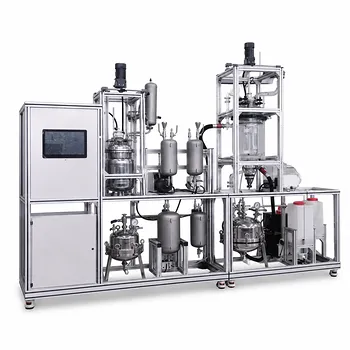
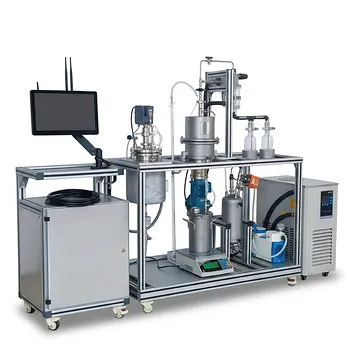
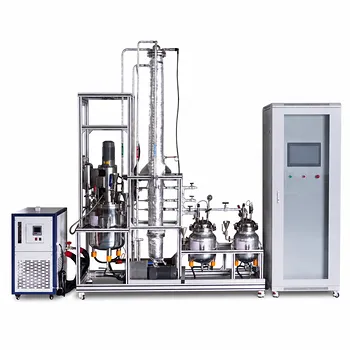
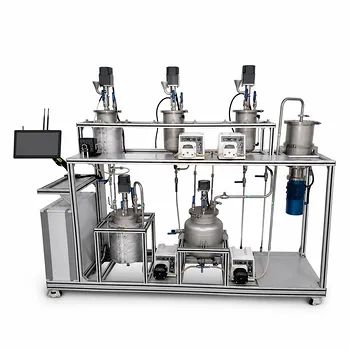
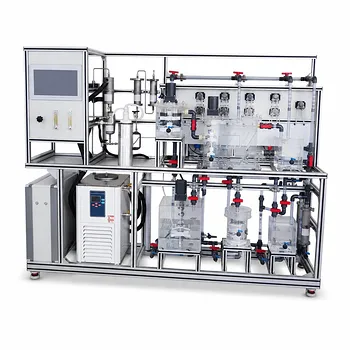
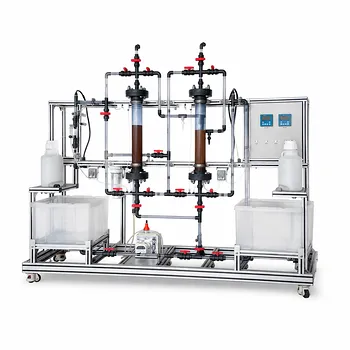
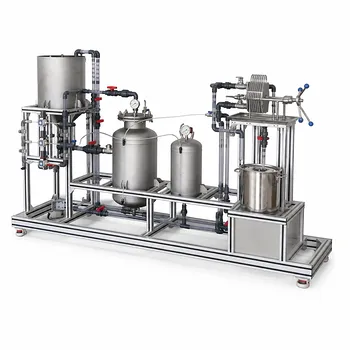
The core of heavy metal removal in a water treatment pilot plant isn't just about adding a chemical; it's about the precise thermodynamic control of the solution environment to force dissolved ions into an insoluble solid phase. By manipulating key variables like pH, temperature, and precipitant concentration, operators directly shift the ionic equilibrium. The pilot plant becomes the testing ground where the abstract principles of the solubility product constant ((K_{sp})), the common ion effect, and coordination chemistry are converted into a reliable, scalable sequence of mixing, reaction, and physical separation to purify water.
While the goal is simple—make dissolved metals form a solid that can be filtered out—the challenge lies in managing multiple, often competing, chemical equilibria. A pilot plant provides the physical infrastructure to study and optimize these competing reactions under controlled, industrial-like conditions, transforming ionic equilibrium principles into a practical separation sequence.
Harnessing the Solubility Product to Force Precipitation
The fundamental yardstick for precipitation is the solubility product constant ((K_{sp})). This value defines the maximum product of ion concentrations that can exist in a stable solution.
When the ion product exceeds the (K_{sp}), the equilibrium shifts to form a solid precipitate. In a pilot plant, this isn't left to chance. Researchers deliberately spike a waste stream with a precipitant to cross this threshold.
The Critical Role of Sulfide Precipitation
A classic demonstration involves removing copper ions ((Cu^{2+})). Rather than just any precipitate, operators target compounds with an extremely low (K_{sp}), like copper sulfide ((CuS)).
With a (K_{sp}) of (6.3 \times 10^{-36}), the equilibrium for (CuS) lies massively toward the solid phase. This makes sulfide precipitation one of the most effective tools for polishing wastewater to meet stringent discharge limits.
Driving the Reaction with the Common Ion Effect
Achieving "complete" removal on paper is different from meeting a legal discharge permit. Simply adding the stoichiometrically exact amount of a precipitant often leaves a residual ion concentration that is too high.
This is where the common ion effect becomes essential. By adding an excess of the precipitant—one that shares a common ion with the target precipitate—the dissolution equilibrium is forcefully shifted toward the solid.
For example, to remove barium ions ((Ba^{2+})), adding an excess of sodium sulfate not only forms barium sulfate ((BaSO_4)) but also introduces a massive sulfate concentration. This surplus of the common ion dramatically suppresses the solubility of the (BaSO_4), driving the dissolved barium level down to parts-per-billion.
Engineering pH-Selective Fractional Precipitation
A real wastewater stream is never a single-metal problem. The deep need is often selective separation—removing one toxic metal while leaving another, or recovering a valuable one. This is where fractional precipitation, governed by pH, becomes critical.
Exploiting Different (K_{sp}) Thresholds
Metal hydroxides do not all precipitate at the same pH. Their distinct (K_{sp}) values mean each has a specific hydroxide ion ((OH^-)) concentration threshold where precipitation begins. A pilot plant’s fine pH control system is the instrument that exploits this.
Operators construct and analyze (lg[M^{n+}] - pH) curves, which visually plot the concentration of a dissolved metal ion against pH. These curves define the precise "operating window" for a separation. For instance, they reveal that trivalent iron ((Fe^{3+})) will precipitate as ferric hydroxide at a low pH of around 4, a condition where divalent ions like zinc or magnesium remain completely in solution.
Case Study: The Al³⁺/Fe³⁺ Hydrolysis Problem
These separation curves also highlight a critical pitfall: the acidic nature of high-valence metal ions. Hydrated (Al^{3+}) and (Fe^{3+}) cations act as polyprotic acids, undergoing stepwise hydrolysis that releases (H^+) ions.
If this auto-acidification is not anticipated, the pH can crash, driving unwanted precipitation inside feed lines or tanks before the intended reaction vessel. The pilot plant teaches a crucial design rule: to maintain a clear, stable feed solution of these metals, a strong acid must be added first to suppress the hydrolysis equilibrium.
Leveraging Coordination Chemistry for Selective Recovery
Sometimes, the target metal is locked in a stable complex, or you need to separate two metals with very similar precipitation properties. Precipitation and pH alone are insufficient.
The pilot plant then becomes a platform for coordination chemistry.
Breaking Stable Complexes to Force Precipitation
Many industrial wastes, like spent photographic fixer, contain metal ions bound tightly in complexes (e.g., silver thiosulfate). Direct precipitation is impossible because the free (Ag^+) ion concentration is infinitesimally small.
The solution is a competitive equilibrium. Silver sulfide ((Ag_2S)) has an astonishingly low (K_{sp}) of (6.3 \times 10^{-50}). Adding sulfide ((S^{2-})) ions initiates a two-step process: it instantly precipitates any free silver, which then pulls the complex dissolution equilibrium so decisively toward free (Ag^+) that the stable complex is torn apart to feed the precipitation reaction.
Dissolving a Mixed Precipitate for Purification
The reverse logic applies for recovery. Consider a mixed sludge of zinc and magnesium hydroxides. If you need a pure magnesium product, you can exploit complexation.
Adding ammonia to the sludge forms a soluble, stable tetraamminezinc(II) complex (([Zn(NH_3)_4]^{2+})). This selectively dissolves the zinc into the liquid phase, leaving the magnesium hydroxide as a purified solid that can be filtered off. This method, tested at pilot scale, demonstrates how manipulating stability constants enables true fractional separation and metal recycling.
Understanding the Trade-offs
While ionic equilibrium principles are powerful, they have operational limits that a pilot plant exposes.
- Sludge Volume vs. Effluent Purity: The common ion effect by adding a large excess of precipitant, like sulfide, guarantees low metal levels, but it generates a voluminous, often difficult-to-dewater sludge, raising disposal costs.
- Ligand Interference: If a waste stream contains complexing agents (like ammonia or EDTA) alongside the heavy metals, simple pH adjustment for hydroxide precipitation will fail. The ligand equilibrium will outcompete the precipitation reaction, keeping the metal in solution.
- Ideal Curves vs. Real Fluids: The clean (lg[M^{n+}] - pH) curves are derived in pure water. In real high-salinity industrial brines, ionic strength effects alter activity coefficients, shifting the actual precipitation pH away from the theoretical value. Pilot plant validation is non-negotiable.
Making the Right Choice for Your Separation Goal
Your choice of treatment logic in a pilot plant is dictated entirely by your primary objective.
- If your primary focus is meeting a strict, single-metal discharge limit: Use sulfide precipitation and the common ion effect. Target compounds with the lowest possible (K_{sp}) and use a precise, excess dose of the precipitant to drive residual concentrations to near-zero.
- If your primary focus is metal recovery or selective separation: Combine pH-controlled fractional precipitation with coordination chemistry. Use pH alone to isolate distinct metal hydroxide bands, and then apply selective ligands to dissolve an unwanted component from a mixed precipitate.
- If your primary focus is treating a complex or unknown waste stream: Never assume simple hydroxide precipitation will work. The pilot plant must first screen for interfering ligands, and you must map the actual precipitation behavior of your specific fluid matrix, not just rely on textbook constants.
The pilot plant translates the elegant mathematics of ionic equilibrium into the messy reality of pumps, tanks, and flowing wastewater, providing the critical scale-up data that no theoretical calculation can replace.
Summary Table:
| Precipitation Method | Core Chemical Principle | Primary Application / Objective |
|---|---|---|
| Sulfide Precipitation | Extremely low solubility product ($K_{sp}$) | Polishing wastewater to meet strict discharge limits |
| Common Ion Effect | Excess precipitant shift in equilibrium | Driving residual metal concentrations to ppb levels |
| Fractional Precipitation | pH-dependent $K_{sp}$ thresholds | Selective separation of multiple metals in mixed streams |
| Coordination Chemistry | Complexation & competitive dissolution | Breaking stable metal complexes and recycling valuable metals |
Optimize Your Environmental and Water Treatment Operations with LABPARK
Translating chemical theory into scalable industrial performance requires robust, reliable testing equipment. LABPARK provides premium Educational and Vocational Unit Operations Pilot Plants in chemical engineering, bioprocess & biotech, and environmental & water treatment.
Engineered for universities, research institutes, and enterprises, our pilot plants help you master complex process controls, optimize precipitation chemistry, and validate heavy metal removal designs.
Ready to elevate your research and training capabilities? Contact LABPARK today to find the perfect pilot plant solution for your lab!
Related Products
- Gallium and Indium Selective Extraction Educational Pilot Plant
- Fixed-Bed Chemical Reaction and Gas Dust Tar Removal Unit Operations Pilot Plant
- Solid Waste Pyrolysis and Refining Educational Pilot Plant for Unit Operations
- Natural Product Extraction Unit Operations Training Pilot Plant
- Supercritical High-Gravity Flash Evaporation Educational Unit Operations Pilot Plant
People Also Ask
- How do pilot plants differentiate physical vs chemical extraction? Enhance Chemical Engineering Training
- What is the significance of the isopycnic line in liquid-liquid extraction? Avoid Column Flooding
- How do droplet motion states affect kD in extraction pilot plants? Optimize Mass Transfer
- Why is predicting multicomponent LLE from binary data more challenging than VLE? Master your pilot plant design.
- How are ternary phase diagrams and LLE data applied in extraction experiments? Optimize Pilot Plant Scale-up