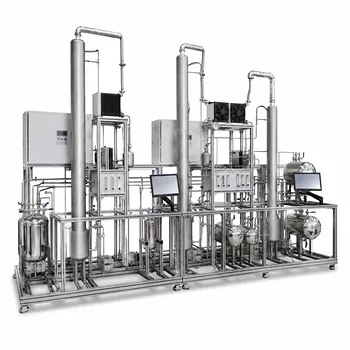
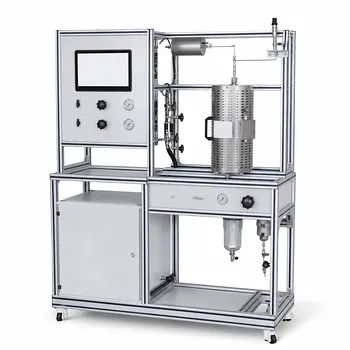
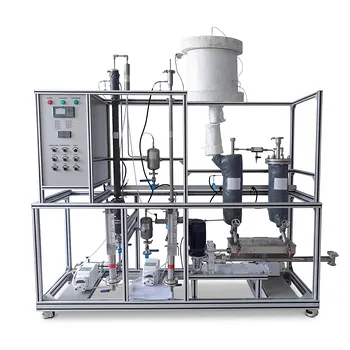
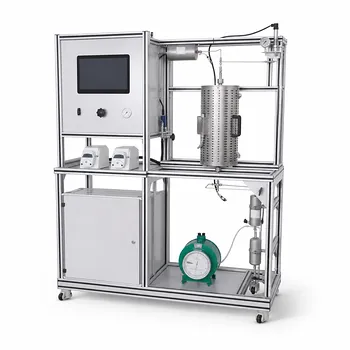
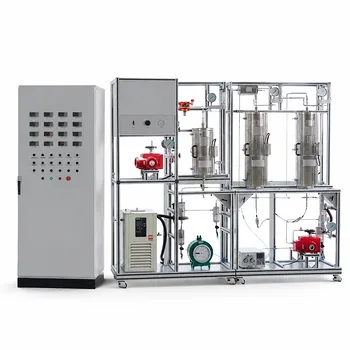
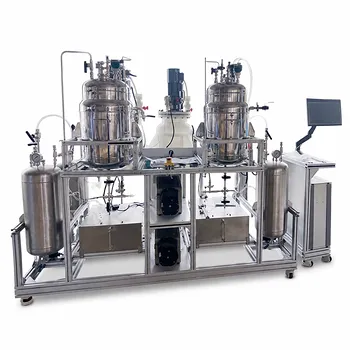
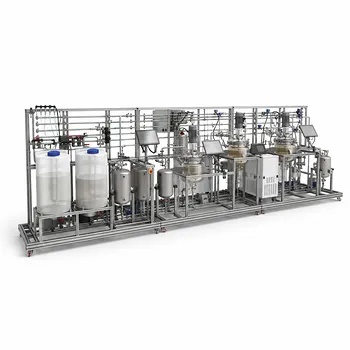
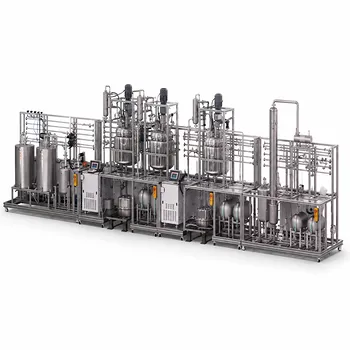
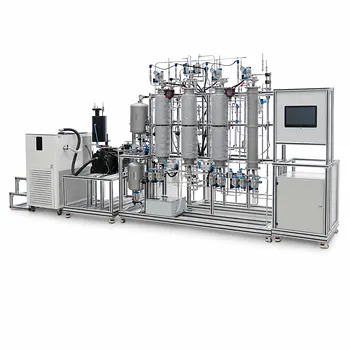
The straightforward answer: In educational pilot plants, a cell separation unit—typically a hydrocyclone or centrifuge—is placed directly between the bioreactor and the distillation column. This unit continuously concentrates and recycles yeast cells back to the fermentor while sending the clarified, ethanol-containing liquid to a beer distillation column for purification. This closed-loop integration maintains a high cell density inside the bioreactor, avoids ethanol toxicity, and transforms a batch process into a steady-state continuous bioprocess that lets students explore reaction kinetics, solid-liquid separation, and thermal purification in one streamlined system.
The core insight: integrating cell separation with distillation does more than just purify a product. It energetically decouples yeast growth from ethanol formation, boosting volumetric productivity while giving students a living laboratory to study how biological, mechanical, and thermal unit operations must be choreographed to run a successful continuous fermentation.
Why Cell Separation is the Unsung Hero of Continuous Fermentation
Overcoming Ethanol Toxicity
Yeast cells become inhibited when ethanol concentration exceeds roughly 8% by weight. In batch setups, this forces an early stop. A continuous loop sidesteps the problem by constantly withdrawing fermentation broth and replacing it with fresh feed, but simply pulling out whole broth would also wash out the microbes. The separation unit solves this by letting you remove only the toxic product while keeping the biocatalyst inside the vessel.
Concentrating and Recycling Yeast Cells
A hydrocyclone or centrifuge exploits the density difference between yeast cells and the liquid. The concentrated cell slurry flows straight back to the fermentor. This cell retention is the secret to a continuous process: cells are not wasted, and the fermentor behaves like a high-density perfusion reactor even at high dilution rates.
Maintaining a High Cell Density
With a separation loop, the fermentor can hold a yeast concentration far above what natural growth alone would achieve. High cell density means a smaller reactor can deliver the same ethanol output, or an existing reactor can push to higher productivity. Students can directly observe how changing the recycle ratio affects biomass concentration and ethanol yield, linking biological kinetics with mechanical separation design.
From Fermentor to Distillation: Purifying the Product
The Beer Column and Its Function
The clarified stream from the separator—still mostly water with 5–8% ethanol—feeds a fractional distillation column (often called a beer column). Here, the unit operation shifts from solid-liquid separation to vapor-liquid equilibrium: trays or packing separate ethanol from water, sending a concentrated ethanol stream overhead and a stillage bottom product. This introduces students to the core principles of thermal purification and column hydraulics.
Addressing the Azeotropic Limit in Educational Setups
Standard fractional distillation hits the ethanol-water azeotrope at about 96 wt%, which is sufficient for many training objectives. In a basic pilot plant, the beer column alone demonstrates reflux ratio control, Murphree efficiency, and continuous feed operation. For programs wanting to showcase fuel-grade production, supplementary dehydration units—molecular sieve adsorption columns or pervaporation membranes—can be tacked on after the beer column, letting students grapple with thermodynamic barriers and hybrid separation technologies.
The Integrated Loop as a Teaching Powerhouse
Demonstrating Biological Reaction Kinetics in Real Time
A continuous bioreactor with cell recycle creates a steady state that makes kinetics tangible. Students can alter dilution rates, substrate concentrations, or recycling rates and measure how ethanol productivity, substrate consumption, and biomass retention respond. This is a dramatic leap from batch experiments, where conditions constantly change.
Solid-Liquid Separation Principles in Action
The separator itself becomes a hands-on module for teaching centrifugal force, cut-size classification, and separation efficiency. Hydrocyclones, for example, illustrate pressure drop and particle-laden flow, while centrifuges introduce rotational mechanics and scale-up challenges. Because the output of this unit directly influences the fermentor’s health, students see the immediate consequences of poor separation—a graded learning moment no textbook can replicate.
Thermal Separation and Column Hydraulics
The distillation column that follows is the pilot plant’s thermal engine. By manipulating the reflux ratio, students control product purity and energy consumption. They also encounter weeping, flooding, and entrainment—practical insights that bridge classroom theory with real operation. When the column runs continuously from an upstream fermentor, they also learn how upstream disturbances (like a temporary drop in ethanol concentration) ripple through a plant and how to dampen them with control strategies.
Understanding the Trade-offs and Practical Challenges
Even an elegantly integrated pilot plant comes with compromises, and discussing them openly builds genuine understanding.
- Cell viability and fouling: Mechanical shear from a centrifuge or high-velocity hydrocyclone can damage yeast cells, gradually reducing fermentation activity. Membrane fouling or clogging of small channels demands regular cleaning.
- Contamination risk: A continuous loop with recycling increases the chance of bacterial contamination spreading through the entire system. Sterilization protocols and single-use connections become critical teaching points.
- Energy and capital cost: Adding a separation unit upfront is an extra piece of equipment, and the distillation column consumes significant steam. The net productivity gain must be weighed against these costs—a perfect scenario to introduce economic optimization.
- Process complexity vs. pedagogical clarity: The more unit operations are chained together, the harder it becomes to isolate cause and effect. Instructors often start students with simple batch fermentation, then add the separation loop, and finally the distillation column, layering complexity as understanding deepens.
Making the Right Choice for Your Educational Goals
The exact configuration of your integrated pilot plant should be guided by the learning outcomes you prioritize.
- If your primary focus is biochemical reaction engineering: Keep the cell separation robust and adjustable. A centrifuge with variable speed or a transparent hydrocyclone allows students to explore how recycle ratio and cell retention time govern productivity, with the distillation column serving mainly as a downstream “black box” that removes ethanol.
- If your primary focus is separation unit operations: Emphasize the distillation column’s performance and, if possible, add a dehydration module like pressure swing adsorption. The fermentor and cell separator then become a reliable feed source, letting students experiment with reflux ratios, feed preheating, and azeotropic limits.
- If your primary focus is integrated process control and plant-wide dynamics: Instrument the loop with flow, temperature, and concentration sensors. Challenge students to design cascading control loops that stabilize the fermentor’s ethanol level by automatically adjusting the distillation column’s feed rate or the cell recycle flow.
- If your primary focus is demonstrating industrial-scale continuous processing: Operate the plant 24/7 (or at least for extended periods) and have students perform scheduled sampling, cleaning, and troubleshooting, just as they would in a real biorefinery. The cell separation–distillation loop then becomes a miniaturized model of a commercial fuel-ethanol plant.
Ultimately, a cell separation unit stitched between a bioreactor and a distillation column turns a collection of standalone experiments into an authentic, continuous bioprocess. The lesson is not just in any single piece of equipment—it’s in the seamless flow of material and energy that transforms a fragile batch culture into a robust, productivity-driven operation students are ready to scale and optimize.
Summary Table:
| Unit Operation | Key Function in Loop | Educational Learning Outcome |
|---|---|---|
| Bioreactor | Continuous fermentation & yeast cell growth | Biological reaction kinetics & steady-state dynamics |
| Cell Separator (Centrifuge/Hydrocyclone) | Yeast concentration & recycling back to fermentor | Solid-liquid separation efficiency & cell retention limits |
| Distillation Column (Beer Column) | Vapor-liquid purification of ethanol (up to 96%) | Thermal separation, reflux ratio control & column hydraulics |
| Dehydration Unit (Optional) | Bypasses the ethanol-water azeotropic limit | Advanced thermodynamic barriers & hybrid separations |
Bring Hands-On Bioprocess Engineering to Your Institution
Are you looking to bridge the gap between classroom theory and real-world industrial operations? LABPARK designs and manufactures high-performance Educational and Vocational Unit Operations Pilot Plants across chemical engineering, bioprocess & biotech, and environmental & water treatment.
By partnering with us, universities, research institutes, and enterprises benefit from:
- Robust Integrated Systems: Safely teach complex continuous processes, from steady-state fermentation to multi-stage distillation.
- Industry-Ready Training: Equip your students and researchers with practical experience in process control, column hydraulics, and system optimization.
- Customizable Configurations: Tailor equipment scales and instrumentation to fit your specific curriculum and research goals.
Take your lab training to the next level—contact LABPARK today to request a quote or custom consultation!
Related Products
- Bio-fermentation Ethanol Production Practical Training Unit Operations Pilot Plant
- Green Anhydrous Ethanol Refining Practical Training Pilot Plant
- Green Anhydrous Ethanol Purification Extractive Distillation Unit Operations Training Pilot Plant
- Ethyl Acetate Synthesis Unit Operations Pilot Plant for Practical Training
- Methanol Synthesis and Catalyst Performance Evaluation Educational Unit Operations Pilot Plant
People Also Ask
- Why Use PTFE & Hastelloy in Chemical Pilot Plants? Prevent Corrosion & Ensure Safety
- Why Compare Predicted and Experimental Excess Enthalpy? Key to Accurate Pilot Plant Scale-up
- Why is the chemical plant startup schedule crucial? De-risk scale-up with pilot plants.
- When to transition from PID to adaptive control in pilot plants? Key process indicators.
- Why must batch and fed-batch fermentation pilot plants be designed to accommodate changing rheological conditions?