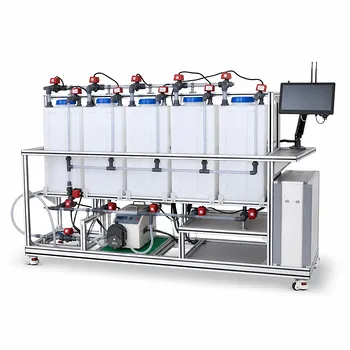
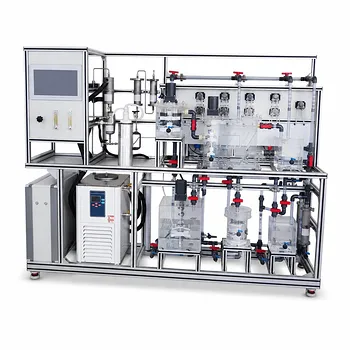
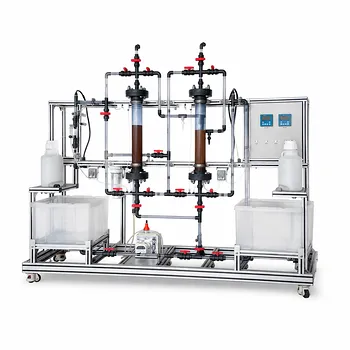
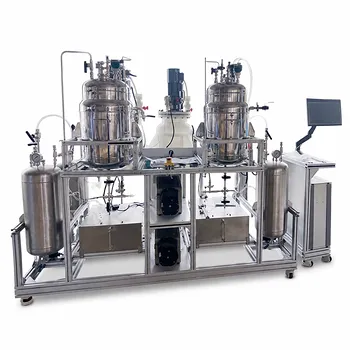
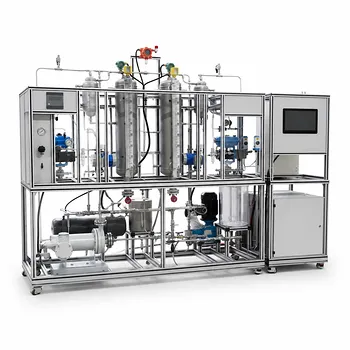
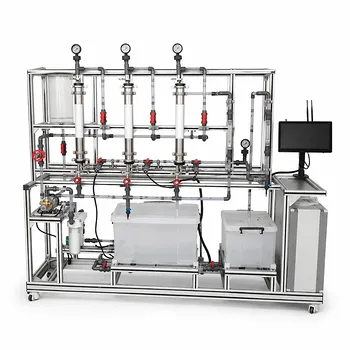
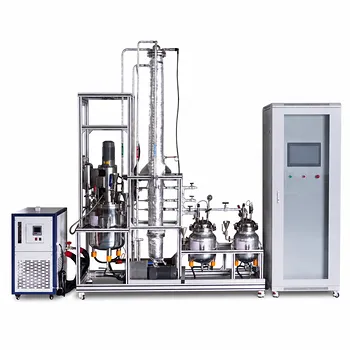
A pilot plant is the critical bridge between textbook environmental chemistry and the complex reality of treating toxic industrial waste. In an educational curriculum, these scaled-down facilities transform abstract treatment principles into a visceral, hands-on discipline. Students don't just learn that wastewater must be neutralized; they physically operate the plant, measure the results, and confront the same safety and efficiency trade-offs they will face in a real fine chemical production facility.
The core challenge of fine chemical education is making the invisible costs of waste—environmental impact and compliance burden—visible to the future engineer. Environmental pilot plants achieve this by forcing students to manage real effluents, optimize for green chemistry metrics like the E-factor, and develop safe handling protocols for hazardous materials, turning theoretical knowledge into instinctive professional competence.
Bridging the Gap from Textbook to Reality
Theorizing about treatment in a lecture hall cannot replicate the chaos of a real waste stream. A pilot plant introduces the non-idealities of industrial life, such as fluctuating pollutant loads and equipment fouling. This section details the core unit operations that form the backbone of this practical education.
Mastering the Core Unit Operations
Fine chemical waste is never a single compound; it's a complex mixture demanding a sequence of physical, chemical, and biological steps. Pilot plants allow students to link these steps together.
- Physical Treatment: Students operate filtration and sedimentation units to remove suspended solids. They can measure pressure drops across a membrane, directly observing fouling and learning pre-treatment necessity.
- Chemical Treatment: Operations like neutralization and advanced oxidation become tangible. Using a pilot plant, a student can neutralize an acidic stream with lime (CaO) and not just calculate the pH change, but physically see the gypsum precipitate forming and handle the resulting sludge.
- Polishing and Separation: Units for ion exchange and adsorption demonstrate polishing steps. Running breakthrough curves on an activated carbon column to remove trace organic contaminants teaches mass transfer dynamics in a way a textbook graph never can.
Quantifying the Environmental Footprint with E-Factors
The concept of "waste" moves from an abstract term to a measurable quantity. A pilot plant is the ideal tool for teaching green chemistry metrics, specifically the E-factor (kg of waste per kg of product).
Performing a Comparative Mass Balance
Students can run a classic Lewis-acid-catalyzed reaction, like a Friedel-Crafts acylation, which generates vast amounts of aqueous salt waste from the quench and neutralization steps. They collect and weigh every waste stream, calculating a high E-factor, often in the range of tens to hundreds.
Validating Greener Catalytic Routes
The same product is then synthesized using a heterogeneous catalyst, such as a solid zeolite, in the pilot plant's flow reactor. The student now performs a new mass balance, dramatically seeing the reduction in aqueous waste. This direct, hands-on comparison of process routes carves the principles of waste minimization into their engineering mindset.
Understanding the Trade-offs and Safety Imperatives
An educational pilot plant’s most profound lesson is that there is no perfect solution; only managed compromises. Students must confront the reality that fixing one problem can create another, all while operating under the non-negotiable constraints of safety.
The Economic and TDS Trade-off in Neutralization
Selecting a neutralizing agent is an exercise in real-world compromise. Using cheap sodium hydroxide (NaOH) is easy, but it creates a high Total Dissolved Solids (TDS) load, which is an invisible, long-term water pollution problem. Using an ammonia solution avoids TDS but introduces a nitrogen nutrient load that can cause eutrophication. Experimenting with reagents like sulfuric acid or lime teaches students to balance cost, safety, and the ability of downstream biology to handle the salt load.
Critically Managing Nanomaterials and Hazardous Waste
Pilot plants expose students to the immense responsibility of handling dangerous materials, providing the critical lesson that waste segregation is an absolute requirement.
- Managing Emerging Hazards: A pilot plant configured with a specialized membrane filtration unit allows students to simulate the capture of nanomaterials. They learn that standard treatment fails and that specialized separation techniques and standardized safety protocols are essential for emerging technologies.
- Enforcing Disposal Rigor: The plant environment instills strict safety protocols. Students learn that inorganic waste containing heavy metals is categorically separate from non-toxic, neutralized brine, and that organic waste liquids must be collected for professional incineration. They practice segregating highly active, explosive, or strong oxidizing/reducing agents into dedicated containers, never mixing them.
Making the Right Choice for Your Goal
An educational curriculum can be sculpted around the pilot plant's capabilities to meet specific pedagogical targets. The teaching focus should align directly with the desired graduate profile.
- If your primary focus is training process operators: Prioritize run-time experience on standard unit operations like neutralization and filtration, emphasizing standard operating procedures, troubleshooting equipment, and consistent effluent monitoring for compliance.
- If your primary focus is developing process design engineers: Use the plant for comparative mass balances focused on the E-factor and waste minimization. Have students design, execute, and compare different synthetic pathways and separation trains, from heavy-sludge chemical routes to catalytic or purely physical separation options.
- If your primary focus is on corporate environmental, health, and safety (EHS) roles: Centralize the curriculum on waste segregation protocols, safe handling of novel hazards like nanomaterials, and the real-time cost calculation of disposal methods for different waste classes.
The true power of an environmental pilot plant is to transform a student’s relationship with waste from innocent ignorance to informed respect.
Summary Table:
| Curriculum Focus | Target Graduate Profile | Key Pilot Plant Operations |
|---|---|---|
| Process Operations | Process Operators | Operating filtration/neutralization units, monitoring effluent, executing SOPs. |
| Process Design | Design Engineers | Performing comparative mass balances, optimizing E-factors, validating catalytic routes. |
| Safety & EHS | EHS Specialists | Waste segregation, handling nanomaterials, managing hazardous chemical waste safely. |
Elevate Your Chemical Engineering Program with LABPARK
Bridging the gap between textbook theory and complex industrial reality requires hands-on training. LABPARK designs and manufactures premium Educational and Vocational Unit Operations Pilot Plants in chemical engineering, bioprocess & biotech, and environmental & water treatment.
We help universities, research institutes, and enterprises build advanced laboratory environments where students can safely master real-world waste treatment, calculate E-factors, and learn vital process safety protocols.
Bring industrial-scale learning to your students—contact our technical experts today to discuss your curriculum needs.
Related Products
- Electrochemical Water Treatment Educational Unit Operations Pilot Plant
- Thermal Desorption Exhaust Gas and Tail Water Treatment Educational Pilot Plant
- Ion Exchange Water Purification Educational Pilot Plant for Engineering Unit Operations
- Water Electrolysis Hydrogen Production and Storage Educational Pilot Plant
- Alkaline Membrane Water Electrolysis Educational Pilot Plant Unit Operations Training System
People Also Ask
- What design features do educational electrochemical pilot plants utilize to manage gas liberation and water loss?
- How can unit operations pilot plants show lead-acid concentration vs state of charge? Real-time monitoring guide.
- How do educational electrochemical pilot plants scale up electrolysis? Master industrial engineering.
- How to Estimate Sulfate in Water Treatment Pilot Plant Deposits: Gravimetric Guide
- How can foaming be managed during steam generation experiments in water treatment unit operations pilot plants? Tips