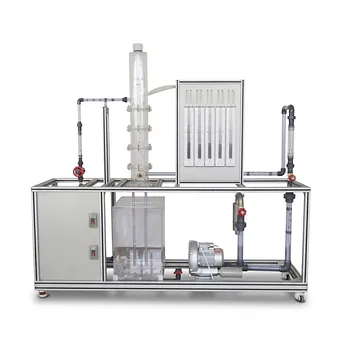
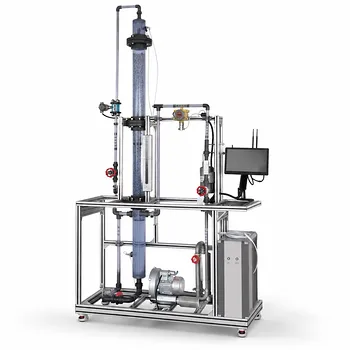
At the intersection of chemical reaction and separation science, a reactive distillation pilot plant vividly demonstrates how to unify two major unit operations into one, process-intensified system. Students learn that by continuously removing products within the column, the equilibrium-limited conversion of a reaction can be pushed to near completion (often >99%), while the exothermic heat of reaction is directly used to drive the separation—eliminating intermediate piping, pumps, and instrumentation. Practically, they face the critical challenge of defining a single operating window where temperature and pressure satisfy both the reaction kinetics and the vapor-liquid equilibrium required for effective distillation, and they must handle structured catalysts that preserve countercurrent flow without flooding.
Reactive distillation is the ultimate case study in process intensification. It teaches students not just how to drive a reaction past its thermodynamic limit, but also how to think holistically about energy, mass, and momentum integration—while confronting the real-world constraints of column hydrodynamics, catalyst packing, and tight controllability that make such a system both powerful and unforgiving.
The Core Educational Concepts a Reactive Distillation Pilot Plant Demonstrates
A reactive distillation column is more than a piece of equipment; it is a living textbook of integrated chemical engineering principles.
Process Intensification and Overcoming Equilibrium Limits
The most fundamental lesson is how process intensification (PI) transforms a classical limitation into a design opportunity. In a conventional reactor, a reaction like esterification hits a chemical equilibrium ceiling. In reactive distillation, one product is continuously distilled away from the catalyst zone.
This in situ product removal shifts the equilibrium position, driving conversion far beyond what an isolated reactor could achieve. Students see how the synergy of reaction and separation replaces multiple unit operations—reactor, distillation train, recycle loops—with a single vessel.
Exothermic Heat Integration and Energy Efficiency
Many reactive distillation demonstrations involve exothermic reactions, such as the synthesis of MTBE or ethyl acetate. The heat released is not wasted; it directly vaporizes the liquid mixture in the column. This illustrates near-isothermal operation and dramatic energy savings.
Rather than external reboilers dominating the heat input, the reaction itself supplies a portion of the duty. Students quantify how this heat integration reduces both utility consumption and the plant's carbon footprint, making the concept of energy-efficient design tangible.
Catalyst Packing and the Synergy of Reaction and Mass Transfer
To achieve simultaneous reaction and separation, the catalyst cannot simply be dumped into the column. It must be structured into specialized packings or located in pockets within wire-mesh internals. This arrangement provides the necessary surface area for the catalytic reaction while maintaining the countercurrent flow of vapor and liquid.
Students learn how catalyst geometry, loading density, and placement influence residence time and mass transfer efficiency. The pilot plant makes abstract concepts like the Height Equivalent to a Theoretical Plate (HETP) directly measurable by comparing performance with and without reaction.
The Practical Challenges Students Encounter First-Hand
While the theoretical benefits are clear, operating a reactive distillation column exposes students to a distinct set of operational hurdles that simulation software often papers over.
Defining the Operating Window: When Kinetics and VLE Collide
The column must be run at a temperature and pressure that makes both the chemical reaction and the vapor-liquid separation happy—and these requirements rarely align naturally. The reaction may demand a high temperature for sufficient rate, while the separation demands a lower temperature to maintain a favorable relative volatility or prevent product degradation.
Students quickly discover that the "window of operation" is narrow. Pushing conversion can force operation into a regime where flooding occurs or where the desired product no longer boils off cleanly. This real-time constraint teaches a respect for thermokinetic coupling that no textbook problem can convey.
Managing Hydrodynamics: Flooding, Weeping, and Entrainment
A reactive distillation column is a gas–liquid contactor under the additional stress of changing molar flow rates from the reaction. Students visually observe hydrodynamic phenomena like flooding, weeping, and entrainment—and learn how these limit throughput and separation efficiency.
In plate columns, they can see liquid weeps through the perforations or froth builds to the tray above. In packed columns, they monitor pressure drop to detect incipient flooding. Adjusting the reflux ratio or reboiler duty becomes a hands-on lesson in column hydraulics, especially as reaction-generated vapor disrupts the steady flow.
Catalyst Morphology and Column Internals
A standard distillation packing would not work; the catalyst particle size and shape must allow downward liquid flow while providing ample surface for reaction without creating excessive pressure drop. If the catalyst morphology is wrong, the column floods at low loads or the reaction zones starve of reactants.
Pilot plants force students to address questions of catalyst packing support, distribution of liquid onto the catalyst bed, and the trade-off between catalyst inventory (for high conversion) and open area (for vapor flow). These design decisions are critical in a real plant and require a deep understanding of both reaction engineering and rate-based distillation.
Control and Stability of an Integrated, Multi-Variable System
Reactive distillation merges two dynamic processes into one, creating a strongly non-linear, multi-variable control problem. Adjusting a heat input affects not only separation but reaction rate; changing the feed composition can swing the column's temperature profile wildly. Students grapple with longer time constants and the potential for snowball effects, where a small disturbance causes a cascade of operational issues.
The pilot plant becomes a proving ground for understanding the limitations of simple control loops. Students see why industrial columns rely on advanced control strategies and why simulation convergence failures reflect genuine physical instability.
Understanding the Trade-offs
Reactive distillation is not a universal solution; it forces compromises that are essential for engineers to appreciate.
- Narrower operating flexibility: The need to satisfy both reaction and separation requirements simultaneously shrinks the safe operating region. A slight pressure upset can kill both conversion and product purity.
- Increased design complexity: The column internals, catalyst loading, and mechanical design are far more sophisticated—and expensive—than a standalone reactor or distillation column. Educational pilots must often use simplified catalyst structures that still demonstrate the principle.
- Catalyst deactivation and maintenance: In-situ catalyst replacement is challenging. In a real plant, the entire column section may need to be lifted out, adding downtime. The pilot plant subtly teaches that catalyst longevity and regeneration strategy are central to economic viability.
- Control challenges: The integrated nature makes the system less forgiving. Students learn that manual control is often insufficient, driving home why model-predictive control is frequently used in industrial reactive distillation units.
How to Use a Reactive Distillation Pilot Plant to Best Suit Your Educational Goals
Different curricula can emphasize different aspects of this powerful unit. Match your learning objectives to the right operational focus.
- If your primary focus is teaching process intensification and sustainable design: Highlight the energy savings, the elimination of intermediate process equipment, and the direct comparison of equilibrium-limited conversion versus reactive distillation. Run experiments where students measure the energy input per kilogram of product for a standalone reactor-plus-distillation train versus the integrated column.
- If your primary focus is advanced process control and operational troubleshooting: Use the column to demonstrate non-linear dynamics. Have students intentionally misalign the operating window, provoke flooding, and try to recover product quality using manual or simple feedback control. The pilot plant’s sensitivity to reflux ratio and feed preheating becomes an ideal platform for control theory.
- If your primary focus is fundamental reaction engineering and mass transfer: Start with simpler separate units before moving to reactive distillation. Once students understand standard kinetics and VLE, use the reactive column to show how the combination changes everything—measuring HETP under reactive conditions, quantifying the enhancement in conversion, and analyzing catalyst effectiveness factors inside the column internals.
Reactive distillation pilot plants turn the theoretical dream of process intensification into a messy, eye-opening reality. They teach that real engineering isn't just about designing a perfect reactor or a perfect column, but about making them work together within a single, elegant, and demanding vessel.
Summary Table:
| Key Focus | Educational Concepts Demonstrated | Practical Challenges Faced |
|---|---|---|
| Process Intensification | Overcoming equilibrium limits in situ | Balancing kinetics and vapor-liquid equilibrium (VLE) |
| Energy Efficiency | Utilizing exothermic reaction heat | Managing multi-variable, non-linear control loops |
| Hydrodynamics & Design | Integrating reaction and mass transfer | Preventing column flooding, weeping, and catalyst dry-out |
Bring Industrial Reality to Your Chemical Engineering Lab
Help your students master complex concepts like process intensification with LABPARK’s advanced Educational and Vocational Unit Operations Pilot Plants. We design and deliver specialized training systems in chemical engineering, bioprocess & biotech, and environmental & water treatment tailored for universities, research institutes, and enterprises worldwide.
Ready to upgrade your laboratory with robust, curriculum-aligned pilot plants? Contact our experts today to discuss your educational goals and request a custom solution.
Related Products
- Multi-Functional Special Distillation Educational Pilot Plant
- Continuous Sieve-Plate Distillation Pilot Plant for Unit Operations Laboratory Education
- Continuous Batch Extractive Distillation Educational Pilot Plant
- Multi-Modal Distillation Unit Operations Training Pilot Plant
- Dual-Mode Rectification Pilot Plant for Practical Training Unit Operations
People Also Ask
- How does operating pressure influence Methylal/Methanol VLE? Discover its impact on distillation
- Why does simple distillation yield higher efficiency than flash distillation? Key thermodynamic differences.
- How does heavy hydrocarbon characterization affect pilot plant design? Optimize VLE & Column Performance
- How to Integrate Spectroscopy in Distillation Pilot Plants for Advanced Process Control
- How to Estimate Distillation Pilot Plant Tray Efficiency? O'Connell's Correlation Guide