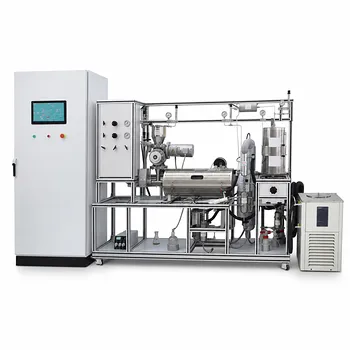
When you’re working with specialty copolymers on a vocational pilot plant, the question isn’t about how fast you can produce them—it’s about whether you can consistently produce the exact same material, time after time. Reproducibility of product distribution is prioritized because these materials are low‑volume, high‑value goods whose performance depends entirely on a precisely controlled molecular architecture. If the distribution of chain lengths, comonomer sequence, or branching varies from batch to batch, the polymer simply won’t meet its functional specification, no matter how efficiently it was made.
Specialty copolymers succeed or fail because of their microstructure, not their manufacturing speed. A vocational pilot plant exists to translate a delicate laboratory recipe into a robust, repeatable process—so reproducibility of the product distribution is the cornerstone of that mission; raw throughput remains a distant secondary concern until consistency is proven.
The Nature of Specialty Copolymers
Unlike commodity plastics, specialty copolymers are engineered for a specific performance envelope—think heat resistance in an aerospace adhesive or selective permeability in a membrane. Their value comes from the molecular detail, not from the tonnage sold.
Low Volume, High Stakes
These materials are produced in small quantities, often just a few kilograms at a time. A single batch that misses its distribution target can represent a complete loss, wasting expensive monomers and months of development work. That makes getting it right far more important than getting it fast.
Performance Is Locked in the Distribution
A copolymer’s properties—mechanical strength, thermal behavior, solubility—are dictated by the statistical distribution of its structural features. Two batches with the same average composition can behave completely differently if one has a broader molecular weight distribution or a non‑uniform comonomer incorporation. Reproducing that distribution is what ensures the final part performs predictably.
Why Product Distribution Is Everything
Product distribution isn’t a secondary quality metric—it’s the direct link between the reactor and the application. Minor shifts in the distribution can erase everything that makes a specialty copolymer special.
The Sensitivity of Complex Architectures
When you’re building a copolymer with block, gradient, or graft structures, the reaction is highly sensitive to local conditions. Subtle variations in mixing, temperature, or reagent addition can dramatically change the sequence of monomers along each chain. A reproducible distribution is proof that you have mastered those sensitivities at pilot scale.
From Lab Curiosity to Pilot‑Scale Certainty
In the laboratory, a researcher can control every nuance manually and get a perfect distribution once. The pilot plant must demonstrate that same distribution can be achieved repeatedly under the “noisier” conditions of larger equipment. Reproducibility validates the scalability of the synthesis, not just its chemistry.
Quality Assurance Starts at the Reactor
For a research institute that will transfer its process to an industrial partner, the quality of the product is defined by the distribution. If the pilot plant cannot reproduce that distribution run after run, subsequent purification or blending cannot fix the fundamental structure. The process is, in effect, still not ready.
The True Purpose of a Vocational Pilot Plant
A vocational pilot plant is not a production line; it is an educational and scaling tool. Its goal is to build process understanding that will prevent failures during full‑scale commercialization.
Process Development Over Production
The mandate of a research institute is to train people and de‑risk processes. Raw throughput metrics—kilograms per hour, reactor utilization—are meaningless if they come with an unstable product distribution. You learn nothing from a fast batch that doesn’t match the target, and you may even misdirect future scale‑up efforts.
Identifying and Controlling Critical Parameters
Only by chasing perfect reproducibility do you discover which variables truly matter. For example, you might find that a 2 °C fluctuation in the initial exotherm broadens the molecular weight distribution by 30%. That insight is gold for the eventual process design, but it’s invisible if you’re optimizing solely for speed.
Understanding the Trade‑offs
Prioritizing reproducibility does not mean throughput is irrelevant. It means throughput is a constraint to be applied only once the process is fundamentally stable. Premature focus on efficiency is the most common source of failure in specialty polymer scale‑up.
The Instinct to Push Productivity Can Backfire
Raising the reaction temperature or increasing the feed rates might cut the cycle time in half. But in a sensitive copolymerization, that same change can cause compositional drift, local hot spots, or insufficient mixing—all of which scramble the product distribution. What looks like a productivity gain on paper becomes a reproducibility loss in reality.
Throughput Follows Understanding
Once the pilot plant team can reproduce the exact distribution across multiple independent batches, they can begin to probe the safe boundaries for increasing throughput without sacrificing quality. At that point, efficiency becomes a systematic optimization problem rather than a gamble.
The Cost of a Failed Batch
When you consider the fully loaded cost of specialty monomers, purification solvents, and operator time, a failed batch is significantly more expensive than a slightly longer, carefully controlled reaction. Reproducibility is therefore an economic imperative, not just a scientific one.
Common Pitfalls to Avoid
Even well‑intentioned teams can undermine reproducibility by overlooking seemingly minor details.
- Treating the pilot reactor as a “big lab flask”: Larger reactors have different mixing patterns and heat removal rates. Relying on lab‑scale timings without re‑optimizing for the pilot environment destroys distribution control.
- Neglecting in‑process analytics: Without real‑time monitoring of conversion, viscosity, or heat flow, the team is flying blind. Reproducibility requires closed‑loop control that can detect and correct small deviations before they impact the distribution.
- Chasing throughput before establishing a baseline: As soon as the conversation shifts to “how can we make this faster,” reproducibility often erodes silently. Always lock down a fully reproducible base case first.
Making the Right Choice for Your Research Goal
Your approach to the pilot plant should align with what you actually need to prove. Use these goal‑oriented guidelines to decide where to invest your energy.
- If your primary focus is process validation for a new copolymer: Obsess over the product distribution. Demonstrate run‑to‑run consistency under tightly controlled conditions, and document every critical parameter that influences the outcome.
- If your primary focus is developing a commercially viable process: First, achieve perfect reproducibility, then systematically explore throughput gains within the window where the distribution remains unchanged. Treat the acceptable distribution range as a hard constraint.
- If your primary focus is vocational training: Teach the principle that specialty materials earn their value through precision, not volume. Show trainees that measuring and maintaining a target distribution is the real mark of a competent polymer engineer.
Reproducibility isn’t a barrier to efficiency—it’s the foundation that makes efficiency meaningful.
Summary Table:
| Metric / Parameter | Reproducibility Focus (Primary) | Throughput Focus (Secondary) |
|---|---|---|
| Primary Goal | Consistent molecular architecture & quality | Maximum output rate (kg/h) |
| Material Type | Low-volume, high-value specialty copolymers | High-volume commodity plastics |
| Key Variables | Precise temperature, mixing, & feed control | Reduced cycle times & reactor utilization |
| Risk of Neglect | Batch failure, out-of-spec product distribution | Process instability & scale-up failure |
Achieve Precise Process Control with LABPARK
At LABPARK, we help universities, research institutes, and enterprises transition smoothly from lab-scale innovation to repeatable pilot-scale success. We design and supply high-quality Educational and Vocational Unit Operations Pilot Plants in chemical engineering, bioprocess & biotech, and environmental & water treatment.
Ready to ensure perfect product reproducibility in your research? Contact our experts today to find the right pilot plant solution for your lab.
Related Products
- Polymerization Granulation and Pellet Processing Educational Unit Operations Pilot Plant
- Multi-Functional Special Distillation Educational Pilot Plant
- Ethyl Acetate Synthesis Unit Operations Pilot Plant for Practical Training
- Continuous Batch Extractive Distillation Educational Pilot Plant
- Bio-fermentation Ethanol Production Practical Training Unit Operations Pilot Plant
People Also Ask
- How do educational unit operations pilot plants address safety and waste management when scaling up?
- How do educational unit operations pilot plants bridge theory and design? Bridge the Engineering Gap
- Why Compare Predicted and Experimental Excess Enthalpy? Key to Accurate Pilot Plant Scale-up
- When to transition from PID to adaptive control in pilot plants? Key process indicators.
- Why Use PTFE & Hastelloy in Chemical Pilot Plants? Prevent Corrosion & Ensure Safety