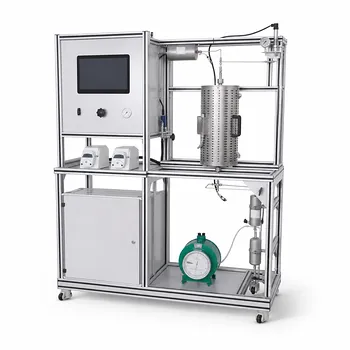
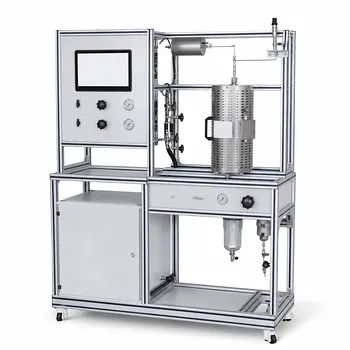
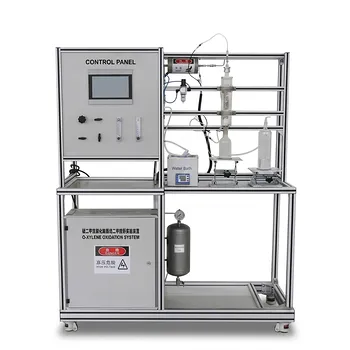
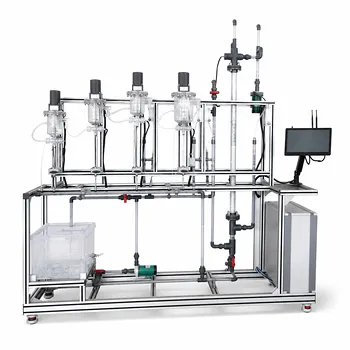
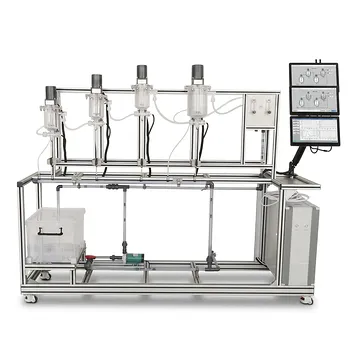
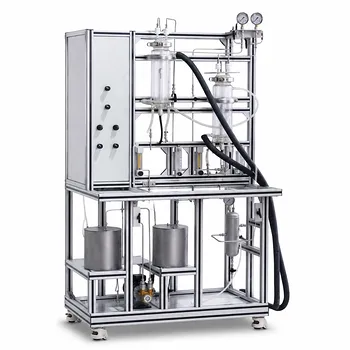
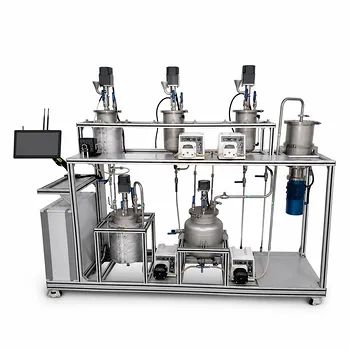
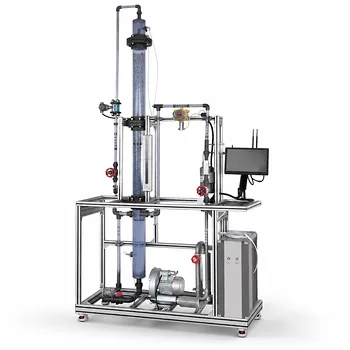
In a pilot-plant setting, the fundamental operational difference is stark: a Fixed Bed Chromatographic Reactor (FBCR) runs in batch mode with a stationary packed bed, while a Simulated Moving Bed Reactor (SMBR) achieves continuous counter-current contact by periodically shifting inlet and outlet ports to simulate solid-phase movement.
The FBCR introduces reactants in pulses through a single column where reaction and separation happen simultaneously – a straightforward setup perfect for feasibility trials. The SMBR, by contrast, integrates continuous product withdrawal and stationary-phase regeneration across a multi-section unit, making it a true continuous-process training platform.
For process development and academic training, the FBCR is the go‑to for initial kinetic and adsorption studies because of its simplicity, whereas the SMBR provides the hands‑on education and optimization data needed to transition from batch to economical continuous manufacturing.
How Each Reactor Works at the Pilot Scale
The Fixed Bed Chromatographic Reactor: Batch Simplicity
An FBCR packs a single column with a mixed bed of catalyst and adsorbent.
Reactants are fed as a rectangular pulse, allowing the reaction and the chromatographic separation of products to occur in the same vessel.
There is no continuous feed – you load a pulse, wait for the reaction-separation wave to travel, and then collect the fractions. This batch nature makes the setup mechanically simple and quick to reconfigure for different chemistries.
Because of this simplicity, FBCRs are routinely used for laboratory-scale feasibility assessment, adsorption equilibrium measurement, and reaction kinetic studies.
They let students see the direct link between pulse injection, retention time, and conversion in a single visual chromatogram.
The Simulated Moving Bed Reactor: Continuous Counter‑Current Action
An SMBR arranges multiple columns in a closed loop and periodically switches the positions of the feed, desorbent, extract, and raffinate ports.
This port rotation simulates a counter-current flow of solid catalyst/adsorbent against the liquid stream. As a result, the reactive and separation zones move through the stationary phase, enabling continuous reactant feed, continuous product withdrawal, and continuous regeneration of the solid phase.
In a pilot-plant SMBR, the operator has direct control over the zone flow-rate ratios and the valve-switching frequency.
That hands‑on experience teaches dynamic mass‑transfer control and how to balance reaction and separation in a steady‑state, rather than transient, operation.
The Distinct Educational Value of Each System
Why Train with an FBCR: Mastering Fundamentals
An FBCR lays bare the core concepts of reactive chromatography with minimal installation complexity.
Students can easily grasp how reaction conversion and product resolution are influenced by pulse shape, feed volume, and column packing – the exact fundamentals they need before tackling a continuous system.
It also allows rapid screening of new catalyst/adsorbent combinations.
Because you can run a batch experiment in minutes, an FBCR is ideal for iterative learning: change one variable and immediately see the effect on conversion and selectivity.
Why Train with an SMBR: Advanced Process Integration
Operating an SMBR pilot plant immerses learners in continuous process design, advanced control strategies, and solvent-minimization techniques.
They must understand how to define the four‑zone configuration, calculate the critical liquid‑solid flow ratios, and tune switching times – skills directly transferable to pharmaceutical and fine‑chemical manufacturing.
The SMBR also demonstrates concepts like internal solvent recycling and near‑quantitative yield.
In typical separations, SMB systems reduce adsorbent and desorbent consumption by factors up to 25 and 2 respectively relative to batch columns, showcasing the economic drivers behind continuous processing.
Process Development: When to Transition from FBCR to SMBR
FBCR as the Feasibility and Kinetic Screening Tool
In an industrial‑oriented development workflow, the FBCR is the first‑stage reactor.
You use it to confirm that the targeted reversible reaction (e.g., esterification, etherification, isomerization) can be driven to completion when products are simultaneously removed from the reaction zone.
Kinetic parameters and adsorption isotherms obtained directly from FBCR pulse experiments form the data basis for the SMBR design.
SMBR as the Optimization and Scale‑Up Platform
Once feasibility is established, the SMBR becomes the platform for continuous‑process optimization.
Its ability to run 24/7 with constant product quality lets researchers refine the separating‑zone lengths and flow rates to maximize space‑time yield and minimize solvent use.
That continuous operation also generates the long‑run stability data that regulatory bodies and production teams require for scale‑up.
Understanding the Trade‑offs
Simplicity vs. Throughput
A major trade‑off is batch simplicity versus continuous productivity.
An FBCR requires no complex valve‑switching hardware and is trivial to clean between runs, but it only processes one pulse at a time.
The SMBR runs continuously and can achieve throughputs an order of magnitude higher, yet it demands careful synchronization of multiple pumps and valves from day one.
Flexibility vs. Operational Complexity
FBCRs readily accommodate solvent gradients and can be switched between reaction chemistries with minimal reconfiguration.
SMBRs, by contrast, are exceptionally difficult to operate with mobile‑phase gradients, and any change in chemistry requires a complete re‑design of the zone flow‑rate ratios.
That complexity is precisely what makes the SMBR a powerful training tool – it teaches students how to handle the multidimensional control problems of real continuous plants.
But for a quick screening of new reaction ideas, the FBCR’s plug‑and‑play nature is unbeatable.
Making the Right Choice for Your Training or Development Goal
Your choice should match the learning objective or the stage of your process‑development pipeline.
- If your primary focus is teaching reactive chromatography fundamentals: Start with an FBCR. Its batch pulse mode directly illustrates how reaction conversion and separation interact, and students can run multiple experiments in a single session without complex setup.
- If your primary focus is developing a scalable continuous process: Transition to an SMBR after the kinetics and adsorption data are in hand. The SMBR trains operators to manage the steady‑state control loops and valve‑switching logic that define modern high‑efficiency manufacturing.
- If your primary focus is minimizing solvent and adsorbent costs: The SMBR’s internal recycling and counter‑current contact dramatically lower consumables. Using it in pilot work teaches the economic optimization of separation processes, a skill that pays for itself at production scale.
- If your primary focus is rapid prototyping of new chemistries: Select an FBCR. Its simple, single‑column design lets you screen catalyst‑adsorbent pairs quickly before you invest in the rigorous parameter‑mapping that an SMBR demands.
When you align the reactor’s operational mode with the core purpose of your training or development campaign, you turn pilot‑plant time into lasting expertise and actionable process knowledge.
Summary Table:
| Feature | Fixed Bed Chromatographic Reactor (FBCR) | Simulated Moving Bed Reactor (SMBR) |
|---|---|---|
| Operation Mode | Batch (pulse feed) | Continuous (counter-current) |
| System Complexity | Simple, single-column setup | High, multi-column with switching valves |
| Primary Application | Kinetic screening & feasibility studies | Process optimization & scale-up data |
| Solvent Consumption | High solvent and adsorbent usage | Low consumption due to internal recycling |
| Ideal Training Focus | Chromatography and reaction fundamentals | Advanced steady-state continuous process control |
Are you looking to upgrade your laboratory or training facility? LABPARK provides premium Educational and Vocational Unit Operations Pilot Plants in chemical engineering, bioprocess & biotech, and environmental & water treatment. Whether you need an FBCR for teaching fundamental kinetics or an SMBR for advanced continuous process scale-up, our custom pilot plants empower universities, research institutes, and enterprises to bridge the gap between theory and industrial practice.
Contact LABPARK today to discuss your project requirements and get a tailored quote!
Related Products
- Multi-Reactor Educational Pilot Plant for Reaction Engineering Unit Operations
- Fixed-Bed Chemical Reaction and Gas Dust Tar Removal Unit Operations Pilot Plant
- Fixed Bed Gas Solid Catalytic Reaction Educational Pilot Plant
- Multi Functional Catalytic Reaction and Reactor Evaluation Educational Unit Operations Pilot Plant
- Educational Unit Operations Pilot Plant for Intraparticle Diffusion Effective Factor Measurement
People Also Ask
- How do educational unit operations pilot plants address safety and waste management when scaling up?
- How do educational unit operations pilot plants bridge theory and design? Bridge the Engineering Gap
- Why Compare Predicted and Experimental Excess Enthalpy? Key to Accurate Pilot Plant Scale-up
- Why Use PTFE & Hastelloy in Chemical Pilot Plants? Prevent Corrosion & Ensure Safety
- How to study gasification in pilot plants? Compare exit gas composition & efficiency