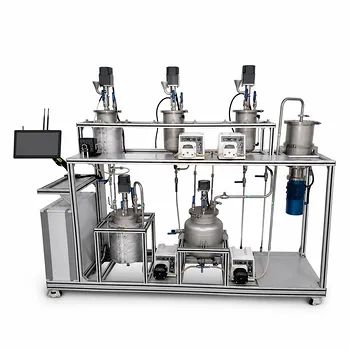
The primary advantage is operational safety and educational clarity. For pilot plants, aqueous phase reforming (APR) of glycerol operates at dramatically milder temperatures (470–550 K) in the liquid phase, avoiding the extreme heat requirements (870–1200 K) of ethanol steam reforming. This directly translates to lower energy costs, significantly suppressed catalyst deactivation from coke, and a cleaner product stream with fewer by-products—all while transforming a biodiesel waste product into a valuable resource.
In a teaching environment, the choice between reforming glycerol and ethanol is a choice between demonstrating an elegant, low-energy liquid-phase process versus managing a complex, high-temperature gas-phase reaction. The APR of glycerol uniquely teaches students to kinetically control side reactions under safer conditions while addressing circular economy principles.
Why Operating Conditions Define the Educational Experience
The stark contrast in physical requirements fundamentally changes what students learn and how safely they can learn it.
Taming the Thermodynamic Barrier
Ethanol steam reforming is a gas-phase reaction that demands intense energy input. Reaching the required activation temperatures of 870 to 1200 K necessitates bulky pre-heaters, heavy-duty vaporizers, and robust high-temperature insulation on the reactor.
Students primarily observe an equipment-intensive battle against thermodynamic equilibrium, where managing heat transfer becomes the dominant operational challenge, often overshadowing the core chemistry. In contrast, glycerol APR occurs in the pressurized liquid phase at 470–550 K.
This lower thermal threshold means the system reaches steady state faster and is inherently safer to operate. The lesson shifts from "how to manage extreme heat" to "how to control reaction pathways through phase behavior and kinetic selectivity."
The Kinetic Advantage and Product Purity
The high temperatures of ethanol reforming accelerate not just the desired hydrogen-producing reaction, but also parasitic side routes. This leads to the formation of carbon monoxide, methane, and solid coke deposits.
Coke accumulation deactivates the catalyst rapidly, forcing students to contend with performance decay during their experiments. APR’s liquid-phase environment kinetically freezes these unwanted side reactions.
Oxygenated intermediates are more easily reformed in the aqueous medium, yielding a hydrogen-enriched stream with substantially less CO and coke. For an educator, this provides a stable, reproducible platform to illustrate the critical principle of kinetic vs. thermodynamic control without the variable of a rapidly degrading catalyst.
Integrating Sustainability and Process Intensification
Teaching with glycerol connects the unit operation directly to real-world biofuel supply chains, enriching the learning context beyond the reactor itself.
Valorizing a Waste Stream
Ethanol is a primary product with competing high-value uses, including fuel blending and chemical synthesis. Glycerol, however, is the crude surplus byproduct of biodiesel production via transesterification.
Every gallon of biodiesel generates approximately one pound of glycerol. Using this oversupplied waste as a teaching feedstock allows instructors to create a powerful narrative around integrated biorefineries and the circular economy.
Students learn that catalyst selectivity in APR can transform a low-value disposal problem into on-site hydrogen, which can then be used to hydrotreat the biodiesel itself, closing the sustainability loop.
Simplified Process Intensification
A pilot plant designed for high-temperature gas-phase reactions requires complex upstream processing: liquid ethanol must be perfectly vaporized and mixed with steam before entering the reactor.
Aqueous glycerol, already in liquid form, bypasses the need for a vaporizer entirely. The process only requires a pressurized fixed-bed or tubular reactor and a downstream gas-liquid separator.
This reduces capital equipment costs and the potential for flow distribution anomalies, which are common educational pain points. Students can focus on the core catalytic principles, such as C-C and C-O bond cleavage, rather than troubleshooting vapor-phase fluid dynamics.
Understanding the Trade-offs
Choosing the APR of glycerol involves accepting a different set of technical challenges that are themselves valuable teaching points.
Lower Intrinsic Hydrogen Yield
The thermodynamics of APR favor lower per-molecule hydrogen yields compared to high-temperature steam reforming. While ethanol's potential for H2 production is higher in theory, in practice this requires cracking all intermediates at high temperature without forming coke.
APR intentionally operates at lower temperatures, so the hydrogen yield is governed by the selective breaking of C-O bonds. This trade-off lets students explore the difference between theoretical yield and practical selectivity, a foundational chemical engineering concept.
Managing a Pressurized Liquid System
While the temperature is mild, APR requires elevated pressures (often 15-50 bar) to maintain water in the liquid phase above 373 K. This introduces the need for high-pressure pumps, back-pressure regulators, and a rigorous focus on hydrostatic safety.
Teaching the safe operation of a pressurized liquid-phase reactor is highly relevant for industries like hydroprocessing and biomass liquefaction. The curriculum grows to include mechanical integrity and liquid-phase sampling under pressure.
Feedstock Impurities
Crude glycerol from biodiesel plants contains salts, methanol, and fatty acid soaps. These impurities can poison APR catalysts more readily than a refined ethanol feed.
This presents a choice: run refined glycerol for perfect mass balance exercises or use crude glycerol to teach about real-world catalyst deactivation mechanisms and feedstock pretreatment. Either path offers distinct educational outcomes, but the impurity challenge must be factored into the experimental design.
Making the Right Choice for Your Educational Goal
The optimal reforming chemistry aligns with the specific operational and pedagogical priorities of your pilot plant.
- If your primary focus is maximizing hands-on safety and equipment simplicity: Choose glycerol APR. The absence of high-temperature gas-phase reactors and vaporizers drastically reduces burn and thermal stress hazards in a teaching lab.
- If your primary focus is teaching modern kinetic control and reaction engineering: Choose glycerol APR. Its liquid-phase chemistry provides a clear, stable platform to observe how pressure and temperature tune product selectivity away from undesired CO and coke.
- If your primary focus is connecting the lab to the bio-based circular economy: Choose glycerol APR. Using a genuine waste product to generate clean hydrogen provides the most compelling and commercially relevant narrative for students.
- If your primary focus is demonstrating the absolute upper limit of hydrogen yield from a molecule: Choose ethanol steam reforming. The high-temperature path can illustrate maximum theoretical conversion, provided you accept the higher operational complexity and catalyst maintenance burden.
Ultimately, glycerol APR shifts the educational pilot plant paradigm from a high-maintenance thermal challenge to an elegant, pressurized lesson in kinetic selectivity and sustainable valorization.
Summary Table:
| Feature | Glycerol Aqueous Phase Reforming (APR) | Ethanol Steam Reforming |
|---|---|---|
| Phase & Temp | Liquid phase (470–550 K) | Gas phase (870–1200 K) |
| Operational Safety | High (milder temperatures, low thermal stress) | Moderate to Low (extreme heat, burn hazards) |
| Equipment Complexity | Simple (no vaporizer required) | Complex (requires pre-heaters and vaporizers) |
| Catalyst Stability | High (coke formation is kinetically suppressed) | Low (rapid catalyst deactivation by coking) |
| Educational Focus | Kinetic control, selectivity, circular economy | Thermodynamic equilibrium, heat transfer |
Modernize Your Engineering Lab with LABPARK
Are you looking to enhance hands-on education with safe, sustainable, and cutting-edge technology? LABPARK provides industry-leading Educational and Vocational Unit Operations Pilot Plants in chemical engineering, bioprocess & biotech, and environmental & water treatment designed for universities, research institutes, and enterprises.
Our advanced pilot plants allow educators to safely demonstrate complex reactions like liquid-phase reforming without high-temperature operational hazards. Help your students master green chemistry, kinetic selectivity, and process scale-up on robust, reliable platforms.
Contact LABPARK today to discuss your laboratory requirements!
Related Products
- Steam Methane Reforming Hydrogen Production and Purification Educational Pilot Plant
- Green Anhydrous Ethanol Refining Practical Training Pilot Plant
- Dual-Mode Rectification Pilot Plant for Practical Training Unit Operations
- Comprehensive Liquid-Liquid Extraction Pilot Plant for Engineering Education
- Alkaline Membrane Water Electrolysis Educational Pilot Plant Unit Operations Training System
People Also Ask
- How Do Temp, Pressure & S:C Ratio Affect Methane Reforming? Optimize Your Pilot Reactor
- What are the differences between steam reforming and ATR in pilot plants? Key Design Guide
- How to Integrate WGS & Purification in Steam Reforming Pilot Plants to Protect Fuel Cells from CO Poisoning
- How is carbon deposition controlled in steam reforming? The Critical Role of S/C Ratio
- What is the difference between allothermal and autothermal steam reforming in pilot plants?