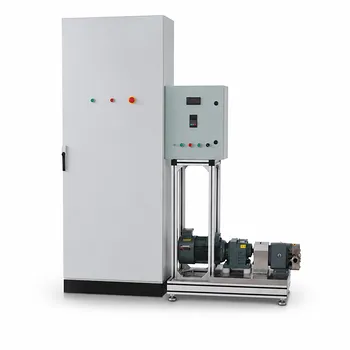
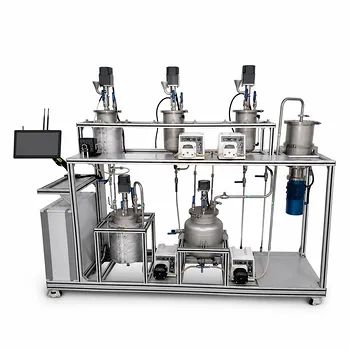
The leap from a beaker to a billion-dollar plant starts with a single column.
While laboratory distillation—like purifying ethyl acetate or 1‑bromobutane—uses a simple glass flask and condenser to collect boiling fractions, educational pilot plants replace that glassware with automated, multi‑stage distillation columns. These columns are equipped with reboilers, reflux controllers, and multi‑point temperature and pressure sensors, allowing students to directly manipulate the same engineering levers that govern industrial separation. That hands‑on control is the bridge that transforms a chemistry exercise into a chemical engineering skill.
The distillation pilot plant is not a bigger flask—it is a controllable, instrumented version of a real industrial column. By forcing students to optimize reflux ratio, manage pressure drop, and measure column efficiency, it converts a basic purification step into a fully analysable unit operation. This is the only reliable way to prepare engineers for the scale‑up, safety, and energy‑conscious decisions they will face in commercial manufacturing.
From Glassware to Control Room: The Missing Engineering Layer
The Illusion of Simplicity in Lab Distillation
In a teaching lab, distillation is a manual, visual task. A student watches a thermometer, adjusts a heating mantle, and switches a receiving flask when the temperature plateaus. The process feels complete, but it hides nearly every parameter that matters in industry. Heat duty is guessed, reflux is zero or uncontrolled, and pressure drop is irrelevant. The student learns separation theory but not separation engineering.
The Industrial Reality: A Column of Controllable Parameters
A real distillation tower is a dynamic system of tray or packed sections, a reboiler, a condenser, and a reflux splitter. Operators change product purity and capacity by tuning reflux ratio, heat input, system pressure, and feed location. No one simply waits for a drop in temperature; they monitor pressure profiles, calculate column efficiency, and adjust to avoid flooding or weeping. A pilot plant brings exactly this reality into the classroom.
How Pilot Plants Inject Real Engineering Skills
Educational pilot units are miniature versions of industrial columns. They allow students to:
- Modify reflux ratio and immediately measure the impact on top and bottom purity.
- Quantify heat duty by reading wattage or flow rates in the reboiler.
- Measure pressure drop across the column, diagnosing flooding or loading points.
- Calculate HETP (Height Equivalent to a Theoretical Plate) by sampling at multiple points and comparing to models. These exercises transform separation from a recipe into a controllable, scalable engineering problem.
Why Scaling Up Is More Than Just a Bigger Flask
Mass and Heat Transfer Dynamics Become Visible
In glassware, the liquid boiling in a 100 mL round‑bottom flask experiences nearly uniform heat. In a column, liquid distribution, vapour‑liquid contact area, and wall effects dominate performance. Pilot plants expose students to maldistribution, weeping, and entrainment—realities that limit industrial throughput. By experimenting with packing type or tray design, they learn how mass transfer limitations dictate column height and diameter, concepts invisible on a benchtop.
Embracing Safety and Process Integration
Laboratory handling of ethyl acetate or 1‑bromobutane rarely addresses runaway exotherms or large‑volume solvent vapour hazards. Pilot‑scale operations introduce process safety fundamentals: automatic over‑temperature shutdowns, pressure relief systems, and safe containment of flammable distillates. Moreover, pilot plants situate distillation within a network of feed tanks, pre‑heaters, and condensate recovery loops, teaching the heat integration and material flow logic that drives commercial‑scale efficiency and sustainability.
The Automation Leap: Sensors and Real‑Time Analytics
Manual thermometers and paper records give way to distributed control systems in the pilot plant. Students track temperature profiles on a screen, log pressure readings every second, and correlate this data with on‑line composition analysers. This mirrors the modern industrial shift towards automated, real‑time quality monitoring and prepares students to validate processes using continuous data rather than single‑point lab samples.
Understanding the Trade‑offs
No teaching tool is perfect. While pilot plants close crucial skill gaps, they come with inherent limitations that educators and students must acknowledge.
Teaching Tools, Not Wholly Authentic Production Units
A pilot distillation column is still a scale model. It may not fully replicate fouling rates, long‑term corrosion, or trace impurity buildup seen in multi‑tonne campaigns. Students gain core engineering thinking, but they must later extend that thinking to the unique material challenges of each specific commercial process.
The Risk of Hardware Overload Over Fundamentals
Access to a gleaming, automated column can tempt a learner to focus on the “buttons and screens” without mastering the underlying vapour‑liquid equilibrium, material balances, or thermodynamic constraints. Effective training always intertwines the new hardware with rigorous first‑principles analysis; otherwise, the pilot plant becomes a sophisticated black box.
Cost and Accessibility
Building and maintaining a pilot‑scale distillation unit requires significant investment in space, utilities, and safety infrastructure. Not every institution can afford a multi‑tray column with full instrumentation. However, even a single, well‑designed column used in a structured, hands‑on curriculum can deliver transformative learning—often more profoundly than a dozen scripted beaker experiments.
Making the Right Choice for Your Educational Goal
The value of a pilot plant depends entirely on what skills you intend to develop. Align the equipment’s capabilities with your specific training objectives:
- If your primary focus is teaching control‑centric industrial operations: Choose a pilot column with an automated reflux splitter, PID temperature control, and a data acquisition system that lets students implement step‑changes in reflux ratio and observe the transient response.
- If your primary focus is a fundamental understanding of column hydraulics and efficiency: Invest in a column that allows easy swapping of packings or trays, with multiple pressure tappings so students can directly measure pressure drop and calculate HETP under varying boil‑up rates.
- If your primary focus is demonstrating the safety and integration of continuous processes: Select a pilot plant that includes a feed pre‑heater, a condensate recovery loop, and built‑in safety interlocks—turning the distillation into a miniaturised, walk‑around version of a production facility.
When the student’s hand leaves the heating‑mantle dial and reaches for a reflux‑ratio setpoint, they stop being a chemist and start becoming a process engineer—and that is the exact moment the pilot plant has done its job.
Summary Table:
| Feature | Lab Glassware Distillation | Educational Pilot Plant | Industrial Separation |
|---|---|---|---|
| Control Mechanism | Manual heating adjustment | Automated reflux & reboiler control | Distributed Control Systems (DCS) |
| Key Parameters | Temperature only | Reflux ratio, pressure drop, HETP, heat duty | Multi-variable process optimization |
| Primary Focus | Separation chemistry & purity | Process engineering & scale-up dynamics | High-throughput commercial production |
Bring Industrial-Scale Learning to Your Institution
Transitioning students from laboratory glassware to commercial-scale engineering requires realistic, hands-on training tools.
LABPARK provides premium Educational and Vocational Unit Operations Pilot Plants in chemical engineering, bioprocess & biotech, and environmental & water treatment. Designed specifically for universities, research institutes, and enterprises, our pilot plants feature industrial-grade automation, precise sensor integration, and robust safety controls to bridge the gap between theory and practice.
Ready to elevate your chemical engineering curriculum or workforce training? Contact LABPARK today to customize the perfect pilot plant solution for your lab!
Related Products
- Multi-Reactor Educational Pilot Plant for Reaction Engineering Unit Operations
- Multi-Functional Membrane Separation Educational Pilot Plant for Unit Operations Lab
- Polymerization Granulation and Pellet Processing Educational Unit Operations Pilot Plant
- Comprehensive Fluid Mechanics Educational Unit Operations Pilot Plant
- Multi-Functional Drying Educational Unit Operations Pilot Plant
People Also Ask
- How do educational unit operations pilot plants address safety and waste management when scaling up?
- How do educational unit operations pilot plants bridge theory and design? Bridge the Engineering Gap
- Why Compare Predicted and Experimental Excess Enthalpy? Key to Accurate Pilot Plant Scale-up
- Why Use PTFE & Hastelloy in Chemical Pilot Plants? Prevent Corrosion & Ensure Safety
- How to study gasification in pilot plants? Compare exit gas composition & efficiency