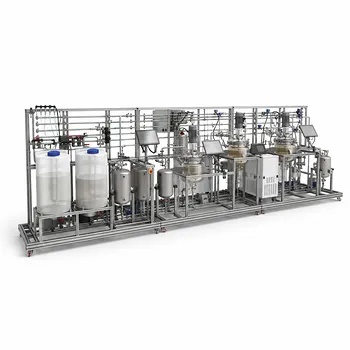
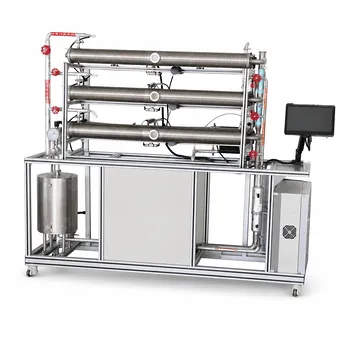
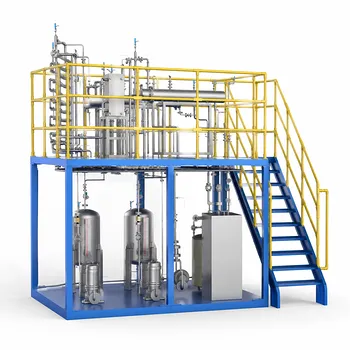
An educational pilot plant without a separation system teaches only half the story—the cheap half. In real industrial facilities, the reactor accounts for roughly 20% of Inside Battery Limits (ISBL) capital, while separation and purification systems consume the other 80%. If you train students on a reactor-only rig, you’re anchoring their intuition in a fantasy where the hardest, most expensive engineering challenge simply doesn’t exist. You must integrate both systems so learners experience firsthand why the purification tail wags the investment dog.
The central reason is brutally simple: economic reality. Industry doesn’t spend 80% of its core plant budget on separation for no reason. Reaction mixtures are messy—they contain unreacted feed, byproducts, and solvents. Teaching students to design and operate only the reaction step ignores the capital-dominant, complexity-defining purification stages that determine whether a process makes money or loses it.
The Economic Wake-Up Call: Why 20/80 Changes Everything
The 20/80 split between reactors and separation isn’t just a textbook number. It’s a design fingerprint that tells you where the risk, the cost, and the intellectual effort live in a commercial plant. An educational pilot plant that mirrors this distribution rewires a student’s brain to ask the right questions from day one.
Anchoring Intuition in Capital Reality
When a student walks into a lab and sees a small reactor surrounded by tall distillation columns, extraction skids, and filtration units, they instantly grasp a non-obvious truth: the reactor is the star, but separation is the stage. The sheer physical footprint of the downstream equipment burns this into memory far more effectively than any pie chart in a lecture hall.
This early exposure prevents the most common cognitive error in young engineers—assuming that once you’ve achieved the desired conversion, the job is nearly done. In reality, getting the molecule is only step one; purifying it to specification while recovering solvents and managing waste is where the real work begins.
The Hidden Curriculum of Capital Efficiency
An integrated pilot plant teaches that a brilliant reactor concept can be economically killed by a nightmare separation. Students run a reaction, then immediately face the downstream consequences: azeotropes that demand extractive distillation, emulsions that wreck liquid-liquid extraction, or heat-sensitive products that force expensive molecular distillation.
This forces them to think about process intensification instinctively—could a reactive distillation column collapse two steps into one? Could a membrane reactor pull out product as it forms, shifting equilibrium? They learn that the reactor and separator are not sequential boxes but partners in a capital efficiency dance.
The Competency Dimension: Skills That Reactor-Only Labs Never Build
Beyond economics, the practical skills gap created by reactor-only training is dangerously wide. Industry expects chemical engineers to troubleshoot entire process loops, not just a single vessel. Supplementary references make clear that real processes are an integrated sequence of pretreatment, conversion, and purification.
Developing a Process-Scale Mindset
In a reactor-only setup, a student’s mental model ends at the reactor outlet. In an integrated pilot plant, their mind must span the full process window—from raw material conditioning to final product tank. They suddenly have to answer questions like:
- How does reactor effluent composition dictate the number of distillation stages?
- What happens to the solvent recycle purity if the extraction column stage efficiency drops?
- How does a distillation column’s reflux ratio interact with the upstream reactor’s heat integration potential?
These are not theoretical musings. They are the daily design and debottlenecking conversations that engineers have in operating plants. The integrated pilot plant is the only safe space to make these mistakes and learn iteratively.
Navigating Interdependencies and Control
An integrated system introduces dynamic coupling that reactor-only labs never expose. If a distillation column floods, it sends a pressure wave backward into the reactor, potentially disturbing conversion. If the reactor’s feed composition drifts, the downstream extraction unit may see a phase inversion.
Students learn that auxiliary units are never optional add-ons; they are enablers. References highlight that even a simple drying pilot plant requires pre-heaters, cyclones, and condensers. Similarly, a catalytic reactor often requires a separation loop—like the biphasic catalysis example, where a gravity separator recovers the catalyst phase. Running this integrated loop teaches students to view the catalyst not as a consumable but as a circulating asset, unlocking concepts around catalyst inventory management and loss rates.
Comparing Batch and Continuous Dynamics with Separation Reality
The shift from batch to continuous manufacturing in pharma and chemicals is fundamentally a separation story. Batch reactors often tolerate messy reaction mixtures because you can clean the pot later. Continuous processes demand that separation stages operate with zero downtime and tight steady-state control.
An integrated pilot plant that offers both batch and continuous modules—connected to identical separation skids—lets students run head-to-head experiments. They see that continuous reactive extraction might avoid the huge hold-up volumes and long cycle times of a batch distillation workup. They directly measure the residence time distributions not just in the reactor, but through the entire downstream train, building a visceral understanding of surge tanks and buffer volumes.
Understanding the Trade-offs and Pitfalls
No design is free of downsides. Over-integrating an educational pilot plant can create its own problems, and pretending otherwise would undermine a teacher’s credibility.
The Complexity Tax
A fully integrated reactor-separation pilot plant is harder to operate safely and requires more instructor oversight. Start-up times lengthen, and debugging becomes a multi-unit nightmare. For a first-semester unit ops lab, there’s a risk that students drown in procedural complexity and never reach the conceptual insight. A phased approach—first running the separation train on pre-defined synthetic mixtures, then coupling to the reactor—often yields better learning.
The Seduction of the Toy Plant
A pilot plant is a scaled-down model, and some phenomena don’t scale linearly. Wall effects in small distillation columns, disproportionate heat losses, and unrealistic entrainment can create operating behaviors that mislead students about commercial realities. The instructor must explicitly call out these scale-up distortions so that students don’t mistake the pilot plant lid for the plant manway. The value lies in the integrated thought process, not in naive direct extrapolation of pilot plant yield percentages.
Resource Intensity
Separation equipment—especially distillation columns with proper structured packing and control valves—is expensive. Solvents, cooling water, and maintenance add recurring costs. A program must weigh whether the deep integrated learning justifies the budget, or whether a hybrid approach (a few physical separation units plus high-fidelity dynamic simulation for the rest) better serves their student volume.
Making the Right Choice for Your Educational Goal
An integrated reactor-separation pilot plant is not a one-size-fits-all solution. Your specific learning objectives should guide how you configure and deploy it.
- If your primary focus is introductory unit operations: Prioritize a standalone separation skid (e.g., a distillation column) initially, then add a simple reactor coupling in later labs to illustrate the interconnectivity shock. This prevents cognitive overload while still seeding the economic insight.
- If your primary focus is advanced process design and capstone projects: Configure a fully integrated sequence (pretreatment, reactor, distillation/extraction, recycle loop) and task students with a techno-economic optimization. Make them justify every unit’s existence, including the capital versus operating cost trade-off for adding a solvent recovery column.
- If your primary focus is teaching the principles of process intensification and modern manufacturing: Include both batch and continuous reactor modules feeding a shared separation system, and introduce advanced configurations like reactive distillation or biphasic catalyst loops. Focus the assessment on comparing start-up times, waste generation, and energy efficiency per kilogram of purified product.
A reactor teaches you to make molecules. A separator teaches you to make money. An integrated pilot plant teaches you that you cannot truly do one without the other.
Summary Table:
| Aspect | Reactor-Only Setup | Integrated Reactor-Separation Setup |
|---|---|---|
| Capital Cost Representation | Covers only ~20% of ISBL capital | Mirrors real-world 20/80 (reactor/separation) split |
| Process Understanding | Ends at reactor outlet; ignores purification | Covers raw material conditioning to final product purity |
| Dynamic Control Skills | Misses system-wide feedback loops | Exposes students to process coupling & recycle loop dynamics |
| Economic Intuition | Promotes unrealistic process assumptions | Teaches process intensification & techno-economic trade-offs |
Bridge the Gap Between Classroom Theory and Industrial Reality
Don't train future engineers on only half the process. LABPARK provides premier Educational and Vocational Unit Operations Pilot Plants in chemical engineering, bioprocess & biotech, and environmental & water treatment tailored for universities, research institutes, and enterprises.
Our systems help you teach realistic process economics, dynamic system control, and true chemical engineering loops. Ready to elevate your lab's capabilities? Contact us today to explore custom pilot plant configurations for your department.
Related Products
- General Purpose Cosmetics Production Unit Operations Training Pilot Plant
- Multi Pump Fluid Transport Process Piping Unit Operations Training Pilot Plant
- Multi-Functional Drying Educational Unit Operations Pilot Plant
- Fixed-Bed Chemical Reaction and Gas Dust Tar Removal Unit Operations Pilot Plant
- 100L Continuous Loop Hydrogenation Educational Unit Operations Pilot Plant
People Also Ask
- How do deviations in estimating latent heat impact pilot plant thermal systems? Avoid hardware mis-sizing.
- Why is the chemical plant startup schedule crucial? De-risk scale-up with pilot plants.
- When to transition from PID to adaptive control in pilot plants? Key process indicators.
- Why Compare Predicted and Experimental Excess Enthalpy? Key to Accurate Pilot Plant Scale-up
- Why Use PTFE & Hastelloy in Chemical Pilot Plants? Prevent Corrosion & Ensure Safety