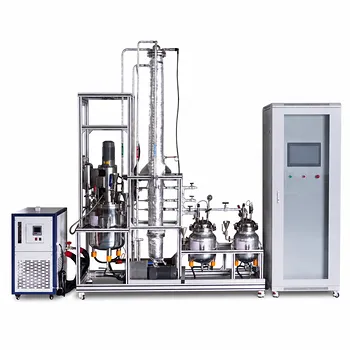
The removal of sulfur and nitrogen impurities is a cornerstone demonstration in petroleum processing pilot plants because it directly reveals how to protect expensive catalysts, prevent catastrophic equipment corrosion, and meet environmental fuel standards. Without physically simulating these purification steps, the complex interplay between feedstock chemistry, operating conditions, and catalyst longevity remains theoretical—and the financial and safety risks of scaling up blind are unacceptable. In a pilot plant, students and researchers see firsthand how “invisible” contaminants like thiophenes and pyridines dictate the entire downstream process design.
Removing sulfur and nitrogen isn’t just a cleaning step; it’s the primary safeguard for the catalyst, the reactor metallurgy, and the economic viability of the entire refining process. A pilot plant makes these invisible threats tangible, transforming abstract chemical compatibility charts into operational understanding.
The Real-World Threats Hidden in Crude Oil
Why Sulfur Compounds Are a Refinery’s Worst Enemy
Crude oil carries two distinct classes of sulfur: active sulfur (H₂S, mercaptans) and inactive sulfur (disulfides, thiophenes, benzothiophenes). Active sulfur attacks distillation columns and piping immediately, causing rapid corrosion that can lead to leaks or catastrophic failure. Inactive sulfur species, while not directly corrosive, become reactor poisons—they bind irreversibly to metal active sites on noble-metal catalysts, permanently deactivating them.
In a pilot plant, students can inject a feed spiked with different sulfur types and monitor corrosion coupons or catalyst activity in real time. This visualizes a principle that’s otherwise just a line in a textbook: the stability of the sulfur species dictates the severity of the hydrotreating conditions required.
How Nitrogen Compounds Sabotage Fuel Quality and Catalysts
Nitrogen-containing molecules like pyridines, quinolines, and carbazoles are thermally unstable. They readily form gums and polymers that plug fuel systems and degrade storage stability. More critically, these basic nitrogen compounds poison the acidic sites on cracking and reforming catalysts—a tiny amount can neutralize the surface acidity that drives the desired reactions.
A pilot plant that demonstrates denitrogenation shows precisely why a hydrotreating stage must sit upstream of a catalytic reformer. The organic nitrogen is converted to ammonia, which is then stripped out. Without this demonstration, the concept of “catalyst protection” remains an abstract specification rather than a visceral, measured necessity.
Why Pilot-Scale Demonstration Is Irreplaceable
Bridging the Gap Between Lab Chemistry and Industrial Reality
A lab flask can show that sulfur poisons a catalyst, but it cannot replicate the mass transfer, fluid dynamics, and heat management of a commercial reactor. Sulfur removal reactions (hydrodesulfurization) are highly exothermic and require precise hydrogen-to-oil ratios and quench zones to prevent temperature runaway. A pilot plant with multiple sampling ports and online gas chromatography teaches how to manage these thermal profiles safely—a skill that no amount of desktop simulation can replace.
Uncovering the Full Reactivity Spectrum
The supplementary references highlight that stable aromatic sulfur species (thiophenes, benzothiophenes) demand far higher temperatures, pressures, and more active catalysts than mercaptans. In a pilot plant, operators can deliberately vary feedstock blends to see the conversion drop-off as the fraction of refractory sulfur increases. This directly informs commercial catalyst selection and reactor design, minimizing the financial gamble of building a full-scale unit that might underperform.
Safety, Sustainability, and Environmental Compliance
Sulfur and nitrogen removal units produce toxic byproducts: H₂S is lethal, and ammonia is corrosive and hazardous. A pilot plant provides a controlled environment to practice safe startup, shutdown, and emergency venting procedures for these systems. Furthermore, demonstrating the removal step connects directly to environmental regulations—low-sulfur diesel and gasoline are not optional. Seeing how deep desulfurization is achieved reinforces the link between process engineering and public health.
Understanding the Trade-offs and Hidden Complexity
The Energy and Capital Cost of Deep Purification
Removing the last traces of sulfur or nitrogen requires disproportionately high hydrogen consumption, higher operating temperatures, and larger reactors. In a pilot plant, students can measure the hydrogen partial pressure drop across the bed and correlate it with conversion. This teaches a fundamental economic lesson: over-purifying can be just as wasteful as under-treating if the specifications don’t demand it.
Pretreatment Integration: The System-Level View
Isolated desulfurization is meaningless without understanding the upstream and downstream interactions. For instance, a catalytic reforming pilot plant integrates a hydrotreating stage to remove sulfur and nitrogen, followed by a stripper to remove the resulting H₂S and NH₃. If any of these steps fail, platinum-based reforming catalysts deactivate within hours. Demonstrating this chain of protection in a pilot plant reveals why a unit operation is never just a standalone box—it’s part of a carefully orchestrated defense-in-depth strategy.
Making the Right Choice for Your Pilot Plant Design
Whether you are building an educational pilot plant or scoping a research unit, the inclusion of a desulfurization/denitrogenation module should be driven by your specific learning or investigation goals.
- If your primary focus is catalyst-deactivation kinetics: Include multiple feed spiking points and online analyzers to map the poison adsorption isotherms under industrial space velocities.
- If your primary focus is operational safety and procedure training: Invest in a fully integrated hydrotreating section with automatic depressurization, gas detection, and sour-water stripping so students experience the entire “cleaning flowsheet.”
- If your primary focus is economic validation of new catalysts: Run side-by-side comparisons of different feedstocks and catalyst candidates, measuring hydrogen consumption and product yield to generate a true techno-economic picture.
- If your primary focus is environmental compliance: Demonstrate final product sulfur levels down to 10 ppm using sacrificial adsorbent beds or deep hydrotreating, emphasizing the reality of modern fuel standards.
A well-designed pilot plant doesn’t just show that impurities are removed—it teaches why every unit operation exists, transforming students and engineers into professionals who can protect multimillion-dollar assets and produce cleaner fuels for the world.
Summary Table:
| Impurity Type | Real-World Threat | Pilot Plant Demonstration Value |
|---|---|---|
| Sulfur Compounds | Corrosion of piping; irreversible noble-metal catalyst poisoning. | Visualizes how feedstock chemistry dictates required hydrotreating severity. |
| Nitrogen Compounds | Neutralizes catalyst acid sites; forms gums that plug fuel systems. | Demonstrates the essential role of upstream hydrotreating and ammonia stripping. |
| Operational Risks | Exothermic heat runaways; exposure to toxic H₂S and corrosive NH₃. | Provides safe, hands-on training for startup, shutdown, and emergency venting. |
Bring Industrial Reality into Your Lab with LABPARK
Are you looking to equip your students and researchers with hands-on experience in critical refining and purification processes? LABPARK designs and manufactures state-of-the-art Educational and Vocational Unit Operations Pilot Plants in chemical engineering, bioprocess & biotech, and environmental & water treatment.
We help universities, research institutes, and enterprises bridge the gap between theoretical chemistry and industrial scale-up with safe, reliable, and highly customizable pilot systems. Whether you need to demonstrate deep desulfurization kinetics, test catalyst longevity, or train operators on hazard safety protocols, our tailored solutions ensure your lab runs at the cutting edge.
Ready to elevate your engineering curriculum or research capabilities? Contact us today to discuss your pilot plant requirements with our experts!
Related Products
- Multi Pump Fluid Transport Process Piping Unit Operations Training Pilot Plant
- Crude Benzene Hydrogenation Educational Unit Operations Pilot Plant
- Green Anhydrous Ethanol Refining Practical Training Pilot Plant
- Polymerization Granulation and Pellet Processing Educational Unit Operations Pilot Plant
- Methane Cracking Educational Unit Operations Pilot Plant
People Also Ask
- Why distinguish Newtonian & non-Newtonian fluids in pilot plants? Prevent design errors.
- Why is the chemical plant startup schedule crucial? De-risk scale-up with pilot plants.
- When to transition from PID to adaptive control in pilot plants? Key process indicators.
- How do deviations in estimating latent heat impact pilot plant thermal systems? Avoid hardware mis-sizing.
- Why Compare Predicted and Experimental Excess Enthalpy? Key to Accurate Pilot Plant Scale-up