The essential role of local composition models in pilot plants comes down to physics over convenience. When you distill or extract a mixture of ethanol and cyclohexane, the molecules are not a random, uniform soup. Strong intermolecular forces organize them into distinct local neighborhoods, and if your thermodynamic model pretends this isn't happening, your pilot plant data will be dangerously misleading. This is why the local composition concept is not just theoretical—it’s the foundation of accurate phase behavior prediction for polar mixtures.
The core problem is nonrandom molecular behavior. Standard "regular solution" models fail with polar components because they ignore the structured, local clustering driven by hydrogen bonds. While the Wilson equation brilliantly captures this nonrandomness for vapor-liquid equilibrium, its standard form cannot predict liquid-liquid phase splits—a critical limitation. This makes the choice between models like Wilson and NRTL a pivotal decision for any pilot plant engineer working with non-ideal systems.
The Failure of Idealized Models with Polar Mixtures
The fundamental job of a pilot plant is to generate data you trust. For separation processes, trusting the data means you must first trust the thermodynamic model that interprets it.
Why "Regular Solution" Assumptions Break Down
Many basic thermodynamic models are built on the assumption of a randomized, homogeneous mixture. In a non-polar system like toluene and n-heptane, this is a safe bet.
Introduce a polar, hydrogen-bonding molecule like ethanol, and the entire premise collapses. Ethanol molecules are not neutral in their environment; they actively seek each other to form hydrogen bonds, creating a local shell that is far richer in ethanol than the bulk liquid.
The Physical Reality of Local Clusters
In an ethanol-cyclohexane pilot plant feed, the mixing is profoundly nonrandom. The polar ethanol molecules cluster around each other, effectively squeezing away the non-polar cyclohexane.
Ignoring these nonrandom molecular arrangements means your model will miscalculate fundamental properties. The predicted vapor composition or liquid-phase activity will diverge from reality, making any calculated column parameters or heat duty requirements useless.
How Local Composition Models Solve the Puzzle
The core innovation of models like the Wilson equation is trading the assumption of random mixing for the reality of a local molar fraction. They don't just ask, "What is the bulk concentration?" They ask, "What is the concentration around a specific molecule?"
The Wilson Equation's Practical Strength in Distillation
For a pilot-scale distillation column separating a homogeneous liquid mixture like ethanol and water, the Wilson equation is a workhorse. Its primary strength is remarkable efficiency.
It can represent multicomponent vapor-liquid equilibrium (VLE) with just binary interaction parameters, which you can regress from a limited set of pilot plant data. This makes it a highly practical model for simulating the column and scaling up the process reliably.
The Critical Warning for Extraction Pilot Plants
The most important thing to know about the standard Wilson equation is its fatal flaw: it cannot predict liquid-liquid phase separation.
If your pilot plant process involves true phase splits—like in a liquid-liquid extraction or a heterogeneous azeotropic distillation column—the standard Wilson equation will mathematically fail to produce two separate liquid phases. Applying it here would not just be inaccurate; it would be a physical impossibility that your simulation software won't be able to solve.
Understanding the Trade-offs in Model Selection
Choosing a thermodynamic model is a deliberate act of compromise between accuracy, complexity, and the specific physics of your system. For polar mixtures, this decision is make-or-break.
The Wilson Equation: Accurate VLE, Blind to LLE
You choose the Wilson equation for its elegant handling of strongly non-ideal, yet fully miscible, liquid mixtures. It excels at modeling VLE for polar and hydrogen-bonded components like alcohols, water, and ketones without the complexity of an extra parameter.
The trade-off is absolute: it cannot model immiscibility. Using it for a process involving a phase split will deform your simulation results into a single, non-physical liquid phase, invalidating the entire pilot plant exercise.
The NRTL Equation: Versatility at the Cost of Complexity
For pilot plants dealing with extraction or heterogeneous distillation, the Non-Random Two-Liquid (NRTL) model is often the necessary default. It contains a third, non-randomness parameter that directly accounts for the structural organization of a liquid, allowing it to successfully predict liquid-liquid equilibrium.
The cost is added complexity. You are now adjusting an additional parameter, which requires more rigorous experimental data for an accurate regression. The logic is simple: you must manage this extra complexity because a model that cannot physically describe your process is of zero value.
Making the Right Choice for Your Process Goal
Your selection hinges entirely on the physical reality inside your pilot plant. There is no single correct model, only the correct model for your system's phase behavior.
- If your primary focus is a homogeneous distillation of polar mixtures: Start with the Wilson equation. It provides an excellent balance of accuracy and simplicity for VLE prediction, requiring only binary parameters to model highly non-ideal behavior.
- If your primary focus is liquid-liquid extraction or heterogeneous azeotropic distillation: You must default to the NRTL equation. The standard Wilson equation is structurally incapable of modeling the liquid-liquid phase split that defines your process, making NRTL's extra non-randomness parameter non-negotiable.
A pilot plant is an investment in truth before scale-up. For polar mixtures, that truth begins with a thermodynamic model that respects the physical reality of how molecules organize, not just how your spreadsheet wishes they would.
Summary Table:
| Thermodynamic Model | Primary Strengths | Main Limitations | Best Applications |
|---|---|---|---|
| Wilson Equation | Accurate VLE for highly polar mixtures; simple binary parameters | Cannot predict liquid-liquid phase separation (LLE) | Homogeneous distillation |
| NRTL Equation | Accurately models both VLE and LLE; highly versatile | Increased complexity due to a third non-randomness parameter | Liquid-liquid extraction & heterogeneous distillation |
Scale Up with Confidence using LABPARK Pilot Plants
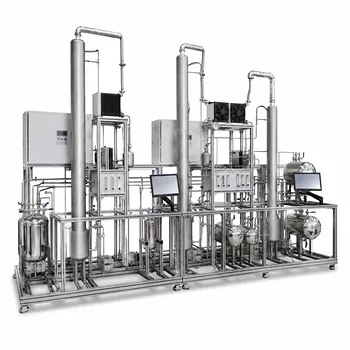
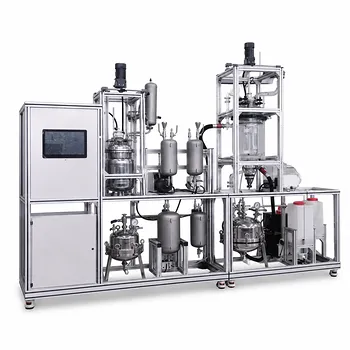
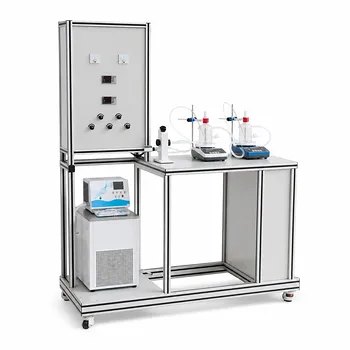
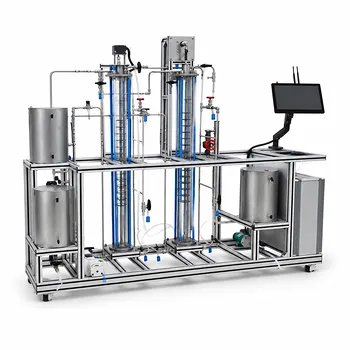
Getting your thermodynamic models right is only half the battle; you need physical pilot plants that deliver reliable, real-world data. LABPARK provides state-of-the-art Educational and Vocational Unit Operations Pilot Plants in chemical engineering, bioprocess & biotech, and environmental & water treatment.
Designed specifically for universities, research institutes, and enterprises, our plants help you bridge the gap between thermodynamic theory and industrial success. Contact us today to discuss your pilot plant requirements!
Related Products
- Electrolyte Distillation Purification and Formulation Educational Pilot Plant
- Ethyl Acetate Synthesis Unit Operations Pilot Plant for Practical Training
- Green Anhydrous Ethanol Purification Extractive Distillation Unit Operations Training Pilot Plant
- Green Anhydrous Ethanol Refining Practical Training Pilot Plant
- Continuous Batch Extractive Distillation Educational Pilot Plant
People Also Ask
- Why does simple distillation yield higher efficiency than flash distillation? Key thermodynamic differences.
- How to Integrate Spectroscopy in Distillation Pilot Plants for Advanced Process Control
- Why is the acentric factor important in pilot plants? Fluid property prediction.
- How to Estimate Distillation Pilot Plant Tray Efficiency? O'Connell's Correlation Guide
- How does double temperature difference control improve distillation pilot plants? Stabilize purity.