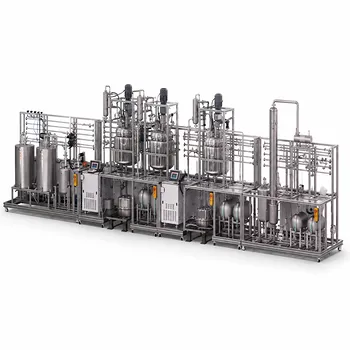
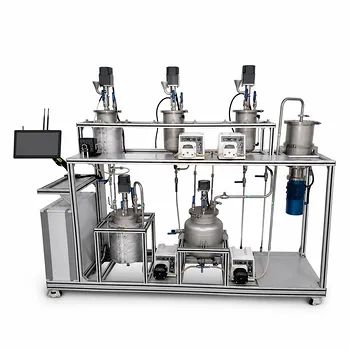
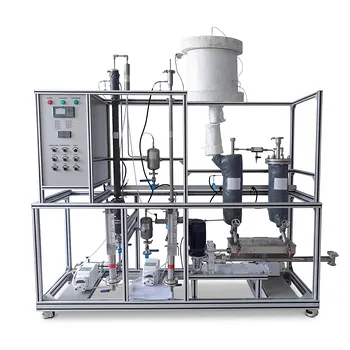
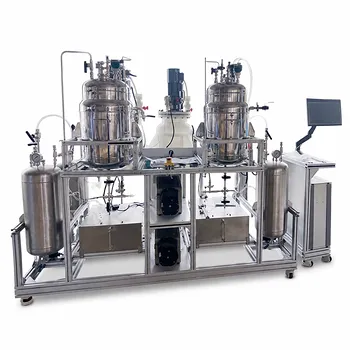
Here’s the hard truth: Without a rigorously defined thermodynamic system and its boundary, a chemical engineering pilot plant is just an expensive tangle of metal and glass—not a scientific instrument. The definition is critical because it dictates exactly what you are analyzing, what enters and leaves, and which conservation laws apply. This simple conceptual act transforms raw sensor data into valid energy and mass balances, enables accurate temperature control, and is the primary safeguard against thermal runaway or overpressure during student experiments.
At its core, a pilot plant is a kinetic sculpture designed to teach thermodynamic logic. The system-boundary definition is the first and most important decision an operator makes—it sets the stage for whether you measure a meaningful process or a dangerous mystery. Without this clear mental box, the most precise pressure gauge is worthless.
The System-Boundary Framework: The Foundation of All Analysis
Before you even touch a valve, you must decide what part of the universe you are studying. This is not a philosophical exercise; it’s a computational necessity.
What Exactly Are We Analyzing? Defining the System
The system is the process fluid—the liquid boiling inside a distillation column or the reacting gas mixture in a continuous stirred-tank reactor (CSTR). It’s the substance whose properties (temperature, composition, enthalpy) you care about.
Choosing the system correctly is what lets you apply the first law of thermodynamics. If you define the system as the entire column including metal walls, you’ll need to account for steel’s heat capacity—a complexity you might not want. Typically, the system is the fluid itself, simplifying energy balances to focus on process heat effects.
The Boundary: Where Theory Meets the Physical World
The boundary is the vessel wall—the stainless steel of a reactor or the glass of a column. But it’s more than a physical container. It’s the interface across which mass, heat, and work are exchanged.
You must classify it: Is it rigid (a fixed-volume batch reactor) or flexible (a piston-like compressor)? Does it allow heat transfer (diathermal) or is it perfectly insulated (adiabatic)? These choices directly control whether you can ignore work terms like PΔV or assume zero heat loss. An incorrectly classified boundary will make your calculated efficiency either impossibly high or dangerously misleading.
Why Sloppy Definitions Lead to Dangerous Miscalculations
When the system-boundary pair is vague, safety analysis crumbles. Consider a reactor heating up: Is the boundary the inner vessel wall or the outer insulation? If you choose the insulation, you might miss the fact that the metal wall is overheating.
Pilot plants are instrumented to measure flows and temperatures at specific points, but sensors only give values at boundaries. If you don’t define that boundary precisely—saying “heat transfer occurs between the fluid and the jacket at the inner wall”—you’ll mistakenly include or exclude energy streams. The result is an energy balance that doesn’t close, making thermal runaway prediction impossible.
From Abstract Idea to Real-Time Control: Practical Applications
Defining the system is not a one-and-done task; it’s the mental switch that unlocks every major control and learning objective in the pilot plant.
Mastering Energy Balances and Temperature Control
Once your boundary is set, you can calculate the energy balance: energy in minus energy out equals accumulation. In a batch reactor, if the boundary is rigid and diathermal, you measure jacket temperature and flow to compute heat removed. This directly tells you how much cooling is needed to prevent an exothermic surge.
Educational pilot plants are designed to show that a poorly chosen boundary (like treating the whole room as the system) gives you a useless balance. Tight boundary focus lets you validate that the chemical equilibrium constant (K) is highly sensitive to temperature—a shift from 373 K to 423 K can increase K tenfold for a gas-phase reaction. Accurate temperature control hinges on knowing exactly where the heat transfer occurs.
Distinguishing Open vs. Closed Systems for Correct Mass Balances
You cannot write a mass balance without defining whether mass crosses the boundary. A continuous distillation column or absorber operates as an open system—reactants and products flow in and out. A batch reactor during its reaction phase is a closed system that exchanges only energy.
Students often confuse the two, leading to nonsensical equations where mass disappears. By clearly stating that a CSTR has inlet and outlet streams (open boundary) while a sealed batch vessel does not, they immediately apply the correct mass conservation form. This distinction is what makes educational pilot plants such powerful demonstrators of mass and energy conservation laws.
Using Measurable Data to Compute the Unmeasurable
Key thermodynamic properties like entropy (S) and internal energy (U) cannot be read from a sensor. Yet, you need them for efficiency calculations. This is where the boundary concept couples with Maxwell relations.
By defining the system and its controllable variables (temperature, pressure, volume) at the boundary, you can use the exact differentials to connect sensor data to these hidden properties. For instance, in a compressor pilot plant, you measure P and T at the inlet and outlet. With the boundary defined as the gas volume under compression, you apply a Maxwell relation to compute the entropy change, bridging abstract theory and physical process control instantly.
Maintaining Autothermal Operation: The Boundary as a Safety Limit
In a gasification reactor pilot plant, the definition of the system boundary becomes a literal safety envelope. To achieve autothermal operation (thermal neutrality), you must feed carbon, oxygen, and steam in precise stoichiometric ratios.
This is often visualized on a triangular feed diagram, where the thermal neutrality line is a boundary condition for the reactor system. Cross that line—say, with too much steam—and you’ve created a sink that requires external heating, potentially leading to unstable temperatures. The pilot plant’s control system enforces these feed boundaries, teaching students that the thermodynamic system’s survival depends on staying inside a well-defined stoichiometric space.
Understanding the Trade-offs and Pedagogical Pitfalls
The act of defining a system is an art of simplification, and that simplicity can be deceptive.
The Oversimplification Trap
Choosing too small a system—like just the catalyst pellet inside a packed bed reactor—makes boundary heat transfer look uniform, ignoring hot spots. Choosing too large a system—like the entire plant—dumps all unit operations into a single black box, crushing any learning about individual unit behavior.
Pedagogical damage occurs when a student applies a closed-system energy balance to a feed stream that is actually an open boundary. The resulting calculation might appear correct but teaches a false methodology. The balance only works if the chosen system and its boundaries accurately reflect reality.
When the Chosen Boundary Complicates the Analysis
There is a cost to precision. Setting the boundary exactly at the inner wall of a reactor requires you to model heat conduction through the wall and film coefficients. This might be overkill for a first-year exercise.
Sometimes, a slightly enlarged boundary (including the cooling jacket fluid as part of the surroundings) simplifies the energy balance because the jacket-outlet temperature becomes a single measurable point. The trade-off is losing detailed wall-temperature profiles. Educators must deliberately choose a boundary that matches the learning objective, not just theoretical purity.
Making the Right Choice for Your Educational Goal
Your system-boundary definition should be a deliberate, documented decision made before any experiment begins. Tailor it to what you need to demonstrate:
- If your primary focus is heat transfer and thermal safety: Draw the boundary tightly around the reacting fluid at the inner vessel wall. This lets you directly monitor heat generation and cooling demand, enabling runaway prevention demonstrations.
- If your primary focus is mass balances and separation efficiency: Define the system as the process fluid inside the column or reactor, treating all inlet/outlet pipes as mass-transfer boundaries. This isolates the unit operation and validates theoretical separation limits.
- If your primary focus is bridging abstract thermodynamics to real control: Use a system where you can measure P, V, T at the boundaries and then apply Maxwell relations. This turns unmeasurable entropy and internal energy into calculated outputs students can verify.
- If your primary focus is autothermal or constrained processing: Define your system’s stoichiometric boundary on a feed diagram. Teach that staying inside the thermal neutrality boundary is a non-negotiable condition for stable, self-sustaining operation.
The single most empowering lesson a pilot plant can teach is that thermodynamics is not a set of equations—it’s a discipline of deciding what counts and what doesn’t. Your definition of the system and its boundaries is the scalpel that makes that discipline practical, safe, and profoundly instructive.
Summary Table:
| System Type | Boundary Type | Key Application | Educational Value |
|---|---|---|---|
| Open System | Mass & energy cross | Continuous distillation / CSTR | Master mass conservation laws |
| Closed System | Only energy crosses | Batch reactor | Prevent exothermic runaways |
| Tight Boundary | Fluid-only focus | Reactor inner wall heat transfer | Direct temperature control analysis |
| Enlarged Boundary | Includes jacket | Simplified energy balances | Practical system-level calculation |
Bring Thermodynamic Logic to Life with LABPARK
Ready to enhance your chemical engineering curriculum or research capabilities? LABPARK provides state-of-the-art Educational and Vocational Unit Operations Pilot Plants in chemical engineering, bioprocess & biotech, and environmental & water treatment.
How LABPARK Empowers Your Institution:
- Hands-On Learning: Enable students to easily define thermodynamic boundaries and master energy balances on physical equipment.
- Uncompromising Safety: Features advanced monitoring controls to demonstrate stoichiometric boundaries safely.
- Industry-Grade Design: Tailored for universities, research institutes, and enterprises seeking robust unit operations.
Contact us today to find the perfect pilot plant for your lab!
Related Products
- Multi-Reactor Educational Pilot Plant for Reaction Engineering Unit Operations
- Fixed Bed Gas Solid Catalytic Reaction Educational Pilot Plant
- Carbon Dioxide Hydrogen Methanol Synthesis Educational Unit Operations Pilot Plant
- Multi-Functional Special Distillation Educational Pilot Plant
- Fixed-Bed Chemical Reaction and Gas Dust Tar Removal Unit Operations Pilot Plant
People Also Ask
- How do educational unit operations pilot plants address safety and waste management when scaling up?
- How do educational unit operations pilot plants bridge theory and design? Bridge the Engineering Gap
- Why Compare Predicted and Experimental Excess Enthalpy? Key to Accurate Pilot Plant Scale-up
- Why Use PTFE & Hastelloy in Chemical Pilot Plants? Prevent Corrosion & Ensure Safety
- How to study gasification in pilot plants? Compare exit gas composition & efficiency