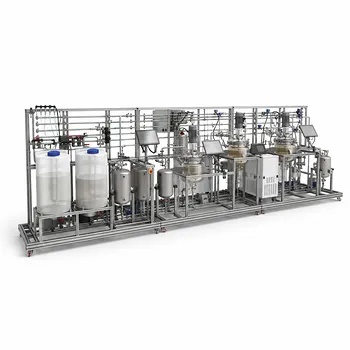
The answer lies in the way multiple process parameters conspire together—not just individually—to dictate your results. Analyzing factor interactions is crucial because pilot-scale bioprocesses are full of synergies and antagonisms that main-effects-only analyses completely miss. By probing how the effect of one parameter depends on the setting of another, you uncover the true shape of your design space, pinpoint robust operating windows, and avoid catastrophic scale-up failures.
The core insight: In a bioprocess pilot plant, single-variable optimization fosters fragile “peak” performance that crumbles under real-world noise. Only interaction analysis reveals the flat, resilient regions where productivity and quality coexist, and where the process can survive the variability of raw materials and imperfect control.
The Hidden Synergies in Your Process
Main-Effects Blind Spots
A classic one-factor-at-a-time (OFAT) optimization assumes each parameter moves in isolation. In reality, temperature, pH, dissolved oxygen, and inducer concentration form a tangled web. A pilot-scale reaction might show that conversion is exquisitely sensitive to inducer concentration at low temperatures, yet becomes robust (nearly constant) at high temperatures. An OFAT study would either miss this entirely or settle on a suboptimal, brittle condition.
The Physics of Interaction
Most bioprocess limitations are driven by coupled transport phenomena and enzyme kinetics. For example, a high temperature can shift a reaction’s limiting step from kinetics to mass transfer. In that regime, increasing the catalyst load has a negligible effect—until you drop the temperature, where it suddenly unlocks a 20 % yield gain. Ignoring the temperature–catalyst interaction paints a dangerously incomplete picture of the process’s operating envelope.
Robustness Is Born from Interactions
Pilot plants rarely enjoy the luxury of perfectly consistent raw materials. A cell culture’s productivity might look excellent at a specific pH and nitrogen feed, but a slight drift in feed composition can devastate it. By mapping the interaction, you often find a plateau where two parameters simultaneously shift, yet the critical quality attribute stays rock-solid. This robustness to process noise is what separates a successful scale-up from a campaign of troubleshooting.
The Critical Role in Process Scale-Up
Defining the Real Operating Window
Full-scale reactors introduce gradients of temperature, pH, and substrate that a pilot vessel can homogenize. A process designed at the “point-optimum” of a main-effects model will wander out of its comfort zone as soon as those gradients appear. Interaction analysis lets you design a window of acceptable operation, not a single setpoint, giving the plant flexibility to absorb scale-induced heterogeneity.
Economic Viability Is a Trade-Off
Optimization is not about maximizing one number. As the supplementary insights underscore, improving product purity or yield typically demands a higher flow rate of utilities or raw materials, driving up operating costs. A true interaction study illuminates the Pareto front—the sweet spots where yield and purity both decline gracefully if you push one side too far. Without this map, you risk blindly selecting a condition that looks brilliant on paper but haemorrhages money in production.
Understanding the Trade-offs of Interaction Analysis
The Experimental Cost Trap
Studying interactions demands statistically designed experiments (DoE) with more runs than an OFAT campaign. A two-factor, three-level full factorial can balloon your pilot schedule. The balancing act is between experimental burden and the sophistication of the insight gained. For early-phase screens, a sparse design may suffice; for a process heading to tech transfer, full interaction quantification is almost non-negotiable.
Complexity vs. Actionable Clarity
A model crammed with three-way interactions can become a black box that operators distrust. You must judge when an interaction is physically meaningful versus just a mathematical fit. Prioritize interactions that have a mechanistic rationale—like temperature–catalyst kinetics—and gently discard those that add noise without explanatory power.
Making the Right Choice for Your Goal
Your approach to factor interaction analysis should map directly to where you are in development and what you aim to achieve.
- If your primary focus is mapping fundamental biology for a first-of-its-kind molecule: Invest in a resolution-IV DoE early to identify the one or two dominating interaction pairs. This buys you physiological understanding without burning excessive runs.
- If your primary focus is rapid process development under time pressure: Start with a fractional factorial that screens many factors. Confirm only the interactions flagged as statistically significant, then augment the design in the region that matters.
- If your primary focus is generating a regulatory submission package for late-stage clinical material: Demonstrate thorough interaction characterization around your claimed operating range. Regulators need to see that your process is not just optimized, but under control when raw materials and scale change.
Taking the time to map interactions is not an academic exercise—it is the single most effective insurance policy against a process that works beautifully in the pilot plant and fails spectacularly at full scale.
Summary Table:
| Aspect | OFAT (Single-Factor) Analysis | Factor Interaction Analysis (DoE) |
|---|---|---|
| Process Insight | Misses biological & physical synergies | Uncovers hidden coupled effects |
| Operating Window | Fragile, single-point optimum | Robust, resilient design space |
| Scale-Up Risk | High failure rate due to gradients | Low risk; accounts for system variability |
| Experimental Cost | Low upfront, high downstream troubleshooting | Balanced upfront DoE cost, high long-term ROI |
Accelerate Your Bioprocess Scale-Up with LABPARK
Transitioning from lab-scale discoveries to industrial reality requires robust process optimization. LABPARK provides state-of-the-art Educational and Vocational Unit Operations Pilot Plants in chemical engineering, bioprocess & biotech, and environmental & water treatment for universities, research institutes, and enterprises.
Our advanced pilot plants empower you to:
- De-risk Scale-Up: Accurately simulate industrial conditions and map critical factor interactions.
- Enhance Training & Research: Deliver practical, hands-on vocational learning with industry-grade process controls.
- Optimize Yields: Identify resilient operating envelopes to maximize efficiency and reduce waste.
Ready to elevate your research and training capabilities? Contact LABPARK today to discuss your custom pilot plant solution!
Related Products
- Bio-fermentation Ethanol Production Practical Training Unit Operations Pilot Plant
- Natural Product Extraction Unit Operations Training Pilot Plant
- Continuous Batch Extractive Distillation Educational Pilot Plant
- Electrolyte Distillation Purification and Formulation Educational Pilot Plant
- High-Gravity Emulsification and Mass Transfer Educational Pilot Plant
People Also Ask
- Why Use PTFE & Hastelloy in Chemical Pilot Plants? Prevent Corrosion & Ensure Safety
- Why Compare Predicted and Experimental Excess Enthalpy? Key to Accurate Pilot Plant Scale-up
- Why is the chemical plant startup schedule crucial? De-risk scale-up with pilot plants.
- When to transition from PID to adaptive control in pilot plants? Key process indicators.
- Why must batch and fed-batch fermentation pilot plants be designed to accommodate changing rheological conditions?