Knowledge Environmental and Water Treatment Education Why is silica reduction a critical objective in boiler feedwater treatment pilot plants? Control methods.
Author avatar

Tech Team · LABPARK

Updated 3 weeks ago

Why is silica reduction a critical objective in boiler feedwater treatment pilot plants? Control methods.


Silica steam-distillation creates glass-hard deposits that slash turbine efficiency—making its removal in high-pressure boiler systems a non-negotiable operational target. In pilot plants, silica reduction is critical because above 500 psi, silica volatilizes into steam and condenses on superheater tubes and turbine blades as a destructive, vitreous layer. Two proven chemical precipitation methods can be demonstrated to control it: modified cold lime softening with ferric sulfate, and modified hot lime softening with magnesium hydroxide.

The fundamental risk is that silica carries over with steam at elevated pressures, forming deposits that are difficult to remove and directly degrade power output. Pilot plants reliably showcase two strategies: cold adsorption on ferric floc (residual ~2–3 ppm) and hot precipitation as magnesium silicate (residual ~1 ppm), each optimized at a specific pH.

The High-Pressure Boiler Problem: Why Silica Can't Be Ignored

Steam-Distillation and Its Costly Consequences

At pressures exceeding 500 psi, silica behaves like a volatile species. It dissolves in steam much the same way salt dissolves in water, transferring from the liquid boiler water into the vapor phase.

Once in the steam, the silica travels through the superheater and deposits on heat-transfer surfaces. The resulting coating is glassy, extremely hard, and thermally insulating. Even a thin layer reduces heat exchange dramatically, forcing the system to burn more fuel for the same output.

Why Turbine Efficiency Takes a Direct Hit

The deposits are not just an insulation problem. On turbine blades, the smooth aerodynamic profile is disrupted, causing a measurable loss in efficiency, sometimes up to several percentage points. The rough surface also creates stress points that can lead to premature blade failure.

Because these deposits cannot be removed by simple water washing once formed, prevention is the only economically viable strategy. That is why feedwater silica reduction becomes the central objective of any pilot-plant program focused on boiler water treatment.

Chemical Precipitation Methods Demonstrated in Pilot Plants

Modified Cold Lime Softening: Adsorption on Ferric Floc

This method leverages hydrous ferric oxide to scavenge silica. Here, ferric sulfate is dosed into the cold feedwater along with lime. The key is to maintain a pH range of 9.0–9.5, where the precipitate exhibits maximum adsorptive capacity.

Silica ions attach to the freshly formed ferric hydroxide floc. The process is straightforward to operate at ambient temperature and produces a residual silica concentration of 2–3 ppm. It is an excellent choice when a pilot plant needs to demonstrate adsorption mechanisms without the complexity of heating.

Modified Hot Lime Softening: Direct Magnesium Silicate Formation

When the process water is heated, a different and more powerful mechanism becomes available. Magnesium hydroxide is precipitated in the presence of silicate ions, forming magnesium silicate directly.

This reaction is rapid and benefits from a pH held at 10.2. To push removal to its practical limit, the pilot plant should employ a sludge blanket design, which provides ample contact time between the water and the active floc. Under these conditions, residual silica can be driven down to about 1 ppm—the benchmark for high-pressure boiler protection.

Understanding the Trade-offs Between Cold and Hot Processes

Residual Silica Targets and Practical Limits

Cold lime softening leaves 2–3 ppm silica, which is often acceptable for medium-pressure boilers but creates risk at the highest operating pressures. The hot process’s 1 ppm residual is more aligned with critical high-pressure installations, but it demands consistent temperature control.

pH Sensitivity and Operator Skill

Both methods are highly pH-dependent. A drift outside the narrow window—9.0–9.5 for cold, 10.2 for hot—sharply reduces removal efficiency. Pilot plants must therefore demonstrate continuous pH monitoring and fine chemical feed adjustment, which are essential skills for plant operators.

Energy Input and Plant Complexity

Cold lime softening saves energy and simplifies the flow sheet, making it attractive for a quick, low-cost demonstration. Hot lime softening requires a heat source and often a sludge recirculation system. The added infrastructure and energy use must be weighed against the lower silica residual and faster kinetics.

How to Apply This to Your Pilot Plant or Study

The right method depends on what you need the pilot plant to prove. Use the following goal-directed recommendations to focus your demonstration.

  • If your primary focus is simulating high-pressure (>500 psi) boiler conditions: Choose hot lime softening with magnesium hydroxide at pH 10.2 and a sludge blanket contactor to reliably hit the 1 ppm silica benchmark.
  • If your primary focus is a low-complexity, ambient-temperature teaching setup: Demonstrate modified cold lime softening with ferric sulfate at pH 9.0–9.5, clearly showing how adsorption can achieve a 2–3 ppm residual.
  • If your primary focus is studying the impact of contact time and reactor design: Use the hot process with variable sludge blanket heights to illustrate how sufficient floc contact drives silica removal to its thermodynamic limit.
  • If your primary focus is comparing chemical precipitation mechanisms: Run both processes side-by-side, highlighting the shift from pure adsorption (cold) to direct magnesium silicate precipitation (hot).

By choosing the method that matches your demonstration goals, you turn a simple pilot plant into a powerful platform for understanding and preventing one of the most costly problems in steam generation—before it ever scales to full operation.

Summary Table:

Feature Modified Cold Lime Softening Modified Hot Lime Softening
Mechanism Adsorption on ferric floc Direct magnesium silicate precipitation
Chemicals Ferric sulfate & lime Magnesium hydroxide & heat
Optimal pH 9.0 – 9.5 10.2
Residual Silica 2 – 3 ppm ~1 ppm
Best For Ambient-temp, low complexity setups High-pressure boiler simulations

Enhance Your Training and Research with LABPARK

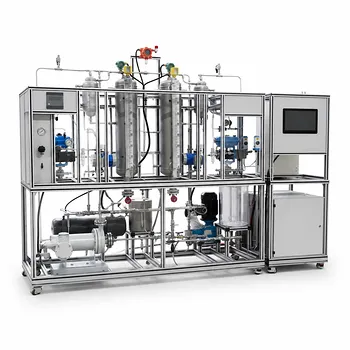
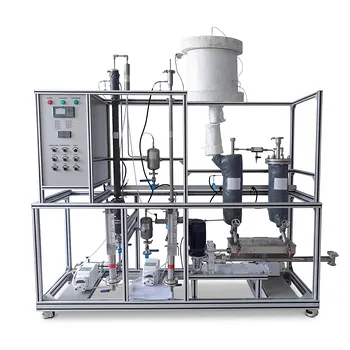
To effectively demonstrate critical water purification processes like silica reduction, you need reliable, scale-down systems. LABPARK provides premium Educational and Vocational Unit Operations Pilot Plants in chemical engineering, bioprocess & biotech, and environmental & water treatment for universities, research institutes, and enterprises.

Our pilot plants help you:

  • Deliver realistic, hands-on training for operators and engineering students.
  • Accurately simulate chemical precipitation, pH control, and sedimentation processes.
  • Accelerate research with customizable, industrial-grade equipment.

Ready to upgrade your laboratory capabilities? Contact us today to discuss your pilot plant requirements!

Related Products

People Also Ask

Related Products

Electrochemical Water Treatment Educational Unit Operations Pilot Plant

Electrochemical Water Treatment Educational Unit Operations Pilot Plant

Enhance engineering education with this pilot-scale electrochemical water treatment plant. Designed for hands-on learning of efficient salt removal, electrolytic reactions, and real-time data acquisition. Features multi-mode control, corrosion-resistant PVC, low-voltage safety, and wireless connectivity for modern teaching labs.

Thermal Desorption Exhaust Gas and Tail Water Treatment Educational Pilot Plant

Thermal Desorption Exhaust Gas and Tail Water Treatment Educational Pilot Plant

Bench-scale educational pilot plant for treating thermal desorption exhaust gas and tail water integrates condensation, Fenton oxidation, precipitation, filtration, and carbon adsorption. Ideal for chemical engineering and environmental labs, teaching unit operations, process control, and real-time data analysis.

Hot Filtration Educational Unit Operations Pilot Plant Laboratory System

Hot Filtration Educational Unit Operations Pilot Plant Laboratory System

This integrated laboratory bench-scale hot filtration pilot plant enables students to study solid-liquid separation under thermal conditions, featuring a stainless steel vessel, removable heating jacket, and multi-layer filter plates for unit operations education, ideal for chemical engineering laboratory curriculum.

Continuous Batch Extractive Distillation Educational Pilot Plant

Continuous Batch Extractive Distillation Educational Pilot Plant

Versatile pilot plant for continuous, batch, and extractive distillation training. High-borosilicate glass column for visualizing hydraulics, 15.6-inch touchscreen with data logging, precise reflux ratio control 1-99, and durable corrosion-resistant frame. Ideal for chemical engineering education and process research.

Water Electrolysis Hydrogen Production and Storage Educational Pilot Plant

Water Electrolysis Hydrogen Production and Storage Educational Pilot Plant

Integrated pilot-scale training system for higher education engineering labs. Features AWE/PEM electrolysis, adjustable DC power, PLC controls, gas-liquid separation, and pressurized hydrogen storage. Hands-on learning in green hydrogen, process control, and safety, ideal for chemical and energy departments.

Natural Product Extraction Unit Operations Training Pilot Plant

Natural Product Extraction Unit Operations Training Pilot Plant

Integrated natural product extraction pilot plant for chemical engineering training bridges theory and industrial practice with modular extraction and evaporation/concentration units, hybrid touchscreen and manual control, realistic process simulation, and self-contained softened water and vacuum utilities.

Ion Exchange Water Purification Educational Pilot Plant for Engineering Unit Operations

Ion Exchange Water Purification Educational Pilot Plant for Engineering Unit Operations

This bench-scale ion exchange pilot plant trains engineering students in water purification. Dual transparent columns simulate industrial softening and demineralization. Students observe fluid dynamics, perform resin regeneration, and analyze breakthrough curves. The corrosion-resistant frame ensures durability in unit operations experiments.

Electrolytic Hydrogen Production Educational Unit Operations Pilot Plant

Electrolytic Hydrogen Production Educational Unit Operations Pilot Plant

Bench-scale electrolytic hydrogen production pilot plant designed for university engineering labs. Provides hands-on training in water electrolysis, gas-liquid separation, and process safety. Fully customizable system with digital PID control, corrosion-resistant components, and hydrogen gas detector. Ideal for chemical engineering curricula.

Electrolyte Distillation Purification and Formulation Educational Pilot Plant

Electrolyte Distillation Purification and Formulation Educational Pilot Plant

Integrated bench-to-pilot scale educational pilot plant for electrolyte distillation, purification, and formulation with borosilicate glass construction, PLC automation, touchscreen HMI, and advanced industrial safety features for hands-on chemical process training, ideal for chemical engineering and materials science curricula.

Alkaline Membrane Water Electrolysis Educational Pilot Plant Unit Operations Training System

Alkaline Membrane Water Electrolysis Educational Pilot Plant Unit Operations Training System

Hands-on educational pilot plant for alkaline membrane water electrolysis hydrogen production, integrating unit operations training with industrial PLC control, real-time data logging, customizable design, durable 316L stainless steel construction, explosion-proof safety, and modern 5G connectivity for university laboratories.

Steam Methane Reforming Hydrogen Production and Purification Educational Pilot Plant

Steam Methane Reforming Hydrogen Production and Purification Educational Pilot Plant

This bench-scale educational pilot plant combines steam methane reforming with hydrogen purification, offering safe, hands-on unit operations training for university engineering laboratories. Its customizable design and high-precision monitoring enable real-time study of catalysis, phase separation, and process dynamics.

Rising and Falling Film Evaporation Educational Unit Operations Pilot Plant

Rising and Falling Film Evaporation Educational Unit Operations Pilot Plant

Hands-on educational pilot plant for studying rising and falling film evaporation, flow regimes, and heat transfer. Customizable for university labs with industrial instrumentation and data acquisition. Enables comparative evaluation of evaporation modes and energy efficiency.

Fluidized Bed Gas Solid Catalytic Reaction Educational Pilot Plant

Fluidized Bed Gas Solid Catalytic Reaction Educational Pilot Plant

Our educational fluidized bed gas-solid catalytic reaction pilot plant is ideal for chemical engineering labs. Students study fluidization dynamics, catalyst evaluation, and process control hands-on. Features include a customizable reactor, touchscreen HMI, and safety interlocks for safe, curriculum-aligned experiments.

100L Continuous Loop Hydrogenation Educational Unit Operations Pilot Plant

100L Continuous Loop Hydrogenation Educational Unit Operations Pilot Plant

This 100L continuous loop hydrogenation pilot plant is designed for chemical engineering education, featuring 316 stainless steel construction, advanced gas-liquid mass transfer components, explosion-proof safety systems, and a 15.6-inch touchscreen with 5G connectivity, cloud data logging, bridging theory and industry.

Multifunctional Membrane Separation Educational Pilot Plant with Ultrafiltration, Nanofiltration, Reverse Osmosis

Multifunctional Membrane Separation Educational Pilot Plant with Ultrafiltration, Nanofiltration, Reverse Osmosis

An integrated laboratory bench-scale membrane separation system for higher education engineering labs combining Ultrafiltration, Nanofiltration, and Reverse Osmosis processes. Features industrial PLC control with touch-screen HMI, transparent piping, and academic assessment software. Ideal for chemical and environmental engineering curricula.

Bio-fermentation Ethanol Production Practical Training Unit Operations Pilot Plant

Bio-fermentation Ethanol Production Practical Training Unit Operations Pilot Plant

Bio-fermentation ethanol production pilot plant for hands-on training in unit operations: fermentation, solid-liquid filtration, membrane separation, and distillation. Bridges theory with industrial practice using industrial-grade components, customizable for university labs. Hybrid automated and manual control for comprehensive learning.

Supercritical High-Gravity Flash Evaporation Educational Unit Operations Pilot Plant

Supercritical High-Gravity Flash Evaporation Educational Unit Operations Pilot Plant

Bench-scale integrated teaching system for advanced separation and mass transfer, combining supercritical high-gravity flash evaporation with heating, chemical reaction, and material collection, featuring modular design, Stainless Steel 316L construction, transparent visualization, touchscreen control, and safety systems for chemical engineering education.

Multi Pump Fluid Transport Process Piping Unit Operations Training Pilot Plant

Multi Pump Fluid Transport Process Piping Unit Operations Training Pilot Plant

Industrial-scale multi-pump pilot plant for unit operations training in fluid transport and process piping, featuring real-material and semi-physical simulation modes, comprehensive pump and flowmeter calibration, and safety-enhanced two-tier platform, bridging academic theory and industrial practice for chemical engineering education.

Multi Functional Membrane Crystallization Educational Unit Operations Pilot Plant

Multi Functional Membrane Crystallization Educational Unit Operations Pilot Plant

Integrated bench-scale membrane crystallization pilot plant for engineering education. Provides hands-on training in advanced separation technologies, combining membrane distillation crystallization and process intensification. Features variable scaling vessels, industrial-grade flow control, and interactive digital data acquisition. Customizable for university labs.

Fixed-Bed Chemical Reaction and Gas Dust Tar Removal Unit Operations Pilot Plant

Fixed-Bed Chemical Reaction and Gas Dust Tar Removal Unit Operations Pilot Plant

Integrated educational pilot plant for studying catalytic gas-solid reactions and downstream gas purification. Features dual fixed-bed reactor, three-stage heating, and touchscreen control for hands-on engineering training. Ideal for chemical and environmental engineering curricula.


Leave Your Message