Without near-instantaneous quenching, the high-value olefins in cracked gas would be lost within milliseconds.
Rapid quenching is critical because it abruptly drops the temperature of the reactor effluent from over 800°C to a range where secondary reactions cannot proceed. This freezes the product slate at its peak olefin concentration, preventing the formation of heavy byproducts and coke that would otherwise degrade the yield. In educational and research pilot plants, this step is replicated with integrated quench columns or transfer-line exchangers, then directly followed by pre-fractionation units—water wash towers, oil‑water separators—that split the stream into heavy oil, water, and light cracked gas, setting the stage for the full distillation train.
Quenching is a kinetic gatekeeper: it stops the cascade of condensation and cycloaddition reactions that turn valuable ethene and propene into tars and coke. Pilot plants then showcase the complete sequence—quenching, pre-fractionation, and separation—under controlled conditions, teaching how thermal management and phase separation design determine the ultimate olefin recovery.
The Critical Role of Rapid Quenching in Olefin Production
Preventing Unwanted Secondary Reactions
At cracking temperatures above 800°C, the primary reactions that produce olefins are accompanied by a web of sequential, degradation reactions.
These include condensation and cycloaddition pathways that polymerize light olefins into polynuclear aromatics and, eventually, solid coke.
Without an immediate temperature drop, the very molecules intended as product are consumed within the piping, dramatically reducing the overall yield.
Preserving Olefin Yield and Minimizing Coke
Quenching reduces the process stream temperature to 200–300°C in a fraction of a second, a characteristic that can be achieved via a transfer‑line exchanger (TLE) or by direct injection of quench oil/water.
This thermal shock brings the gas below the activation energy threshold of the degradation reactions, freezing the chemical composition at its most valuable olefin concentration.
Design criteria such as residence times below 1 second and minimal pressure drop in the TLE are essential to avoid back‑out of the yield curve and to limit coking on heat exchanger surfaces.
Timing and Temperature Targets
The target quench temperature is chosen to be just above the dew point of heavy components, so they remain vaporized until deliberate condensation in the next step.
Hitting this narrow window simultaneously locks in olefin yield and prepares the stream for efficient liquid–gas pre‑fractionation, demonstrating how thermal control drives both reaction and separation outcomes.
Demonstrating Quenching and Pre-Fractionation in a Pilot Plant
Replicating Industrial Quench Systems at Small Scale
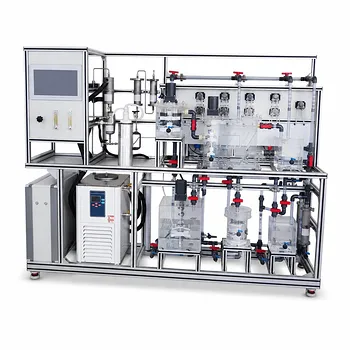
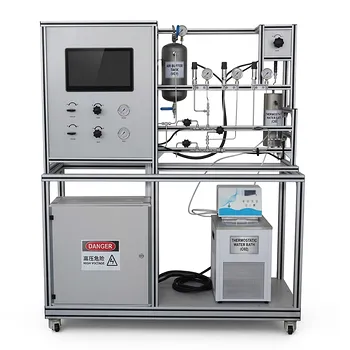
Unit operations pilot plants faithfully reproduce the quenching step with a quench column (direct contact with cooled recycle oil or water) or a miniature TLE.
A steam dilution system, often integrated upstream, lowers the hydrocarbon partial pressure—students can alter the steam‑to‑hydrocarbon ratio and directly observe how it shifts the product distribution and quench load.
This hands‑on manipulation makes abstract cracking‑chemistry principles tangible at an operational scale.
Pre-Fractionation: Separating Oil, Water, and Light Cracked Gas
Once cooled to 200–300°C, the mixture enters a pre‑fractionation train built from a water wash tower and an oil–water separator.
The wash tower removes quench water and water‑soluble tars, while the separator (gravity or coalescing type) splits the condensed oil from the aqueous phase.
The overhead light cracked gas—rich in C1 to C4 hydrocarbons—is then directed toward compression and cryogenic distillation, exactly as in a commercial plant.
Hands‑On Learning with Key Variables
Adjusting cooling rates, wash‑water temperature, and separator interface levels allows students to quantify the impact on phase separation purity and heat recovery.
This real‑time feedback solidifies fundamental unit operations such as liquid‑liquid separation, indirect heat exchange, and the trade‑off between quenching speed and fouling tendency.
From Pre-Fractionation to Full Separation — Pilot Plant Configurations
Exploring Distillation Sequences
The light cracked gas leaving pre-fractionation must be separated into high‑purity olefins. Pilot plants let students configure distillation columns to compare three classic sequences:
- Sequential separation (demethanizer‑first): The baseline, highly adaptable to feedstock changes, offering clear cause‑and‑effect insight into the main fractionation train.
- Front‑end deethanization: Removes C2 and lighter first, reducing the cryogenic load on the downstream chilling system. However, the higher reboiler temperature can initiate butadiene polymer fouling—a real process risk students can observe and mitigate.
- Front‑end depropanization: Separates C3‑and‑lighter early, simplifying later refrigeration but requiring robust heavy‑component knockout to protect the column.
Running these configurations on a pilot scale generates real data on energy consumption, component split efficiency, and thermal risks, bridging the gap between simulation and industrial practice.
The Role of Heat Integration and Energy Recovery
A pilot plant equipped with a TLE teaches energy recovery principles directly—high‑pressure steam generated on the shell side can be used to drive downstream compressors, mirroring full‑scale plants.
By tracking steam flow and temperature profiles, students learn how the quenching rate influences both yield preservation and the net energy export of the process.
Non‑Condensable Gases and Real‑World Challenges
Even trace amounts of non‑condensable gases (e.g., air) in the cracked gas can severely degrade condenser performance downstream.
These gases accumulate at the cold wall, forming a gas‑film thermal resistance layer that collapses the heat transfer coefficient.
Pilot plant operators learn to vent these gases through bleed valves, gaining a visceral lesson in why industrial cryogenic systems are meticulously purged and maintained.
Understanding the Trade‑offs
No single quenching or separation strategy is universally superior—the pilot plant reveals the inherent compromises.
- Direct‑injection quench offers the fastest cooling and minimal exchanger coking, but sacrifices high‑grade heat that could otherwise be recovered.
- Indirect TLE quenching recovers valuable steam, yet is sensitive to fouling and demands extremely short residence times to prevent degradation inside the exchanger.
- Sequential distillation is flexible and easy to troubleshoot, but inherently consumes more refrigeration than optimized front‑end schemes.
- Front‑end deethanization lowers cryogenic load, but the reboiler temperature can initiate fouling, requiring chemical additives or periodic cleaning. These trade‑offs are not theoretical—students measure the consequences in real time, building the intuition needed for plant design decisions.
Making the Right Choice for Your Pilot Plant Study
When designing or using a unit operations pilot plant to study the ethylene process, align the configuration with your educational or research objective.
- If your primary focus is cracking kinetics and yield preservation: Prioritize a rapid‑quench system with precise residence time control and on‑line gas analysis to capture the true product slate.
- If your primary focus is energy integration: Select a TLE‑equipped pilot plant and fully instrument the steam network to quantify energy recovery under varying quench conditions.
- If your primary focus is separation fundamentals: Start with a sequential distillation layout; its transparency makes the relationship between operating variables and component splits unambiguous.
- If your primary focus is process optimization and fouling risk: Experiment with front‑end deethanization or depropanization while carefully monitoring reboiler skin temperatures and polymer indicators. By matching the pilot plant’s capabilities to the learning goal, you transform abstract chemical engineering principles into measurable, actionable insight—the true value of hands‑on unit operations education.
Summary Table:
| Process Step | Key Function | Typical Equipment & Methods |
|---|---|---|
| Rapid Quenching | Drops temp from >800°C to 200–300°C within milliseconds to freeze olefin yields and prevent coking. | Transfer-line exchangers (TLE) or direct-contact quench columns. |
| Pre-Fractionation | Separates the cooled stream into heavy oils, water, and light cracked gas. | Water wash towers and oil-water separators (gravity/coalescing). |
| Fractionation & Separation | Purifies light cracked gases into individual high-purity olefin products. | Demethanizer-first, front-end deethanizer, or front-end depropanizer sequences. |
Bring industrial-scale chemical engineering concepts to life in your lab. LABPARK designs and supplies premium Educational and Vocational Unit Operations Pilot Plants in chemical engineering, bioprocess & biotech, and environmental & water treatment. Tailored for universities, research institutes, and progressive enterprises, our pilot plants empower hands-on mastery of complex thermal control, phase separation, and distillation dynamics.
Ready to enhance your research and training programs? Contact LABPARK today to find the perfect pilot plant configuration for your facility!
Related Products
- Methane Cracking Educational Unit Operations Pilot Plant
- Dual-Mode Gas Absorption and Desorption Unit Operations Training Pilot Plant
- Bench Scale Dual Column Gas Separation and Capture Educational Pilot Plant
- Fixed-Bed Chemical Reaction and Gas Dust Tar Removal Unit Operations Pilot Plant
- Gas-Solid Heterogeneous Separation Demonstration Educational Unit Operations Pilot Plant
People Also Ask
- How do ethane vs naphtha cracking influence teaching pilot plant analytical configurations? Key Design Guide
- How can flow-NMR be integrated with pilot plant reactors to monitor kinetics? A Complete Guide
- How do cracking temperature and residence time affect olefin yield? Pilot Plant Guide
- How are utility consumption rates integrated into chemical pilot plant economic evaluations?
- How should OSBL investments be estimated? Key Steps to Avoid Budget Overruns in Pilot Plant Projects