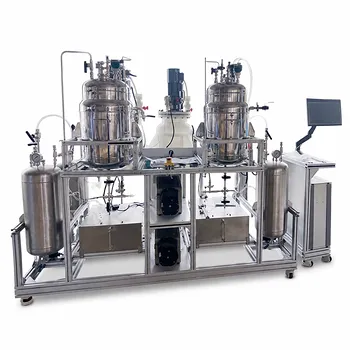
Before you can separate a mixture by flash distillation, the feed must exist as both liquid and vapor. Operating a flash pilot plant without verifying that the feed is in the vapor–liquid coexistence region at the chosen temperature and pressure is the fastest way to waste a run. The mathematical check to confirm this state uses the equilibrium constants (K_i): if both (\sum K_i z_i > 1) and (\sum z_i / K_i > 1) hold, the feed will split into two phases, and meaningful separation data can be collected.
The entire purpose of a flash distillation pilot plant is to exploit vapor–liquid equilibrium. A single wrong assumption about the feed’s thermal state can render the experiment useless—no separation occurs if the feed is entirely liquid or entirely vapor. The two simple inequalities (\sum K_i z_i > 1) and (\sum z_i / K_i > 1) are a quick, definitive litmus test for the two-phase region before a drop of fluid enters the vessel.
Why the Feed’s Phase State Is Non‑Negotiable
The Flash Drum’s Only Trick – Vapor–Liquid Coexistence
A flash vessel simply provides a low‑resistance environment for a partially vaporized feed to separate into a vapor and a liquid stream. It performs no fractionation; it cannot create a phase that isn’t already present. If the feed entering the drum is a subcooled liquid (below its bubble point), the entire stream remains liquid, and no vapor product leaves the overhead.
Similarly, if the feed is a superheated vapor (above its dew point), no condensation occurs inside the vessel. In both cases, the “flash” step disappears, and the pilot plant becomes nothing more than an expensive piping exercise.
The Cost of an Incorrect Feed State
A failed run in a pilot plant doesn’t just waste time and utilities. It erodes confidence in the experimental design and can lead to misdiagnosed equipment issues. Because a single‑phase feed still flows through the system, the absence of a temperature drop or a second stream might be misattributed to valve problems, sensor failure, or heat loss—when the root cause is simply a feed that was never in the right thermodynamic condition.
Verifying the feed state upfront confirms that the chosen flash temperature (T) genuinely sits between the bubble point (T_b) and the dew point (T_d). Only then will the equilibrium stage produce the vapor and liquid samples needed for vapor‑liquid equilibrium (VLE) data and mass balance closure.
The Mathematical Litmus Test for Two‑Phase Existence
Equilibrium Constants as the Key
The check relies on the distribution of each component between phases, captured by the equilibrium constant (K_i = y_i / x_i). These values are functions of temperature and pressure (and, in non‑ideal systems, composition). At the target flash pressure (p) and temperature (T), two extreme scenarios define the boundaries of the two‑phase region:
- Bubble point ((T = T_b)): The mixture is saturated liquid; the first infinitesimal bubble of vapor forms. At this exact condition, (\sum K_i z_i = 1) (where (z_i) is the overall feed mole fraction).
- Dew point ((T = T_d)): The mixture is saturated vapor; the first drop of liquid condenses. At this exact condition, (\sum z_i / K_i = 1).
Why Two Inequalities Are Necessary
If the flash temperature is above the bubble point, the fugacity of the components drives more material into the vapor phase. Mathematically, (\sum K_i z_i) exceeds 1. If the temperature is below the dew point, enough condensation potential exists to form a liquid phase, and (\sum z_i / K_i) exceeds 1. Therefore:
- (\sum K_i z_i > 1) confirms that the temperature is not below the bubble point (i.e., the mixture isn’t a subcooled liquid).
- (\sum z_i / K_i > 1) confirms that the temperature is not above the dew point (i.e., the mixture isn’t a superheated vapor).
Only when both inequalities are true simultaneously is the feed guaranteed to enter the flash drum as a partially vaporized stream—the very state that makes flash distillation possible.
A Practical Walkthrough
- Set the target flash pressure and temperature.
- Determine (K_i) values for each component at these conditions using an appropriate thermodynamic model (e.g., Wilson, NRTL, or even ideal (K_i = P_i^{\text{sat}} / P) if justified).
- Compute (S_1 = \sum K_i z_i) and (S_2 = \sum z_i / K_i) for the known feed composition.
- Interpret the result:
- (S_1 > 1) and (S_2 > 1) → feed is in the two‑phase region; proceed.
- (S_1 \leq 1) → feed is below or at the bubble point; increase temperature or pressure.
- (S_2 \leq 1) → feed is above or at the dew point; lower temperature or increase pressure.
This simple numeric check can be performed in a spreadsheet before a single valve is opened, saving hours of troubleshooting.
Common Pitfalls to Avoid
Blind Reliance on Inaccurate (K_i) Models
The inequalities are only as good as the equilibrium constants used. If an ideal gas/liquid assumption is applied to a highly non‑ideal mixture (azeotropes, polar components), the predicted phase envelope may be wrong. Always use a thermodynamic model validated for your system, even in a pilot setting.
Ignoring Pressure Drop and Heat Loss
The theoretical check assumes equilibrium at the exact pressure and temperature inside the flash vessel. Real pilot plants experience pressure drops across feed lines and heat losses to the environment. A target flash temperature that mathematically satisfies the two‑phase check may still produce a single‑phase feed if the actual liquid entering the drum has cooled below the bubble point. Insulate lines and place temperature sensors as close to the vessel inlet as possible.
Overlooking Composition Shifts During Heat‑up
When a liquid feed is preheated to the flash temperature, partial vaporization can begin inside the heat exchanger. The vapor and liquid may not re‑equilibrate before reaching the flash vessel, leading to a feed stream that is not a representative equilibrium mixture. A static mixer or a short residence section upstream can help restore equilibrium, but the plant layout must account for this.
Confusing This Check with Continuous Distillation Criteria
The (q)-line concept (used in McCabe‑Thiele analysis for continuous distillation) also addresses feed thermal condition, but its purpose is to locate the intersection of operating lines—not to confirm flash vessel operability. The (\sum K_i z_i) and (\sum z_i / K_i) inequalities are the direct, unambiguous flash criteria.
Making the Right Choice for Your Pilot Run
Before any flash distillation experiment, embed this verification into your standard operating procedure. The decision path is straightforward:
- If your primary focus is generating VLE data: Run the two‑inequality check for every planned temperature‑pressure combination. Use a rigorous thermodynamic package and validate the bubble‑ and dew‑point calculations against known saturation points.
- If your primary focus is demonstrating a separation concept: Use the check to select an operating envelope that guarantees two‑phase feed, then confirm the actual feed temperature at the vessel inlet. A conservative margin of at least 5 °C inside the two‑phase region is a practical safety net.
- If your primary focus is troubleshooting a failed run: Immediately re‑evaluate the feed state with the inequalities. Many “equipment problems” turn out to be a single‑phase feed due to a preheater setpoint drift or an overlooked pressure constraint.
A flash pilot plant earns its keep only when vapor and liquid leave the vessel. The simple arithmetic of (\sum K_i z_i > 1) and (\sum z_i / K_i > 1) is your fastest, cheapest insurance that the separation you came to study will actually happen.
Summary Table:
| Feed Phase State | Mathematical Criteria | Pilot Plant Outcome |
|---|---|---|
| Subcooled Liquid | $\sum K_i z_i \le 1$ | No vapor forms; zero separation achieved. |
| Two-Phase Coexistence | $\sum K_i z_i > 1$ and $\sum z_i / K_i > 1$ | Successful vapor-liquid separation. |
| Superheated Vapor | $\sum z_i / K_i \le 1$ | No condensation forms; zero separation achieved. |
Optimize your laboratory and training workflows with reliable, industry-grade equipment. LABPARK provides premium Educational and Vocational Unit Operations Pilot Plants in chemical engineering, bioprocess & biotech, and environmental & water treatment. Tailored specifically for universities, research institutes, and enterprises, our systems deliver the hands-on accuracy needed to master vapor-liquid equilibrium and separation processes.
Ready to elevate your department's experimental capabilities? Contact us today to find the perfect pilot plant solution!
Related Products
- Multi-Functional Special Distillation Educational Pilot Plant
- Multi-Modal Distillation Unit Operations Training Pilot Plant
- Continuous Batch Extractive Distillation Educational Pilot Plant
- Continuous Sieve-Plate Distillation Pilot Plant for Unit Operations Laboratory Education
- Supercritical High-Gravity Flash Evaporation Educational Unit Operations Pilot Plant
People Also Ask
- Why does simple distillation yield higher efficiency than flash distillation? Key thermodynamic differences.
- Why is the acentric factor important in pilot plants? Fluid property prediction.
- How Batch vs Continuous Configuration Affects Distillation Pilot Plant Versatility & Footprint
- How does double temperature difference control improve distillation pilot plants? Stabilize purity.
- How to Estimate Distillation Pilot Plant Tray Efficiency? O'Connell's Correlation Guide