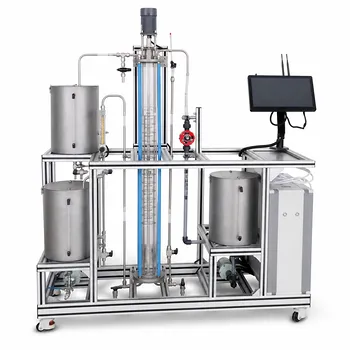
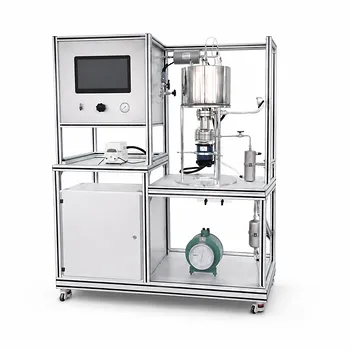
Scaling a reactive distillation process from a 2.5 cm glass column to a 7.5 or 10 cm pilot plant is not just a bigger tube—it’s a fundamental shift into industrial reality. A small laboratory column can prove that a heterogeneous catalyst drives the desired reaction under distillation conditions, but it cannot answer the questions that determine commercial viability. The transition to a pilot-scale column is necessary because only an intermediate size can expose the real-world mass transfer, heat transfer, and hydrodynamic behaviors that control catalyst lifetime, product purity, and process economics.
A 2.5 cm lab column operates in a nearly ideal world where kinetic chemistry dominates. The 7.5–10 cm pilot plant forces you to confront the scale‑dependent non‑idealities—transport limitations, maldistribution, impurity interactions, and thermal effects—that make or break a full‑scale reactive distillation process. Skipping this step risks a transition from flawless lab results to a failed commercial plant.
The Hidden Gaps in a 2.5 cm Column
Reaction Kinetics Without Mass Transport Realism
A small laboratory column typically uses fine catalyst particles or coated packings where internal diffusion paths are short.
This suppresses the intraparticle diffusional resistance that becomes significant when larger, industrial‑sized catalysts are loaded.
For consecutive reactions—for example, the oxidehydrogenation of butene to butadiene—increasing the particle size directly lowers the yield of the intermediate product.
The 2.5 cm setup cannot reveal the optimal particle size where chemical kinetics truly dominates, leaving a blind spot for reactor design.
Why Hydrodynamics Remain Invisible at the Lab Scale
In a narrow column, vapor and liquid distribute nearly ideally; there is no need for redistribution and no room for large‑scale fluid maldistribution.
Commercial reactive distillation units, however, often involve multibed configurations with external heat exchangers, where complex gas redistribution and liquid channeling can develop.
These hydrodynamic complexities do not scale with simple similarity rules—they must be observed and measured in a pilot‑scale system to tune “effective” parameters in mathematical models.
The Illusion of Catalyst Stability
A 2.5 cm column typically runs only a few grams of catalyst and operates over short timeframes.
It cannot simulate how feedstock impurities accumulate, how mechanical attrition damages extrudates, or how thermal cycling degrades catalytic surfaces over hundreds of hours.
Without the pilot column, catalyst lifetime, fouling rates, and regeneration intervals remain guesses—not data.
What the Pilot Plant Column Actually Reveals
Catalyst Performance Under Industrial Clocks
A 7.5–10 cm column can operate continuously for days or weeks, exposing the catalyst to realistic thermal histories and impurity spikes.
This allows researchers to measure deactivation rates, product purity stability, and techno‑economic feasibility under conditions that mimic a scaled‑down commercial unit.
Only such data can justify the capital investment of a full‑scale reactive distillation column.
Heat Transfer and Thermal Safety
Larger vessels have a lower surface‑area‑to‑volume ratio, leading to longer residence times and a greater risk of thermal degradation.
Pilot distillation often requires higher jacket temperatures to achieve reasonable boil‑up rates, which can decompose solids on vessel walls or trigger side reactions invisible in a glass column.
These tests surface potential hot spots and runaway scenarios long before they become an industrial hazard.
Process Control and Measurement Realities
Pilot columns rely on industrial instrumentation—radar level sensors, in‑process GC—which carry measurement inaccuracies of ±5–10 % due to foaming or unstable vacuum.
Vacuum control can fluctuate, shifting boiling points and causing bumping or foaming, especially below 50 mmHg.
Understanding these practical limitations is essential for designing reliable end‑point determination and maintaining product quality at scale.
The Real Trade‑offs of Pilot Plant Operation
Time and Resource Intensity vs. the Cost of Ignorance
Pilot runs take hours longer than lab‑scale distillations and consume more feed and catalyst.
However, the insights gained prevent far more expensive failures when scaling directly from a 2.5 cm column to a commercial tower.
Thermal and Mechanical Stress on Product and Catalyst
The prolonged heat exposure in a pilot column can decompose thermally sensitive products—a degradation pathway a short lab run never reveals.
At the same time, fluid dynamics and packing movements test the mechanical stability of catalyst structures, flagging attrition that would silently destroy catalyst inventory in a plant.
Operational Complexities of Scale‑Down
Pilot vessels have a higher minimum agitatable volume, meaning more solvent or reaction mixture is required to reach the end point, complicating solvent‑recovery economics.
Vacuum fluctuations and jacket‑temperature limits demand a deeper understanding of process dynamics that simply does not exist at the 2.5 cm scale.
How to Decide When to Move to a Pilot Column
- If your primary focus is fundamental reaction screening or catalyst discovery: A 2.5 cm column may suffice to confirm kinetic feasibility and generate initial selectivity data.
- If your primary focus is developing a scalable process for industrial deployment: The 7.5–10 cm pilot column is non‑negotiable; it alone provides the catalyst‑lifetime, hydrodynamic, and impurity‑resistance data required for a credible techno‑economic evaluation.
- If your primary focus is testing novel catalytic structures (structured packings, different particle sizes): Piloting is essential to evaluate pressure drop, liquid holdup, and mechanical integrity under realistic flows.
- If your primary focus is ensuring product quality and process safety: Pilot runs expose thermal degradation pathways, vacuum‑control issues, and measurement inaccuracies that would otherwise appear only in a commercial plant.
Moving to a pilot column transforms a promising catalytic chemistry into a predictable, de‑risked unit operation—the indispensable bridge from the laboratory bench to the process flowsheet.
Summary Table:
| Parameter | 2.5 cm Laboratory Column | 7.5–10 cm Pilot Column |
|---|---|---|
| Primary Focus | Kinetic chemistry & catalyst discovery | Hydrodynamics & scale-up validation |
| Transport Realism | Ideal heat/mass transfer; short diffusion | Real-world mass transfer & thermal safety |
| Catalyst Evaluation | Short-term activity (grams of catalyst) | Long-term stability, fouling & attrition |
| Fluid Dynamics | Ideal flow; no redistribution needed | Channeling, maldistribution & vacuum effects |
Bridge the Gap from Lab to Industrial Scale with LABPARK
Transitioning to pilot-scale testing is critical to de-risking your process. LABPARK provides premium Educational and Vocational Unit Operations Pilot Plants in chemical engineering, bioprocess & biotech, and environmental & water treatment.
Tailored for universities, research institutes, and enterprises, our robust pilot solutions help you accurately analyze mass transfer, thermal safety, and catalyst lifetimes.
Ready to validate your scale-up process? Contact LABPARK today to consult with our engineering experts!
Related Products
- Multi-Functional Special Distillation Educational Pilot Plant
- Fixed Bed Gas Solid Catalytic Reaction Educational Pilot Plant
- Comprehensive Liquid-Liquid Extraction Pilot Plant for Engineering Education
- Continuous Sieve-Plate Distillation Pilot Plant for Unit Operations Laboratory Education
- Continuous Batch Extractive Distillation Educational Pilot Plant
People Also Ask
- Why does simple distillation yield higher efficiency than flash distillation? Key thermodynamic differences.
- How does double temperature difference control improve distillation pilot plants? Stabilize purity.
- How to Integrate Spectroscopy in Distillation Pilot Plants for Advanced Process Control
- How to Verify Distillation Boundary Lines & Composition Regions with Pilot Plants
- Why is the acentric factor important in pilot plants? Fluid property prediction.