The practical integrity of your pilot plant data—and the equipment it represents—depends on it. Using modified corresponding states methods is essential because standard models fundamentally fail to predict the viscosity and thermal conductivity of non-ideal gas and liquid mixtures at the high pressures and densities common in pilot operations. This failure can lead to a 10% or greater error in critical design parameters like vessel diameter, directly invalidating your scale-up calculations and experimental results.
Standard corresponding states methods break down for dense, nonconformal fluid mixtures. A pilot plant’s core function is to provide reliable data for scale-up. Applying density-dependent corrections, based on the Modified Enskog Theory, is the non-negotiable bridge between simple thermodynamic models and the transport properties that actually govern heat transfer, pressure drop, and fluid dynamics in your system.
The Fundamental Limitation of Standard Models
The principle of corresponding states is a powerful tool. It allows us to relate the properties of a complex target fluid to a well-characterized reference fluid like methane, using critical constants and the acentric factor (ω). This works well for predicting thermodynamic (p-V-T) properties and even phase equilibria for conformal solutions.
When Simple Theories Break Down
The problem arises when we extend this to transport properties—viscosity and thermal conductivity.
- The Critical Failure Point: A primary reference highlights a sharp, mathematical limit. Predictive equations for transport properties can fail spectacularly when the density ratio ($\rho/\rho^c$) is greater than or equal to 1. This is the realm of dense gases and supercritical fluids, which are precisely the operating conditions found in many high-pressure pilot plants.
- The Nonconformal Fluid Challenge: Industrial fluid mixtures at high density are often nonconformal. Their molecular shapes and interactions deviate significantly from a simple reference fluid. Standard two-parameter corresponding states models do not capture these complex, shape-dependent collisions that dictate momentum and energy transfer at a molecular level.
The consequence is not a minor error. A 10% deviation in gas viscosity can significantly alter the calculated diameter for a separator or fractionator, directly affecting fluid dynamics, residence time, and separation efficiency. In a pilot plant designed for validation, this makes the data worthless.
How Modified Methods Deliver Operational Accuracy
A modified corresponding states method bypasses this limitation by abandoning a purely thermodynamic foundation for transport properties. It introduces a physical correction rooted in molecular theory.
Integrating the Modified Enskog Theory
The core of the modification is the incorporation of density-dependent correction factors from the Modified Enskog Theory (MET) . While simple corresponding states treats a fluid as a continuous medium defined by its state, MET acknowledges that molecules have a physical size, especially relevant at high density.
- Molecular Hard-Sphere Effects: MET models dense fluids as an ensemble of hard spheres. As density increases, molecules are packed tightly, and the frequency of collisions skyrockets.
- The Correction Factor: This theory provides a mathematical factor that directly adjusts viscosity and thermal conductivity based on how molecular packing deviates from a dilute gas. This factor becomes critically important as the radial distribution of molecules changes at high density, something a simple state-point correlation entirely misses.
By integrating this density-dependent correction into the corresponding states framework, you create a model that correctly accounts for both the thermodynamic state and the physical, molecular-scale momentum and energy transfer. This ensures your heat exchanger and piping network simulations are grounded in reality, not just theoretical convenience.
The Direct Impact on Pilot Plant Design and Education
In an educational or R&D pilot plant, the goal is to learn and validate. Ignoring these corrections guarantees you learn the wrong lesson.
Validating Theory with Reality
A core educational objective is to cross-validate theoretical predictions with direct experimental measurements. A standard corresponding states method that gives a wildly inaccurate viscosity doesn't teach a student about fluid dynamics; it sets them up for failure. A modified method provides a prediction accurate enough that deviations from experimental data become meaningful, revealing the true non-idealities of the mixture.
Managing Temperature-Dependent Properties
The logic of modification extends to other critical areas where simple relationships fail.
- Viscosity’s Temperature Duality: You can directly observe fundamental physics: liquid viscosity decreases with rising temperature, while gas viscosity increases. A model must capture this correctly.
- The Wall Effect Correction: For highly viscous fluids, the temperature boundary layer near a tube wall creates a local viscosity significantly different from the bulk fluid. The correction factor $(\mu/\mu_w)^{0.14}$ is essential for accurate heat transfer and pressure drop calculations. Neglecting it for heavy crude oil, for example, is a classic and costly error.
- Variable Thermal Conductivity: For process materials, thermal conductivity ($k$) is not a constant. Modeling its temperature dependence—decreasing for solids and liquids, increasing for gases—using expressions like $k = k_0(1 + \beta T)$ is crucial for accurate energy balances across a wide temperature range.
Preventing Catastrophic Sizing Errors
The practical output of any pilot plant design calculation is equipment sizing. Using predicted transport properties is not an academic exercise; it’s a safety and operational imperative. An incorrect viscosity value propagates directly into the Reynolds number, the friction factor, pump power requirements, and heat transfer coefficients. The modified method is your primary defense against building a multi-million-dollar industrial plant based on a pilot unit that was fundamentally mis-sized.
Understanding the Trade-offs
Applying these modifications is not about obtaining a perfect, universal equation. It is a deliberate trade-off between unearned simplicity and actionable accuracy.
- Complexity vs. Physical Realism: The modified method is more mathematically complex than a basic two-parameter model. However, it is far less computationally intensive than a full-on molecular dynamics simulation. You are trading the false simplicity of a broken model for the justified complexity of one that respects real fluid behavior.
- Reference fluid dependency: The accuracy of a modified corresponding states method is still tied to the quality of the reference fluid data and the specific mixing rules used. It's a powerful interpolation tool, but its predictive limits for truly exotic mixtures must still be respected.
Making the Right Choice for Your Pilot Plant Goal
Your choice of method should be a direct consequence of your experimental objective and fluid system.
- If your primary focus is working with low-pressure, ideal gases: A standard corresponding states method may be sufficient for initial educational demonstrations of basic thermodynamic principles.
- If your primary focus is simulating high-density gases, supercritical fluids, or high-pressure natural gas separation (e.g., methane-ethane): Use a modified corresponding states method with a density-dependent Enskog correction as a non-negotiable standard practice.
- If your primary focus is validating performance of viscous fluids or precise heat exchangers: You must integrate both the density-dependent transport correction and the temperature-driven wall-viscosity correction $(\mu/\mu_w)^{0.14}$ to obtain any meaningful data from pressure drop and heat transfer experiments.
The modified method is not just an incremental improvement; it is the difference between a pilot plant that accurately represents physical reality and one that is a dangerously misleading toy.
Summary Table:
| Method | Key Mechanism | Best Suited For | Main Benefit / Risk |
|---|---|---|---|
| Standard | Conformal fluid matching (e.g., methane reference) | Low-pressure, simple ideal gases | High risk of >10% viscosity/sizing errors in dense fluids |
| Modified | Density-dependent Enskog Theory (MET) corrections | High-pressure, dense & non-ideal mixtures | Precise transport property predictions and safe scale-up |
Scale Up with Confidence using LABPARK Pilot Plants
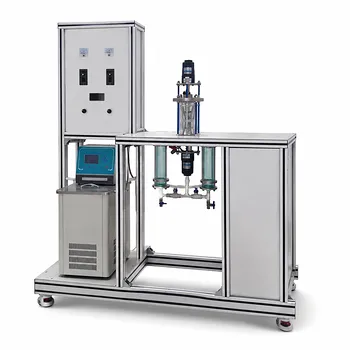
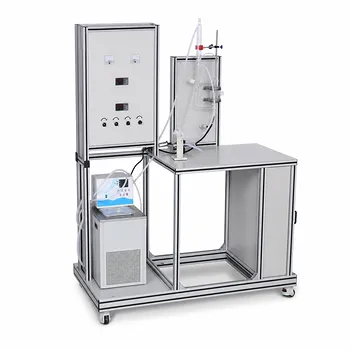
Accurate thermodynamic calculations deserve precise experimental validation. LABPARK provides state-of-the-art Educational and Vocational Unit Operations Pilot Plants in chemical engineering, bioprocess & biotech, and environmental & water treatment.
Designed specifically for universities, research institutes, and enterprises, our robust systems help you bridge the gap between theoretical calculations and industrial reality.
Contact our experts today to find the ideal pilot plant solution for your lab!
Related Products
- Liquid-Liquid Mass Transfer Coefficient Determination Educational Pilot Plant
- Binary System Vapor Liquid Equilibrium Data Determination Educational Unit Operations Pilot Plant
People Also Ask
- Why Compare Membrane-Reservoir Models with Pilot Plant Data? Ensure Successful Process Scale-Up
- How does column packing affect absorption intensification, and how is it evaluated experimentally?
- What are the limitations of the Wilke-Chang correlation? Avoid critical mass transfer errors.
- What is the role of the Sherwood number ($Sh$) in pilot plants? Master mass transfer scale-up
- Why is the calculation of gas and liquid diffusion coefficients critical? Unlock Accurate Pilot Plant Scale-Up