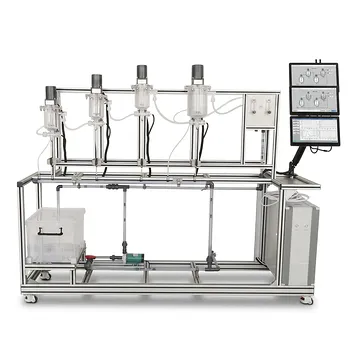
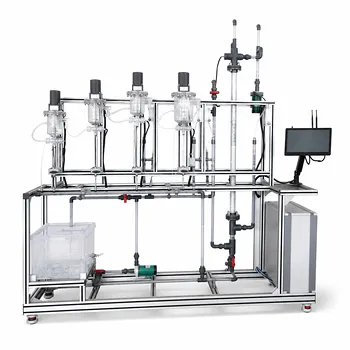
Geometric similarity is the non-negotiable starting point for any meaningful scale‑up or scale‑down study.
It is critical because only when all physical proportions—impeller‑to‑tank diameter, liquid height, impeller clearance, and baffle width ratios—are held constant can you trust that the fluid flow patterns, velocity fields, and local mixing zones observed in a laboratory stirred tank are directly representative of an industrial reactor. Without this proportional consistency, even identical average power inputs can produce radically different local mixing intensities, leading to failed solids suspension, dangerous hot spots, and inconsistent reaction outcomes.
Geometric similarity preserves the relative positions of every impeller blade, baffle, and tank wall, creating a common fluid dynamic “map” between scales. It is the essential prerequisite that allows you to then intelligently match the dynamic parameters—such as tip speed, power per volume, or turbulence intensity—that govern your process. Neglect it, and your pilot‑plant data can become dangerously misleading.
The Blueprint of Scale‑Down: What Geometric Similarity Really Means
Geometric similarity is not a vague design goal; it is a strict mathematical condition. Every linear dimension in the small‑scale model must be scaled by the exact same factor. This includes ratios like impeller diameter (D) to tank diameter (T) ((D/T)), liquid level ((Z/T)), impeller off‑bottom clearance ((C/T)), and baffle width ((B/T)).
Constant Ratios, Predictable Flows
When you keep (D/T), (Z/T), and (C/T) identical, you ensure that the impeller discharges fluid into the tank at the same relative position, and the streamlines that follow—hitting baffles, turning, recirculating—are geometrically similar. The same relative flow map means you can directly compare local velocities, shear rates, and turbulence intensities after correcting for scale.
This is why researchers in university labs can study a 100‑mm‑diameter reactor with water and be confident that the flow structure they see is a miniature version of a 3‑meter industrial unit handling viscous polymer. Without geometric similarity, the miniaturized flow would be a different beast entirely.
The First Step in the Laws of Similitude
Geometric similarity is the foundation beneath kinematic similarity (matching velocity patterns) and dynamic similarity (matching force ratios). You cannot achieve the latter two without first locking in the proportions of the domain. It allows the safe, inexpensive testing with surrogate fluids—water instead of hazardous solvents, air instead of reactive gases—because the physical constraints that govern mixing are being faithfully reproduced.
Beyond Average Values: Why Local Mixing Matters More Than Overall Power
A common pitfall is to assume that matching average energy dissipation (\epsilon) or power per unit volume (P/V) is sufficient. The supplementary evidence proves this wrong: three vessels with the same average (\epsilon) but different geometries will produce entirely different fluid motion.
The Energy Dissipation Trap
Average (\epsilon) hides the extreme spatial variation in turbulence. Near the impeller blades, energy dissipation can be 10–50 times higher than the bulk. If your geometry changes—say, a smaller impeller in a relatively larger tank—you concentrate that energy into a tiny zone, leaving the rest of the vessel starved of mixing. This is invisible in a simple (P/V) calculation.
Impeller Diameter and the Flow/Power Split
The impeller‑to‑tank diameter ratio (D/T) is a master switch for how energy is distributed. A low (D/T) (small impeller screaming at high speed) produces intense but localized turbulence; it may pulverize droplets near the blades but fail to suspend solids in the far corners. A high (D/T) (large impeller turning slowly) generates gentler, more uniform bulk motion, ideal for solids suspension but perhaps too weak for fast chemical reactions.
Geometric similarity locks in the (D/T) ratio, guaranteeing that the split between intense impeller‑zone dissipation and bulk circulation is the same at both scales. This is not a luxury—it is the only way to predict whether a solid will sit on the bottom, a gas bubble will be properly dispersed, or a polymerization reaction will run away.
The High Cost of Ignoring Geometry: Real‑World Consequences
The practical fallout from failing to maintain geometric similarity is not theoretical. Stirred tank polymerization reactors, in particular, expose the risks.
Solids Suspension Failure
Industrial reactors often must maintain a uniform concentration of catalyst particles or growing polymer solids. If a pilot‑scale experiment used a geometrically dissimilar tall, thin vessel while the plant operates a short, wide one, the local fluid velocities needed to lift solids could be completely misrepresented. The scaled‑up design might then deliver insufficient bottom velocities, allowing solids to accumulate and eventually plug the reactor.
Hot Spots and Runaway Reactions
Exothermic reactions like polymerization rely on impeller‑driven flow to sweep heat away from reaction zones. When geometry differs, the local heat transfer coefficient distribution changes. A lab vessel that successfully avoided hot spots might, when scaled without geometric control, produce a large‑scale vessel where fluid near the wall is nearly stagnant. The resulting temperature spikes can trigger runaway reactions or destroy the desired molecular weight distribution.
Understanding the Trade‑offs: Where Geometric Similarity Falls Short
Geometric similarity is essential, but it is not omnipotent. A wise scale‑up engineer knows its limits.
The Square‑Cube Law and Its Limits
Volume increases with the cube of the linear scale, while surface area increases with the square. This means that even with perfect geometric similarity, the ratio of surface‑dependent phenomena (heat transfer, wall friction) to volume‑dependent phenomena (reaction rate, power input) changes. A geometrically identical 100‑L pilot reactor will have far more surface area per unit volume than a 10,000‑L production unit, inherently making it easier to cool. That is why dynamic similarity parameters—like maintaining constant tip speed or power per unit volume—must often be layered on top.
When You Must Abandon Pure Geometric Scaling
Sometimes process constraints force a deviation. For instance, typical laboratory gas‑sparged reactors often have a height‑to‑diameter ratio of 3:10 to handle gas holdup, while industrial units might be 1:2 to manage hydrostatic head and backmixing. In such cases, engineers deliberately depart from strict geometric similarity and then compensate by matching key parameters like the mixing time or the critical impeller speed for just‑suspended solids. The critical insight is this: you can only safely deviate once you fully understand what the geometric similarity was preserving in the first place.
Making the Right Choice for Your Mixing‑Study Goal
Geometric similarity is not a binary checkbox; it is a strategic decision that must align with your ultimate objective.
- If your primary focus is process safety and product quality (e.g., polymerization, exothermic reactions): Strictly maintain geometric similarity throughout the scale‑up chain. Preserve the (D/T) and baffle ratios to ensure local shear, turbulence distribution, and heat removal patterns translate predictably from bench to plant.
- If your primary focus is bulk hydraulic performance (power draw, blending time, gross solids suspension): Start with geometric similarity, but accept that you will need to supplement it with a dynamic criterion—typically constant power per unit volume or constant tip speed—to manage the changing surface‑to‑volume ratio.
- If your pilot reactor cannot physically replicate the plant geometry (e.g., very tall lab column vs. wide industrial tank): Acknowledge that you have broken the first law of similitude and invest heavily in computational fluid dynamics (CFD) or scale‑down protocols that deliberately match the local impeller‑zone energy dissipation, rather than the overall average.
Geometric similarity does not solve every scale‑up challenge, but without it, you are not solving the right problem—you are merely guessing at the right flow.
Summary Table:
| Scale-Up Parameter | Definition & Role | Impact of Deviation |
|---|---|---|
| Geometric Ratios ($D/T$, $Z/T$, $C/T$) | Keeps relative vessel, impeller, and baffle dimensions constant. | Distorts flow patterns and velocity fields. |
| Local Energy Dissipation | Ensures local turbulence near the impeller matches bulk mixing. | Leads to localized hot spots or poorly mixed zones. |
| Impeller-to-Tank Ratio ($D/T$) | Determines the split between high shear and bulk circulation flow. | Causes solids suspension failure or over-sheared fluids. |
| Surface-to-Volume Ratio | Governs heat transfer and wall friction relative to reactor volume. | Affects thermal control and heat removal capability. |
Bridge the Gap Between Lab Scale and Industrial Success
Achieving reliable chemical mixing and heat transfer starts with the right equipment design. LABPARK provides advanced Educational and Vocational Unit Operations Pilot Plants in chemical engineering, bioprocess & biotech, and environmental & water treatment for universities, research institutes, and enterprises.
Whether you are training future engineers, validating kinetics, or scaling up production, our pilot plants are engineered to ensure your experimental data translates perfectly to industrial scales.
Ready to elevate your research and process design? Contact LABPARK today to discuss your custom pilot plant requirements with our specialists!
Related Products
- Multi-Stage Stirred Tanks in Series Residence Time Distribution and Mixing Performance Determination Educational Pilot Plant
- Multi-Reactor Educational Pilot Plant for Reaction Engineering Unit Operations
- Multi Functional Catalytic Reaction and Reactor Evaluation Educational Unit Operations Pilot Plant
- Ethylbenzene Dehydrogenation Educational Unit Operations Pilot Plant
- Methane Cracking Educational Unit Operations Pilot Plant
People Also Ask
- How does MRF model impeller rotation in CFD? Key Boundary Conditions Explained
- How can a CSTR pilot plant demonstrate reactor staging? Visualize volume savings.
- How does steady-state multiplicity affect the operation and safety of exothermic reactions within a CSTR pilot plant? - Guide
- What parameters to monitor transitioning from Batch to CSTR? Master Pilot Plant Setup
- Why is temperature regulation via a cooling jacket a critical feature in CSTR pilot plants used for laboratory training?