The simple act of turning an outlet valve on a reciprocating pump is a recipe for catastrophic pressure buildup—not a legitimate flow control strategy. In chemical engineering pilot plants, a standard outlet throttle valve is unsuitable because reciprocating pumps are positive displacement machines: their flow rate is rigidly fixed by piston geometry and speed, not by downstream resistance. Closing the valve forces the pump to push the same volume into a blocked path, spiking pressure instantaneously and risking pipeline rupture or motor burnout. The correct approach is to manipulate the source of displacement—adjusting stroke length, varying motor speed, or safely diverting excess flow through a bypass return line.
A reciprocating pump treats a throttle valve not as a brake but as a wall. To protect people and equipment in a pilot plant, flow must be regulated by changing how much fluid the pump actually displaces or by giving the excess a harmless escape route—never by trying to starve its discharge.
The Fundamental Mismatch: Positive Displacement vs. Throttling
Why Reciprocating Pumps Defy Flow Restriction
A reciprocating pump’s discharge flow is a deterministic product of its mechanical action. The governing equation, (Q = 60nFs), ties flow directly to three physical variables: rotational frequency ((n)), stroke length ((s)), and piston cross-sectional area ((F)). System resistance, the lever that throttling uses to control flow in centrifugal pumps, does not appear in this relationship.
Positive displacement means the pump will expel a trapped volume of liquid with every stroke, no matter the downstream obstacle. Throttling merely makes the pump work harder against the restriction, while the flow rate remains nearly unchanged until the point of mechanical failure.
The Pressure Danger of a Closed Throttle
Because the displaced volume cannot be compressed, a closing outlet valve produces an immediate, runaway pressure rise. The energy of the motor concentrates into a pressure spike that can rupture the pump casing, crack piping, or overload the drive.
In a pilot plant environment—where operators may be learning, and equipment is often exposed for educational visibility—this hazard is unacceptable. A single misadjusted valve during startup can turn a teaching moment into a safety incident. That is why throttling at the outlet is structurally forbidden for positive displacement pumps.
Safe and Precise Flow Control Methods in Pilot Plants
Adjusting the Pump’s Displacement Directly (Stroke & Speed)
Modifying the two accessible variables in the displacement equation—stroke length and speed—offers the most energy-efficient and precise flow regulation.
- Stroke length adjustment physically limits how far the piston travels, changing the volume swept per cycle. This requires a mechanical linkage that permits variable stroke, which is mechanically complex but eliminates all bypass losses.
- Motor speed variation via a variable frequency drive (VFD) changes the reciprocating frequency (n). This method is exceptionally clean, maintains high efficiency across the turndown range, and is widely used in modern pilot plants.
Both techniques alter the pump’s inherent characteristic curve, so the flow delivered is exactly the flow desired, with no energy wasted fighting a valve.
Bypass Regulation: Diverting Excess Flow
When mechanical stroke or speed adjustments are impractical—for instance, on a fixed-speed, fixed-stroke pump—the safe alternative is a bypass control valve. A fraction of the discharged liquid is routed back to the suction line through a controlled return path.
This approach does not alter the pump’s output; it simply reroutes the unneeded portion. The pump continues to move its full displacement, so energy consumption remains at the maximum, leading to lower overall efficiency. However, bypass regulation is simple to install, robust, and well-suited for pilot plants where simplicity and safety outweigh energy concerns.
For processes demanding a very wide flow turndown (high rangeability), a split-range bypass scheme can be implemented. A small bypass valve handles low-flow requirements with excellent control authority, while a larger valve opens only when demand exceeds the small valve’s capacity. This avoids the noise, oscillation, and poor accuracy that plague a single oversized bypass valve at small openings.
Understanding the Trade-offs of Each Control Method
No single flow regulation method is universally superior; each involves compromises that must be weighed against the pilot plant’s educational, safety, and operational goals.
- Energy efficiency vs. mechanical simplicity: Direct stroke or speed adjustment delivers the highest efficiency but introduces mechanical or electronic complexity. Bypass regulation is drop-dead simple but wastes a significant portion of input energy, especially at low net flow rates.
- Control accuracy at low flow: Variable speed drives and split-range bypass arrangements both preserve controllability when the pilot plant operates at a small fraction of its design capacity. A single, undivided bypass line can suffer from poor valve authority below 20% opening.
- Safety envelope: All three safe methods (stroke, speed, bypass) keep the pump’s discharge path open at all times, preventing the pressure spike that defines throttling. In contrast, any approach that restricts the outlet directly—even partially—carries a latent risk that a small mistake can become a major failure.
Making the Right Choice for Your Pilot Plant
Your decision hinges on what the pilot plant must teach or achieve. Choose the control strategy that aligns with the core learning objective or operational priority.
- If your primary focus is demonstrating energy-optimal process control: Use a variable-speed drive with a pump capable of stroke adjustment. This allows students to compare pump curves, measure efficiency gains, and see how displacement directly governs flow.
- If your primary focus is safe, low-maintenance operation with minimal setup complexity: Install a bypass control loop. It will run reliably even with fixed-speed, fixed-stroke pumps, and it makes the positive displacement principle visible: flow is always being generated; you just divert the excess.
- If your primary focus is high rangeability for a single pump across multiple unit operations: Combine a bypass loop with a split-range valve pair. This setup demonstrates how industrial plants tackle wide flow variations without introducing control instability.
Select the method that serves the experiment’s true lesson, and you will never need to put a throttling valve between a reciprocating pump and its destination.
Summary Table:
| Control Method | Safety Level | Efficiency | Mechanism |
|---|---|---|---|
| Outlet Throttling | ❌ Dangerous (Pressure Spike) | Very Low | Restricts discharge path |
| Direct Displacement (Stroke/Speed) | Safe | High | Alters piston travel/frequency |
| Bypass Regulation | Safe | Low | Reroutes excess flow to suction |
Elevate Your Chemical Engineering Lab with LABPARK
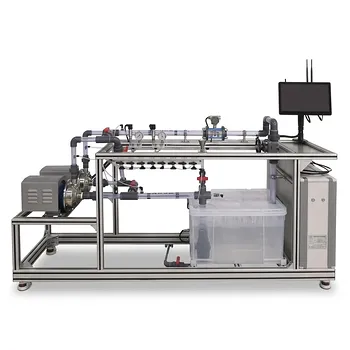
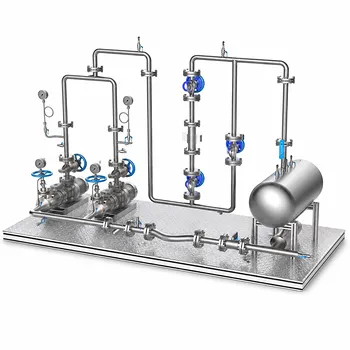
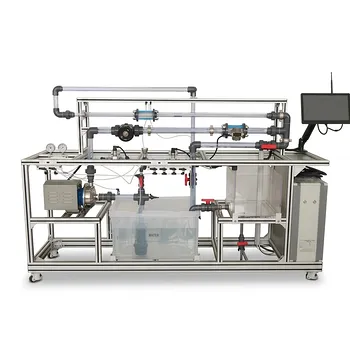
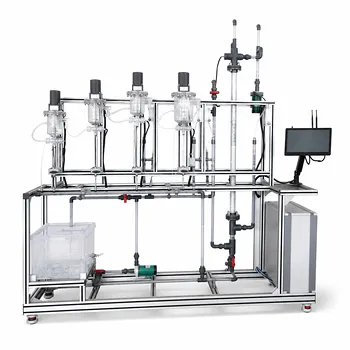
Building safe, efficient, and educational pilot plants requires the right equipment design. At LABPARK, we provide state-of-the-art Educational and Vocational Unit Operations Pilot Plants in chemical engineering, bioprocess & biotech, and environmental & water treatment for universities, research institutes, and enterprises.
Our pilot plants are engineered with safety and pedagogical clarity in mind—integrating proper flow control mechanisms like VFD speed regulation and bypass loops to prevent hazardous pressure build-ups.
Why Partner with LABPARK?
- Industry-Standard Safety: Built-in safeguards protect students, researchers, and equipment.
- Tailored Solutions: Customized pilot plants designed to match your specific curriculum or research goals.
- End-to-End Support: Comprehensive documentation, curriculum integration, and technical assistance.
Ready to upgrade your lab's training capabilities? Contact LABPARK today to request a catalog or schedule a consultation!
Related Products
- Centrifugal Pump Performance Determination Educational Unit Operations Pilot Plant
- Multi Pump Fluid Transport Process Piping Unit Operations Training Pilot Plant
- Natural Product Extraction Unit Operations Training Pilot Plant
- Ethyl Acetate Synthesis Unit Operations Pilot Plant for Practical Training
- Chemical Pipeline Assembly and Fluid Transport Practical Training Unit Operations Pilot Plant
People Also Ask
- Why start a centrifugal pump with a closed outlet valve? Protect your pilot plant motors.
- How can cavitation and slurry erosion be studied and mitigated using fluid transport and centrifugal pump pilot plants?
- How does fluid density affect pump head and pressure? Avoid Pilot Plant Motor Overload
- How does fluid viscosity affect centrifugal pump performance? Key pilot plant correction methods.
- How does fluid density affect centrifugal pump performance & motor safety in pilot plants?