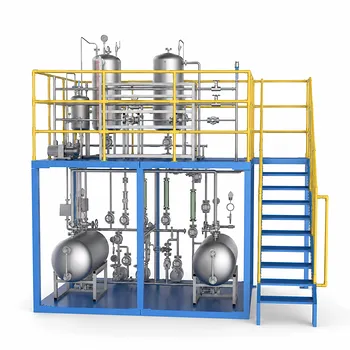
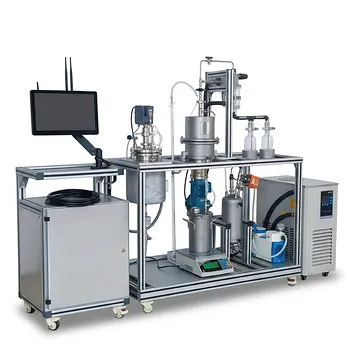
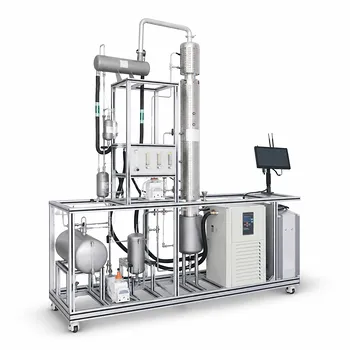
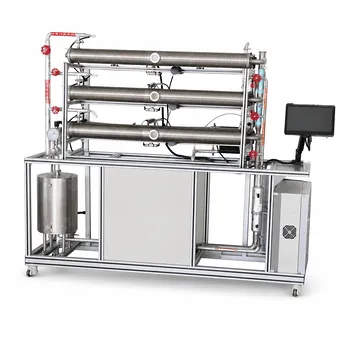
Pervaporation pilot plants are uniquely effective for teaching and researching azeotropic separation because they sidestep the fundamental thermodynamic limitations of distillation. Instead of relying on boiling point differences—which vanish at the azeotropic point—pervaporation uses a selective membrane. A thin, dense membrane with specific affinity properties acts as a molecular filter, allowing the more permeable component to pass through based on its chemical interaction with the membrane and vapor pressure. This lower-temperature, entrainer-free process dramatically reduces energy consumption and carbon footprint, making it an ideal platform for demonstrating modern green separation technology.
Traditional distillation hits a wall with azeotropes because vapor-liquid equilibrium equalizes compositions. A pervaporation pilot plant teaches students to break that wall by switching the driving force from boiling points to selective membrane permeation—a hands-on lesson in sustainable, energy-efficient separation that eliminates hazardous entrainers and operates at gentle temperatures.
Overcoming the Thermodynamic Barrier
Why Traditional Distillation Fails with Azeotropes
Azeotropic mixtures exhibit a constant boiling point where the vapor and liquid compositions become identical. At this point, vapor-liquid equilibrium (VLE) prevents any further enrichment by simple distillation. To push past the azeotrope, conventional processes must add a chemical entrainer, which introduces a third component that alters the activity coefficients.
Entrainers like benzene or cyclohexane are often toxic and require intensive downstream purification. This makes azeotropic distillation both chemically complex and a poor teaching model for safer, greener separations. Students see a process burdened with high energy demands and hazardous chemicals—far from an ideal platform for modern engineering education.
The Membrane Advantage: Separation by Affinity, Not Boiling Point
Pervaporation operates on a completely different separation mechanism. It uses a dense polymeric or inorganic membrane that does not rely on relative volatility. Instead, the driving force is the difference in chemical potential across the membrane, achieved by a partial vacuum on the permeate side. A component’s ability to cross the membrane depends on its solubility and diffusivity in the membrane material.
The process follows three sequential steps: preferential sorption of the desired component into the membrane surface, selective diffusion through the membrane matrix, and desorption as a vapor on the permeate side. Because this pathway bypasses VLE constraints entirely, azeotropes can be separated in a single step without any additive. For instance, a hydrophilic polyvinyl alcohol (PVA) membrane can pull water out of ethanol near the azeotropic point, achieving purities up to 99.8%.
A Hands-On Lesson in Green Chemistry and Process Intensification
Eliminating Hazardous Entrainers
One of the most powerful teaching moments a pervaporation pilot plant provides is demonstrating a clean, physical separation that removes the need for chemical entrainers. Students see that by simply choosing a membrane with the right chemical affinity, they can replace a complex ternary distillation scheme with a straightforward, entrainer-free process.
This change eliminates toxic waste streams and the energy required to recover the entrainer. It directly aligns with the 12 principles of green chemistry, showing future engineers how to design separations that are inherently safer and less wasteful.
Energy Efficiency at Lower Temperatures
Traditional distillation must vaporize the entire liquid feed, consuming enormous latent heat. Pervaporation, by contrast, only vaporizes the permeating component. Because the feed remains liquid and the process operates at moderate temperatures, energy savings of 30% to 40% over azeotropic distillation are commonly realized.
This low-temperature operation also makes pervaporation exceptionally suited for heat-sensitive materials, something a distillation column cannot handle. Researchers gain a separation tool that preserves biological or pharmaceutical integrity while teaching students the importance of energy pinching and process integration.
Compact, Modular, and Easily Scalable Design
A pervaporation pilot plant has a small footprint and a modular membrane configuration. This flexibility allows for rapid adjustment of membrane area and simple scale-up studies. Students can literally change a membrane cartridge to test different materials, giving them direct insight into the structure-property-performance relationship.
The system’s modularity also makes it ideal for hybrid configurations. A common teaching exercise couples a distillation column that concentrates an ethanol-water mixture to its azeotropic point with a pervaporation unit that polishes the distillate to absolute ethanol. This hybrid setup embodies process intensification, showing how combining unit operations can bypass individual thermodynamic limits.
Understanding the Trade-offs in a Research and Teaching Context
Membrane Fouling and Long-Term Stability
No separation technology is without its challenges. In pervaporation, membrane fouling from feed impurities or concentration polarization can reduce flux over time. A pilot plant environment turns these challenges into valuable research questions: How does one clean the membrane? What pre-treatment strategies are needed? This hands-on troubleshooting deepens a student’s understanding of practical plant operations.
Throughput Limitations and Specific Membrane Chemistry
Pervaporation membranes typically exhibit lower permeation rates compared to the mass transfer rates in a distillation column, meaning they may not be the best choice for very high-capacity bulk separations. Additionally, membrane selectivity is highly chemistry-specific. A membrane optimized for water removal from ethanol may be ineffective for separating an organic-organic azeotrope. This limitation forces researchers to think carefully about membrane material selection and crystallizes the concept that no single unit operation is a universal solution.
Bridging Theory and Practice with Hybrid Configurations
A distillation-pervaporation hybrid is a powerful research platform that demonstrates how to overcome thermodynamic limitations through integration. The distillation column first brings the mixture to the azeotropic composition. The pervaporation unit then selectively removes water, shifting the equilibrium and allowing the column’s bottoms product to reach far higher purity. Students witness a real-world solution that embodies modern process systems engineering, where the whole is genuinely greater than the sum of its parts.
Making the Right Choice for Your Educational or Research Goal
Your selection between a traditional distillation pilot plant and a pervaporation system depends on the specific principles and skills you aim to impart.
- If your primary focus is demonstrating fundamental thermodynamics: Use pervaporation to show that separation does not have to obey vapor-liquid equilibrium. It makes the abstract concept of chemical potential tangible.
- If your primary focus is green engineering and sustainability: A pervaporation pilot plant is unmatched. It eliminates toxic entrainers and dramatically cuts energy use, giving students a direct experience in designing clean processes.
- If your primary focus is process scale-up and industrial relevance: The modular, hybrid-capable design of a pervaporation unit reflects modern process intensification strategies directly transferable to the pharmaceutical and solvent recovery industries.
- If your primary focus is safe handling of chemicals: Because pervaporation operates at low temperatures and avoids hazardous additives, it provides a safer, low-risk learning environment for heat-sensitive or reactive compounds.
A pervaporation unit operations pilot plant transforms an intractable thermodynamic problem into a clear demonstration of molecular selectivity, giving students and researchers the tools to separate the inseparable—cleanly, safely, and with an eye on the future of chemical processing.
Summary Table:
| Feature | Pervaporation Pilot Plant | Traditional Distillation |
|---|---|---|
| Separation Basis | Selective membrane affinity & diffusivity | Boiling point differences (VLE) |
| Azeotrope Handling | Bypasses VLE; single-step separation | Fails at azeotrope; requires chemical entrainers |
| Energy & Temperature | 30%-40% energy savings; gentle temperatures | High energy consumption; high vaporizing heat |
| Safety & Environment | Green, entrainer-free, safe for heat-sensitive feeds | Toxic waste streams, hazardous chemicals used |
| System Design | Compact, modular, and ideal for hybrid setups | Bulky, complex, and rigid configurations |
Elevate Your Chemical Engineering Lab with LABPARK
Ready to bring cutting-edge membrane separation technology to your students and researchers? LABPARK provides state-of-the-art Educational and Vocational Unit Operations Pilot Plants in chemical engineering, bioprocess & biotech, and environmental & water treatment.
Specifically designed for universities, research institutes, and enterprises, our systems bridge the gap between theoretical chemistry and real-world industrial practice. Contact LABPARK today to discover how our modular pilot plants can enhance your curriculum and research capabilities!
Related Products
- Multi Pump Fluid Transport Process Piping Unit Operations Training Pilot Plant
- Rising and Falling Film Evaporation Educational Unit Operations Pilot Plant
- Supercritical High-Gravity Flash Evaporation Educational Unit Operations Pilot Plant
- Natural Product Extraction Unit Operations Training Pilot Plant
- Multimodal Absorption and Desorption Pilot Plant for Unit Operations Training
People Also Ask
- Why distinguish Newtonian & non-Newtonian fluids in pilot plants? Prevent design errors.
- Why is the chemical plant startup schedule crucial? De-risk scale-up with pilot plants.
- When to transition from PID to adaptive control in pilot plants? Key process indicators.
- How do deviations in estimating latent heat impact pilot plant thermal systems? Avoid hardware mis-sizing.
- How to study gasification in pilot plants? Compare exit gas composition & efficiency