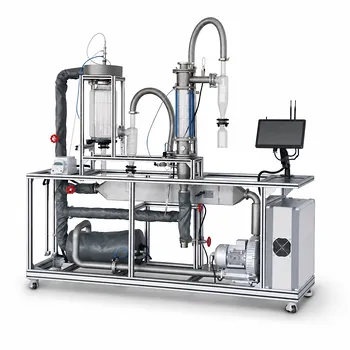
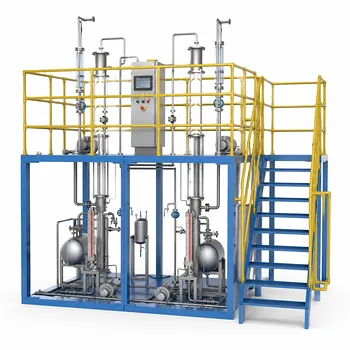
The core necessity of a multi-stage design in a pervaporation pilot plant boils down to one fundamental physical challenge: the feed stream cools itself. As the liquid mixture flows across the membrane, the permeating components draw their latent heat of vaporization directly from the sensible heat of the feed, causing a sharp temperature drop. Because the transmembrane flux decreases exponentially with this temperature decline, a single long membrane stage becomes catastrophically inefficient. A multi-stage configuration, with intermediate heat exchangers placed between membrane modules, is therefore the essential engineering solution to reheat the feed and restore an economically viable separation rate.
A multi-stage design with intermediate reheaters is not an optional upgrade—it is a critical design feature that overcomes the exponential loss of flux caused by self-cooling. For chemical engineering education, this setup transforms a simple separation unit into a powerful platform for teaching coupled heat and mass transfer optimization.
The Pervaporation Self-Cooling Problem
Pervaporation is unique because the phase change happens inside the membrane module itself. Understanding why this matters is the first step in appreciating the need for staging.
Where the Energy Comes From
In most thermal separations, like distillation, an external reboiler supplies the heat of vaporization. Pervaporation is fundamentally different. The energy required to vaporize the permeating molecules is extracted directly from the sensible heat of the feed liquid. The membrane operates with a vacuum on the downstream side, and the liquid permeate evaporates into the vapor phase as it crosses the membrane. This evaporation chills the feed.
The Exponential Performance Penalty
The immediate consequence is a temperature drop along the length of the membrane. This is critical because the driving force for pervaporation—the partial pressure difference—is highly temperature-sensitive. As the feed cools, its vapor pressure falls, reducing the transmembrane flux exponentially. A 10°C drop in feed temperature can easily cut the permeate flux in half, making a single, long module extraordinarily unproductive.
Why a Single Stage Fails
A pilot plant with a single, continuous membrane area would simply experience a continuously declining flux profile. The downstream portion of the membrane would contribute very little to the separation while adding to the system’s cost and pressure drop. For an educational plant aiming to demonstrate industrial relevance, this is an unacceptable design.
The Role of Staging and Intermediate Heat Exchangers
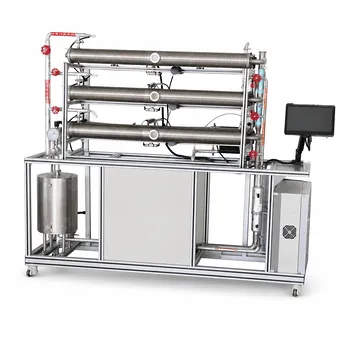
The solution is to break the total membrane area into discrete stages, each followed by a heat exchanger. This creates a sawtooth temperature profile that keeps the feed hot enough to drive the separation.
Reheating as a Process Control Lever
Between each stage, an intermediate heat exchanger reintroduces the thermal energy lost to vaporization. This brings the feed back to the optimal operating temperature before it enters the next membrane module. For a student or researcher, this plant layout isn’t just about maintaining flux—it provides direct control over a critical process variable.
Bridging Heat and Mass Transfer Education
The heat exchangers themselves become a focal point for learning. Students can measure inlet and outlet temperatures, calculate the specific heat duty required, and determine the overall heat transfer coefficient (U). They can compare how different heat exchanger configurations (e.g., a double-pipe heater using steam or hot oil) and flow geometries affect the reheating efficiency and the overall process economics.
Teaching Process Optimization
The multi-stage design makes the inherent trade-off tangible. Adding more stages and reheaters recovers flux and reduces the total membrane area needed, but it increases the capital cost of heat exchangers, piping, and instrumentation, as well as the thermal energy consumption. The pilot plant becomes a hands-on optimization problem: students must balance membrane area against energy input to find a minimum total cost for a given separation duty.
Understanding the Trade-offs in Educational Plant Design
While a multi-stage, continuous design is necessary for demonstrating true process intensification, it’s not the only configuration used in education, and each has its place.
Multi-Stage Continuous vs. Batch Single-Stage
A complementary reference point is the batch pervaporation pilot plant. These typically use a single-stage module and recirculate the feed back to a heated storage tank. The key differences highlight the trade-offs. A batch plant offers maximum experimental flexibility—you can easily change feed compositions and study a full concentration run down to ppm levels using the same setup. However, it is inherently less energy-efficient and requires more membrane area per unit of product because mixing the concentrated permeate-depleted stream back into the tank causes a redilution effect. The multi-stage plant teaches continuous, steady-state industrial practice; the batch plant teaches kinetic and process dynamics at the expense of energy efficiency.
Complexity and Educational Fidelity
The multi-stage arrangement introduces the real-world challenge of managing pressure drops across stages and ensuring even flow distribution. While this adds mechanical complexity, it forces students to confront practical engineering issues like pump sizing and inter-stage control. The educational value lies in this fidelity—the plant behaves like its industrial counterpart, not an idealized textbook model.
Making the Right Choice for Your Educational Goal
The decision to use a multi-stage pervaporation plant depends on the learning outcomes you prioritize. For chemical engineering education, consider the following recommendations.
- If your primary focus is demonstrating industrial-scale process efficiency and heat integration: Invest in a multi-stage continuous plant. It is the only way to physically show the necessity of staging and allow students to optimize the capital (membrane) vs. operating (energy) cost trade-off.
- If your primary focus is flexible research on membrane materials across diverse feedstocks: A batch single-stage plant may be more practical. It allows rapid screening of membrane performance across a wide range of concentrations with minimal setup changes, although at a higher specific energy consumption.
- If your primary focus is teaching heat exchanger design and measurement: Ensure the intermediate reheaters are heavily instrumented and can be configured with different internal geometries. This allows students to verify fundamental heat transfer calculations and connect them directly to a mass transfer process, bridging two core chemical engineering disciplines.
The multi-stage design with intermediate heat exchangers is ultimately a perfect teaching tool because it makes an invisible phenomenon—the latent heat of vaporization—directly measurable in terms of temperature drop, flux decline, and the power of a well-placed heat exchanger.
Summary Table:
| System Feature | Process Function | Educational & Practical Value |
|---|---|---|
| Multi-Stage Design | Prevents exponential flux decline by splitting membrane area | Teaches continuous, industrial-scale steady-state optimization |
| Intermediate Heaters | Reheats the feed to counteract cooling from vaporization | Allows students to calculate specific heat duty and U-values |
| Advanced Sensors | Monitors sawtooth temperature profile and pressure drop | Provides real-world training on process control and hydraulics |
Bring Industry-Grade Process Dynamics to Your Lab with LABPARK
To truly master complex separation processes, students and researchers need hands-on access to realistic systems. LABPARK provides state-of-the-art Educational and Vocational Unit Operations Pilot Plants in chemical engineering, bioprocess & biotech, and environmental & water treatment.
Designed for universities, research institutes, and enterprises, our pervaporation pilot plants offer precise heat integration and multi-stage configurations that make physical transport phenomena measurable.
Contact LABPARK today to consult with our experts and design a custom pilot plant tailored to your curriculum and research goals!
Related Products
- Multi Pump Fluid Transport Process Piping Unit Operations Training Pilot Plant
- Rising and Falling Film Evaporation Educational Unit Operations Pilot Plant
- Supercritical High-Gravity Flash Evaporation Educational Unit Operations Pilot Plant
- Natural Product Extraction Unit Operations Training Pilot Plant
- Multimodal Absorption and Desorption Pilot Plant for Unit Operations Training
People Also Ask
- Why distinguish Newtonian & non-Newtonian fluids in pilot plants? Prevent design errors.
- Why is the chemical plant startup schedule crucial? De-risk scale-up with pilot plants.
- When to transition from PID to adaptive control in pilot plants? Key process indicators.
- How do deviations in estimating latent heat impact pilot plant thermal systems? Avoid hardware mis-sizing.
- Why Compare Predicted and Experimental Excess Enthalpy? Key to Accurate Pilot Plant Scale-up