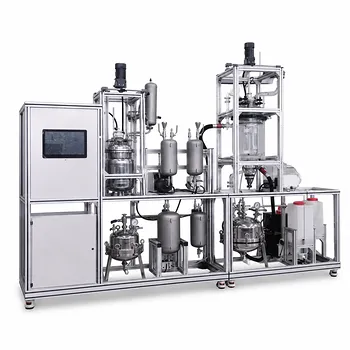
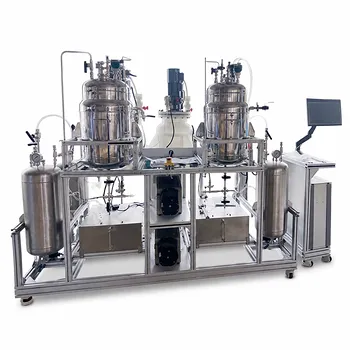
A fractional distillation column, a gas-liquid absorption column, and an electrochemical reactor form the irreducible core of any educational pilot plant targeting bulk inorganic chemicals. These three unit operations directly mirror the industrial backbone of the sector—simulating air separation for nitrogen/oxygen, acid production for sulfuric and nitric acid, and the chlor-alkali process for chlorine. When combined into a single pilot-scale setup, they give students hands-on access to the thermal separation, mass transfer, and electrochemical conversion fundamentals that define modern large-scale inorganic manufacturing.
To teach bulk inorganic chemical production effectively, an educational pilot plant must demonstrate the physical and chemical principles behind the industry’s highest-volume products. The three essential unit operations are fractional distillation, gas-liquid absorption, and electrochemical cells—because they embody the core separation and reaction steps for air gases, mineral acids, and chlorine, respectively.
Why These Three Unit Operations Are Essential for Inorganic Chemical Education
An educational pilot plant isn’t just a collection of hardware. It’s a carefully chosen curriculum in steel and glass. For bulk inorganics, the learning objectives revolve around gas processing, liquid-phase mass transfer, and large-scale electrochemistry. These three unit operations cover that spectrum while maintaining the equipment footprint and safety envelope required for a teaching laboratory.
Fractional Distillation: The Air Separation Paradigm
Air separation is the starting point for the entire industrial gas industry. By including a pilot-scale fractional distillation column, students can replicate the cryogenic liquefaction and distillation of air to produce nitrogen and oxygen.
The unit teaches fundamental thermal separation science—vapor-liquid equilibrium, reflux ratio control, and column efficiency under non-ambient conditions. It also introduces the challenges of handling cryogenic fluids, insulation, and energy integration. This one operation opens the door to discussing the production of billions of cubic meters of industrial gases annually.
Gas-Liquid Absorption: Modeling Acid Production
Sulfuric and nitric acid rank among the world’s most produced chemicals. Their manufacture hinges on gas-liquid absorption steps: absorbing SO₃ in sulfuric acid to make oleum, or absorbing NO₂ in water to form nitric acid.
An absorption column in the pilot plant lets students study countercurrent contacting, mass transfer coefficients, and reactive absorption dynamics. They can change liquid-to-gas ratios, measure concentration profiles, and see how equilibrium limitations affect conversion. It’s a direct, physically transparent model of the heart of the acid industries, without requiring the extreme exothermicity of the full-scale reactor sections.
Electrochemical Reactors: Simulating Chlor-Alkali
The chlor-alkali process is the electrochemical backbone of the inorganic world. An educational pilot plant with an electrochemical unit—using an electrolytic cell, automated gas-liquid separator, and sensors for current density and pH—replicates the production of chlorine, hydrogen, and sodium hydroxide at a safe scale.
Students learn not just Faraday’s laws but real-world factors: current efficiency, electrode passivation, and the stringent safety protocols for handling wet chlorine gas. The unit bridges classroom theory and industrial control, showing how cell voltage, membrane integrity, and brine purity directly affect product quality and energy consumption.
Building a Coherent Pilot Plant Around These Kernels
Isolating these three operations misses the point of a pilot plant. The hardware must be arranged into an integrated sequence that mimics real chemical process flows, allowing students to trace material from raw feed to separated product.
A typical industrial chemical process consists of feed pretreatment, chemical conversion, and product separation. The educational pilot plant should mirror this. A vaporizer or feed filtration unit ahead of the distillation column, for example, demonstrates pretreatment. The electrochemical reactor can serve as the “reaction” step, with downstream gas-liquid absorption for scrubbing or product recovery representing separation. This modular flow-sheet thinking trains students to optimize the entire chain, not just a single unit.
Integrating Pre-treatment, Reaction, and Separation
Use process flow principles from the references: a raw-material preparation stage, a reactor, and multiple separation units. In practice, the absorption column might clean a vent gas stream from the chlor-alkali reactor, or the distillation column might pre-concentrate a feed before electrolysis. By letting students reconfigure these modules, they directly experience the impact of upstream conditions on downstream separation efficiency and overall yield.
Demonstrating Both Batch and Continuous Modes
The shift from batch to continuous manufacturing is reshaping the chemical industry. Your pilot plant should include the ability to run some units in both modes. For example, the electrochemical reactor can be configured for continuous brine electrolysis, while the distillation column inherently functions continuously. Contrasting these with a batch crystallization or reaction step (perhaps an auxiliary module) drives home concepts like residence time distribution, inventory reduction, and real-time process control. This dual-mode capability equips students with the skills modern employers demand.
Understanding the Trade-offs and Considerations
While these three unit operations form a powerful educational core, they have clear limitations that must be acknowledged. An honest, objective view helps you design a more effective and safe laboratory.
- Model systems simplify the chemistry: The pilot absorption column may use CO₂-water or SO₂-air rather than aggressive real-acid systems, reducing hazards but also removing the complexities of corrosive materials and high heats of absorption. Students must be explicitly taught the gap between the model and reality.
- Safety and utility infrastructure is non-negotiable: Electrochemical units producing chlorine demand scrubbed gas handling, corrosion-resistant materials, and forced ventilation. Fractional distillation may require large cooling water flows and electrical capacity for reboilers. Overlooking utility requirements—steam, cooling water, drainage, adequate power—will render even the best-designed unit inoperable. Plan your lab infrastructure around these units first.
- Significant industrial processes are excluded: The three-unit core does not directly model high-pressure catalytic synthesis (ammonia via Haber-Bosch) or high-temperature furnaces for phosphoric acid. You must decide whether the curriculum’s focus on separation and electrochemistry justifies this omission. If ammonia synthesis is a pillar of your program, a catalytic packed-bed reactor module becomes necessary.
Making the Right Choice for Your Educational Goals
The selection of unit operations must align with the specific skills you want your students to carry into industry. Use the following goal-oriented breakdown to guide your configuration.
- If your primary focus is gas separation and cryogenic fundamentals: Center the pilot plant on the fractional distillation column. Augment it with heat integration demonstrations and advanced control strategies for distillation.
- If your primary focus is acid production and mass transfer education: Make the gas-liquid absorption column the star. Add multiple sampling points for concentration analysis and design exercises around column diameter and packing selection.
- If your primary focus is industrial electrochemistry and process safety: Invest in a fully instrumented chlor-alkali cell. Emphasize gas management, membrane technology, and the relationship between cell voltage and current efficiency.
The most versatile educational pilot plant weaves all three operations into a single, reconfigurable flow sheet. That way, students move beyond isolated experiments and into true process integration—the essential skill for any chemical engineer tackling bulk inorganic production.
Summary Table:
| Unit Operation | Industrial Process Mimicked | Key Learning Outcomes |
|---|---|---|
| Fractional Distillation | Air separation ($N_2$/$O_2$ production) | Vapor-liquid equilibrium, thermal separation, reflux control |
| Gas-Liquid Absorption | Acid production ($H_2SO_4$/$HNO_3$) | Countercurrent mass transfer, absorption dynamics, L/G ratios |
| Electrochemical Reactor | Chlor-alkali process ($Cl_2$/$NaOH$) | Faraday's laws, current efficiency, electrochemical safety |
Empower the Next Generation of Chemical Engineers with LABPARK
Are you looking to upgrade your engineering lab with industry-aligned equipment? LABPARK provides state-of-the-art Educational and Vocational Unit Operations Pilot Plants in chemical engineering, bioprocess & biotech, and environmental & water treatment for universities, research institutes, and enterprises.
Our custom-engineered pilot plants enable hands-on learning for fractional distillation, gas-liquid absorption, and electrochemical reactor operations, preparing your students for real-world industrial challenges.
Take the next step in optimizing your lab curriculum—contact us today to discuss your project requirements with our engineering team!
Related Products
- Fixed-Bed Chemical Reaction and Gas Dust Tar Removal Unit Operations Pilot Plant
- Natural Product Extraction Unit Operations Training Pilot Plant
- Multi Pump Fluid Transport Process Piping Unit Operations Training Pilot Plant
- Multi-Modal Distillation Unit Operations Training Pilot Plant
- Ethyl Acetate Synthesis Unit Operations Pilot Plant for Practical Training
People Also Ask
- When to transition from PID to adaptive control in pilot plants? Key process indicators.
- How do deviations in estimating latent heat impact pilot plant thermal systems? Avoid hardware mis-sizing.
- Why Compare Predicted and Experimental Excess Enthalpy? Key to Accurate Pilot Plant Scale-up
- How to study gasification in pilot plants? Compare exit gas composition & efficiency
- Why Use PTFE & Hastelloy in Chemical Pilot Plants? Prevent Corrosion & Ensure Safety