Hydrophilicity, separation size, and chemical resilience are your three decision pillars. When evaluating nanofiltration (NF) membranes for a pilot plant, these three measurable characteristics—Molecular Weight Cutoff (MWCO), contact angle, and pH tolerance—directly translate into the real-world performance you’ll see. A lower MWCO delivers higher retention of target molecules at the cost of throughput, a lower contact angle signals higher water flux and better organic fouling resistance, and a wide pH tolerance gives you the freedom to clean aggressively, which is indispensable for fouling-heavy food or wastewater streams.
Every membrane selection is a deliberate trade-off between purity, productivity, and plant longevity. Understanding how MWCO, contact angle, and pH tolerance interact lets you design a pilot trial that mirrors your full-scale process challenges, not just a single idealized metric.
Molecular Weight Cutoff (MWCO): The Key to Separation Size
What MWCO Really Tells You
MWCO is the molecular weight of a solute at which the membrane achieves 90% rejection. It is not a hard cutoff but a point on a rejection curve, and the shape of that curve determines how cleanly you can separate two similarly sized molecules. A membrane with a 150–300 Da MWCO will retain around 94% of glucose, while one with a 200–300 Da rating may drop that retention to roughly 90% but will let more fluid through.
Throughput vs. Purity in Pilot Plant Practice
A lower MWCO always means a denser selective layer, so the pure water permeability drops. In a food processing pilot plant, opting for a 300 Da membrane to recover a valuable small peptide might sound safer, but the resulting flux could make the process economically unviable. You must decide whether losing a fraction of product to the permeate is acceptable to gain 30–50% more throughput.
The Rejection Curve: Sharpness Matters
Plotting rejection against molecular weight yields an S-shaped curve. A steep curve indicates uniformly sized pores and precise, high-resolution separations; a diffuse curve signals a broad pore distribution and poorer selectivity. For educational or validation pilot runs, feeding standard markers (glucose, cytochrome C, myoglobin, etc.) and constructing this curve is the only way to know if the membrane can truly isolate your target from similar background molecules.
Contact Angle: The Window into Hydrophilicity and Fouling
Hydrophilic Membranes Deliver More Water Faster
A low contact angle means high hydrophilicity. The primary reference shows that a membrane with a 25° contact angle can produce a pure water flux of 120 L/m²h at 6 bar, nearly double the 65 L/m²h of a 46° membrane. In a water treatment or food plant, this translates directly into smaller membrane area requirements and lower energy costs for the same permeate output.
Organic Fouling Resistance Is Built into the Surface
Hydrophilic surfaces attract water and naturally repel many hydrophobic foulants like oils, fats, and proteins. For food processing streams rich in lipids or for surface water containing natural organic matter, choosing the membrane with the lowest feasible contact angle systematically extends operating cycles between cleanings and preserves flux stability.
No Single Angle Fits All Applications
While lower contact angles reduce organic fouling, they can sometimes swell more in certain solvent environments or adsorb specific charged species differently. The pilot plant is your chance to validate whether a given contact angle holds its advantage over hundreds of hours, not just in a 2-hour clean-water test.
pH Tolerance: The Lifeline for Chemical Cleaning
Wide pH Windows Enable Aggressive CIP
Organic and biological fouling in food and wastewater pilot plants is inevitable, and the only way to manage it is thorough Clean-in-Place (CIP). A membrane rated for pH 2–11 can withstand hot caustic washes to strip fats and proteins and acidic washes to dissolve mineral scale. Without this tolerance, you either clean mildly and accept permanent flux decline or risk hydrolyzing the membrane skin and losing selectivity.
Material Choice Directly Affects Acid Resistance
Polymeric membrane stability in extreme pH is not inherent. Sulfonated or specially coated composites maintain stable rejection of ions and small organics while resisting acid-catalyzed degradation. In a pilot plant simulating acidic dairy cleaning solutions or industrial wastewater, selecting an acid-stable NF membrane prevents the data scattering caused by a degrading polymer matrix, which would otherwise be mistaken for a process problem.
Food Safety and Cleaning Validation
In food processing pilot plants, pH tolerance also ties directly to sanitation protocols. A membrane that survives repeated high-pH, high-temperature sanitization cycles without shedding material or losing integrity protects both the product and the trial’s regulatory credibility.
Understanding the Trade-offs
No single membrane can simultaneously deliver the highest retention, the highest flux, and the most universal chemical tolerance. A membrane optimized for low MWCO will inherently sacrifice permeability. An extremely hydrophilic membrane might have a narrower pH stability because its functional groups are more susceptible to hydrolysis. A membrane with a pH range of 1–13 may trade off some selectivity or cost significantly more.
The critical mistake is to select a membrane on a single parameter alone. For instance, chasing the lowest contact angle without checking pH tolerance can result in a membrane that fluxes spectacularly for the first 24 hours and then irreversibly fails during the first aggressive CIP cycle. The pilot plant exists precisely to expose these interactions under realistic cycling conditions.
Making the Right Choice for Your Pilot Plant
The correct membrane selection aligns your most critical process requirement—purity, throughput, or long-term robustness—with the parameter that governs it.
- If your primary focus is maximum product purity or near-complete removal of a small contaminant: Choose a membrane with an MWCO two to three times smaller than your target molecule and verify the rejection curve is sharp.
- If your primary focus is maximizing throughput and minimizing energy costs: Prioritize a low contact angle to secure high flux, and be willing to use a slightly higher MWCO as long as acceptable retention is maintained.
- If your primary focus is long-term pilot reliability on heavily fouling streams: Select a membrane with the widest pH tolerance you can find and validate that its contact angle remains consistent even after multiple CIP cycles.
Only by mapping these three measurable characteristics onto your specific plant’s pain points do you move from a generic membrane trial to a genuinely predictive pilot study.
Summary Table:
| Characteristic | Main Impact | Selection Guideline |
|---|---|---|
| MWCO (Da) | Separation size & product purity | Choose 2-3x smaller than target for high purity; higher MWCO for higher throughput. |
| Contact Angle (°) | Hydrophilicity & fouling resistance | Lower angle increases water flux and repels organic/protein foulants. |
| pH Tolerance | Chemical cleaning (CIP) limits | Wider tolerance (e.g., pH 2–11) allows aggressive washing to restore flux. |
Elevate Your Research with LABPARK Pilot Plants
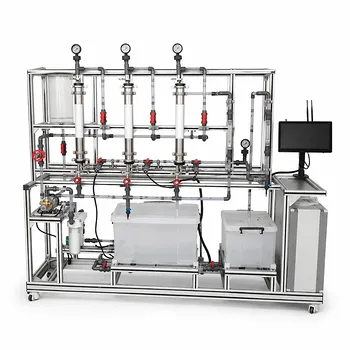
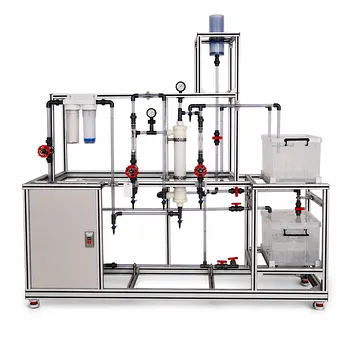
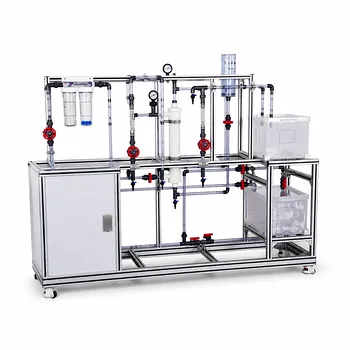
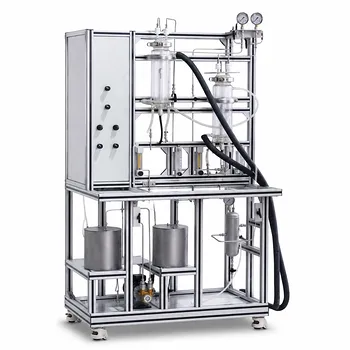
Optimizing nanofiltration processes requires reliable, scalable testing systems. LABPARK provides advanced Educational and Vocational Unit Operations Pilot Plants in chemical engineering, bioprocess & biotech, and environmental & water treatment tailored for universities, research institutes, and enterprises.
Our systems allow you to precisely analyze key parameters like MWCO, contact angle, and fouling under realistic operational conditions. Contact LABPARK today to discuss your pilot equipment needs and request a tailored solution.
Related Products
- Multifunctional Membrane Separation Educational Pilot Plant with Ultrafiltration, Nanofiltration, Reverse Osmosis
- Multi-Functional Membrane Separation Educational Pilot Plant for Unit Operations Lab
- Ultrafiltration Membrane Separation Educational Pilot Plant
- Hollow Fiber Ultrafiltration Membrane Separation Educational Pilot Plant
- Multi Functional Membrane Crystallization Educational Unit Operations Pilot Plant
People Also Ask
- Pervaporation vs. Vapor Permeation: Handling Suspended Solids in Membrane Pilot Plants
- How do PEI, PVDF, and PSU membranes compare in pilot plants? Find the best fit.
- What are the trade-offs of polymer vs inorganic membranes in teaching pilot plants? Key laboratory comparison.
- How can operators optimize operating conditions and cleaning protocols in membrane separation pilot plants to mitigate fouling?
- What are the advantages of membrane separation in pilot plants? Efficient Organic Vapor Recovery