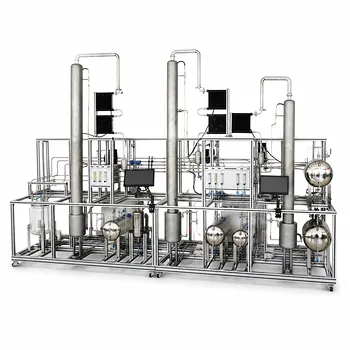
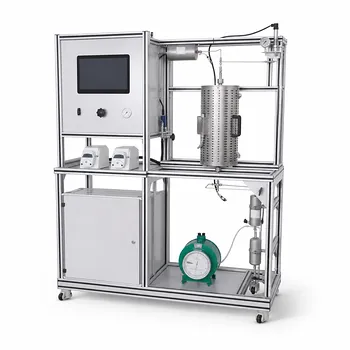
The single greatest operational headache you will face in a dichloropropanol saponification pilot plant is not the reaction itself, but the relentless formation of calcium chloride scale. Running this process at the 98–100°C boiling point with lime milk rapidly creates a high-solids environment where heat exchangers foul, columns clog, and a massive volume of high-salinity wastewater demands a viable treatment strategy. Your pilot plant experience is less about proving the epichlorohydrin chemistry and more about confronting the physical realities of precipitation kinetics and equipment maintainability in a continuous process.
This pilot plant is a definitive sandbox for mastering solids handling and de-scaling protocols. The core takeaway is that your ability to demonstrate a commercially viable process hinges entirely on managing the heat exchanger fouling rate and treating the calcium chloride brine—two challenges that require moving beyond simple stoichiometry to precise control of residence time, mixing energy, and cleaning cycle logistics.
Deconstructing the Scaling Challenge in Real Time
The primary reference correctly identifies the formation of calcium chloride ($CaCl_2$) as the source of operational misery. However, the critical nuance for an academic researcher is understanding why this scale is so destructive in a pilot environment.
The Fouling Mechanism on Hot Surfaces
In your pilot plant, the reaction mixture is a slurry. When this slurry contacts the hotter surfaces of a heat exchanger or a steam-jacketed reactor wall—surfaces above the fluid’s bulk temperature—localized boiling occurs.
This forces calcium salts to precipitate directly onto the metal, forming a hard, insulating crystalline layer. Unlike a simple suspension of solids that can be pumped through a tube, this scale adheres tenaciously and creeps over time.
Heat Transfer Degradation and Runaway Energy Costs
The layer of calcium salt scale acts as a powerful thermal insulator. You will observe a sharp drop in the overall heat transfer coefficient ($U$) within hours, not days.
This forces you to continuously increase steam pressure on the utility side just to maintain the target 98–100°C reaction temperature. In a pilot plant with limited boiler capacity, this quickly becomes a bottleneck, and it’s a stark lesson in how a lack of heat integration makes a process commercially unviable.
Column and Piping Blockages
The scaling is not limited to heat exchangers. Any distillation or stripping column used to recover unreacted dichloropropanol or purify epichlorohydrin will suffer tray or packing fouling.
Pilot-scale columns have smaller clearances than industrial units, making them far more susceptible to complete blockage from solids carryover. Controlling the entrainment of lime solids and precipitated $CaCl_2$ from the reactor to the downstream separation train is your primary separation challenge.
Mastering the Byproduct and Wastewater Dilemma
Producing epichlorohydrin inherently means co-producing a significant mass of dissolved calcium chloride. The pilot plant makes managing this stream an inescapable, real-world problem.
The Criticality of Lime Milk Molar Ratios
The primary reference highlights a 1.10–1.15 molar ratio of $Ca(OH)_2$. This is a deliberately narrow window with a crucial trade-off. Excess hydroxide pushes the reaction to completion but promotes rapid epichlorohydrin hydrolysis to glycerol.
Insufficient lime leaves unreacted chlorohydrin in the product stream, creating a byproduct that contaminates your epichlorohydrin and adds toxicity to the wastewater. Your pilot plant operators must titrate lime milk precisely, learning that a shift in pH here represents a direct yield loss and a purification nightmare downstream.
High-Salinity Wastewater Mechanical Reality
The process generates an aqueous stream saturated with calcium chloride. This isn't a trace element issue; it's a high-volume, high-concentration brine disposal problem.
Your pilot plant will quickly reveal that simple neutralization is insufficient. The sheer mass of dissolved solids means you cannot simply discharge it. Students should map the mass balance of chlorine and calcium to model the total dissolved solids (TDS) load and evaluate integration points for an evaporator or crystallizer to recover calcium chloride as a potential salable solid, thereby closing the water loop.
Understanding the Scale-Down Complexity
While you are studying a specific reaction, the auxiliary references correctly frame this as a classic scale-up/scale-down validation problem. The saponification reaction is rife with scale-sensitive parameters.
Mixing Speed and Solids Suspension
The power required to keep calcium hydroxide solids suspended scales non-linearly with impeller diameter and speed. A perfectly homogeneous suspension in a 1-liter flask will stratify in a 100-liter pilot reactor.
You must use dimensionless numbers (like the Froude number for solids suspension) to predict the minimum impeller speed needed in the pilot plant. Failing to achieve off-bottom suspension results in a pile of unreacted lime at the reactor base, which completely invalidates your kinetic data and makes the Design of Experiments (DOE) results useless.
Heat Removal and Thermal Runaway Risks
The epichlorohydrin saponification is exothermic. As you scale up, the surface-area-to-volume ratio plummets, making heat removal far less efficient.
You will move from an isothermal, perfectly controlled lab beaker to a pilot reactor where localized hot spots can accelerate byproduct formation and even trigger thermal decomposition of epichlorohydrin. Tracking the process signature via multivariate analysis, as the references suggest, becomes mandatory—you’re no longer just tracking product purity but also the thermal history that determines it.
Practical Trade-offs and Pitfalls
Your decision-making in the pilot plant will be a constant exercise in balancing conflicting objectives. Objectivity demands we acknowledge these limits.
The first trade-off is between product yield and equipment run time. Using the recommended 1.15 molar ratio pushes conversion but increases the rate of epichlorohydrin hydrolysis, potentially lowering yield if residence time isn't tightly controlled. Conversely, a lower ratio saves product but leaves more unreacted toxic organics in the brine, increasing your wastewater treatment burden.
The second trade-off involves cleaning frequency versus process continuity. You can institute a rigorous Clean-in-Place (CIP) protocol using diluted acid to dissolve calcium carbonate and chloride scale after every batch, but this tanks your plant uptime and generates secondary waste streams. Alternatively, you can run continuously but must accept a slow, inevitable creep in pressure drop and a gradual shift in heat transfer dynamics that violates steady-state assumptions in your models.
The final pitfall is data interpretation with fouled sensors. Calcium salt scale doesn’t discriminate; it will coat your pH probes and thermocouples as readily as it coats the reactor walls. An operator who isn't routinely verifying instrument readings against grab samples will make critical process adjustments based on drift, not reality. This teaches the vital lesson that a pilot plant’s data is only as trustworthy as its instrumentation maintenance frequency.
Making the Right Choice for Your Research Goal
Your approach to operating this specific pilot plant must be dictated by your primary objective: fundamental process understanding or batch validation.
- If your primary focus is reaction kinetics and yield optimization: Run the reactor as a continuous stirred-tank reactor (CSTR) with tight pH control. Prioritize the rapid quenching of the product stream to instantly stop hydrolysis and avoid the distillation step altogether for your mass balance closure, isolating epichlorohydrin via an alternative separation method like solvent extraction to avoid the scaling of hot columns.
- If your primary focus is industrial process validation and separation science: Accept that you must deal with the scaling. Implement a decanter after the reactor to remove a large portion of the solids before a stripping column. Run extended campaigns to generate data on fouling resistance factors ($R_f$) over time and conduct a techno-economic analysis on the energy cost of continuous operation versus the downtime cost of chemical cleaning cycles.
- If your primary focus is environmental engineering and sustainability: Treat the reactor as a brine generation unit. Focus all analytical effort on characterizing the $CaCl_2$ stream for residual organic contaminants (DCP, epichlorohydrin). Evaluate an oxidative treatment step before evaporation, designing the process not as an epichlorohydrin plant, but as a brine recovery plant with a valuable organic co-product.
This pilot plant is less a fine chemicals synthesis tool and more a rigorous test of your ability to manage a solid-fluid system under thermal stress; master the solids, and you master the process.
Summary Table:
| Challenge | Cause | Mitigation Strategy |
|---|---|---|
| Calcium Chloride Scaling | Localized boiling precipitating salts on heat exchangers | Precise residence time control & Clean-in-Place (CIP) cycles |
| Equipment Blockages | Solids carryover in small-clearance pilot columns | Install a decanter post-reactor to remove solids |
| Byproduct Hydrolysis | Excess lime milk ($Ca(OH)_2$ ratio > 1.15) promoting glycerol formation | Tight control of lime titration and rapid quenching |
| High-Salinity Wastewater | High-volume brine generation ($CaCl_2$ accumulation) | Evaporator/crystallizer integration to recover salt |
Bring Industrial Realities into Your Lab with LABPARK
Mastering complex chemical processes like saponification and scaling mitigation requires hands-on experience with industry-grade systems. LABPARK provides state-of-the-art Educational and Vocational Unit Operations Pilot Plants in chemical engineering, bioprocess & biotech, and environmental & water treatment for universities, research institutes, and enterprises.
Our custom-designed pilot plants empower your students and researchers to safely tackle real-world engineering challenges, from solids handling to process optimization.
Ready to elevate your research and training capabilities? Contact LABPARK today to request a quote!
Related Products
- Electrolyte Distillation Purification and Formulation Educational Pilot Plant
- Bio-fermentation Ethanol Production Practical Training Unit Operations Pilot Plant
- Potassium Salt Thermal Dissolution and Crystallization Separation Educational Unit Operations Pilot Plant
- High-Gravity Emulsification and Mass Transfer Educational Pilot Plant
- Ion Exchange Water Purification Educational Pilot Plant for Engineering Unit Operations
People Also Ask
- Why does simple distillation yield higher efficiency than flash distillation? Key thermodynamic differences.
- How to Integrate Spectroscopy in Distillation Pilot Plants for Advanced Process Control
- How does double temperature difference control improve distillation pilot plants? Stabilize purity.
- How to Verify Distillation Boundary Lines & Composition Regions with Pilot Plants
- Why use non-ideal VLE calculations in distillation pilot plants? Ensure accurate scale-up & purity