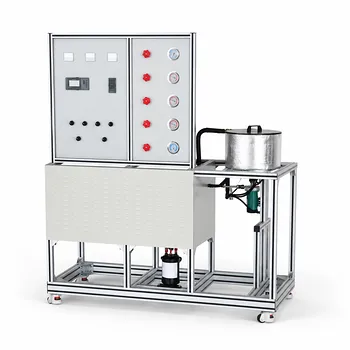
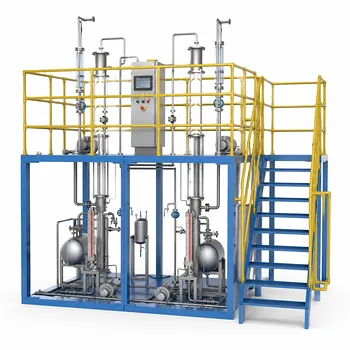
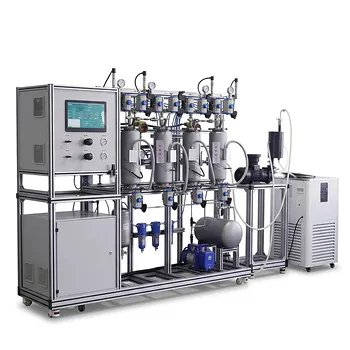
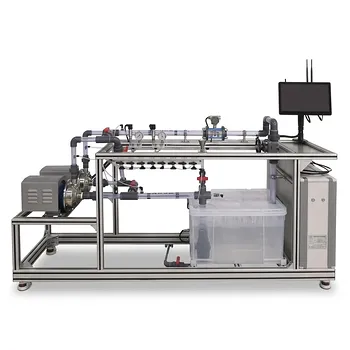
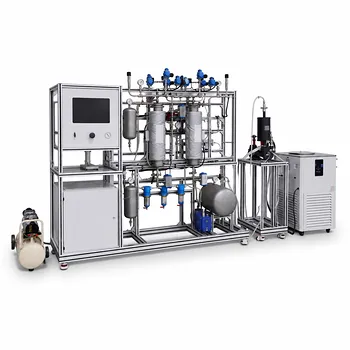
The pressure ratio and flow rate requirements of your gas compression module directly map to distinct compressor categories. In a chemical engineering pilot plant, reciprocating compressors are the go-to for high pressure ratios at low volumetric flow rates, rotary compressors serve moderate discharge pressures with low power consumption, and centrifugal (and axial) machines dominate high-flow applications that operate at comparatively lower pressure ratios. This application envelope is the first, most critical filter for your compressor selection.
The choice of compressor type in a unit operations pilot plant is not a matter of preference—it’s a direct consequence of the process’s required pressure ratio and inlet flow rate. Reciprocating machines give you extreme pressure rise but at limited capacity; centrifugal machines deliver enormous volumes but with a ceiling on per-stage pressure ratio; rotary units sit in the middle, offering steady flow at moderate pressures. Understanding these boundaries is the foundation for a safe, representative, and research-valid system design.
The Operating Envelopes: Pressure Ratio vs. Flow Rate
Every compressor technology has a sweet spot defined by how it converts mechanical energy into gas pressure and flow. In a training or research plant, misapplying an envelope leads to non-representative data, mechanical failure, or hazardous conditions.
How Reciprocating Compressors Dominate the High-Pressure, Low-Flow Zone
Reciprocating compressors are positive-displacement machines that use a piston to physically trap and compress a fixed volume of gas.
This design inherently limits the amount of gas they can move per stroke but allows them to generate extremely high pressure ratios – even up to the 1500–3000 bar range needed for high-pressure polymerization studies. Their typical flow ranges are below about 25,000 actual cubic feet per minute (acfm), and in educational setups they shine when gas rates drop below 10 Mscfd and discharge pressures exceed 2000 psig.
Their efficiency is best described using isentropic efficiency, where the polytropic index equals the heat capacity ratio. For pilot plant students, this makes the thermodynamics straightforward and directly tied to the temperature rise they measure.
The Centrifugal Compressor’s High-Volume, Moderate-Pressure Range
Centrifugal compressors are dynamic machines that accelerate gas via a high-speed impeller and convert the velocity into pressure. They thrive at high inlet flow rates – from roughly 400 acfm up to over 100,000 acfm. Their discharge pressures generally sit between 150 and 4,000 psig, with a practical per-casing limit around 1,000 psig for many common designs.
Because they rely on continuous conversion of kinetic energy, centrifugal machines have no cylinder clearance and therefore suffer no volumetric efficiency losses from residual gas expansion. Their performance is modeled on a polytropic basis, where efficiency depends heavily on inlet volumetric flow. This behavior produces a distinct, non-linear efficiency versus flow curve that students can plot and analyze.
Where Rotary Compressors Fit: Moderate Pressure, Steady Flow, Low Power
Rotary compressors – including screw, vane, and lobe types – are also positive-displacement devices but use rotating elements rather than a reciprocating piston. They naturally produce a relatively uniform flow without the pulsation of a reciprocating machine.
In a pilot plant, rotary compressors bridge a gap: they handle moderate discharge pressures (typically above blowers but below the extreme limits of a reciprocating unit) while consuming less power than a centrifugal for the same low- to mid-range flow. They are particularly valuable when you need to demonstrate steady, continuous compression with low energy input and minimal pulsation dampening.
Why the Pressure Ratio-Flow Rate Envelope Matters in Pilot Plants
The Role of Efficiency Curve Shape in Process Understanding
An educational pilot plant is not just about moving gas – it’s about teaching the thermodynamics. Centrifugal and axial compressors exhibit polytropic efficiency curves that change shape as inlet flow varies. Reciprocating compressors map to an isentropic model with a different shape. By running both types in the same unit operations lab, students overlay these curves and see why a 5,000 acfm process that demands a pressure ratio of 2.5 cannot be served efficiently by a reciprocating machine, and why a 300 acfm stream needing a pressure ratio of 40 will stall a centrifugal impeller.
Mechanical Complexity and Safety Protocols
Pressure ratio does not just dictate the compressor type – it dictates the safety envelope. Reciprocating ultra-high-pressure systems for polymer research introduce risks like plunger gas leakage, fatigue-induced cracking of high-pressure components, or line blockages from thermal decomposition. A pilot plant that includes both a centrifugal module and a reciprocating high-pressure module gives students hands-on experience with the distinct mechanical complexity and safety protocols tied directly to the pressure-flow envelope.
Understanding the Trade-offs
Selecting a compressor for your unit operations module means weighing capacity against pressure capability, and operational simplicity against process realism. These trade-offs are the pedagogical heart of the exercise.
Reciprocating Compressors: Extreme Pressure at the Cost of Flow and Steady Operation
The piston-in-cylinder design provides unmatched pressure head, but comes with inherent limitations: pulsating flow that requires surge volumes, higher maintenance due to valves and rings, and a practical upper capacity limit. For pilot plants aiming to simulate low-rate, high-head reactions, the reciprocating unit is indispensable; for high-volume gas transport loops, it is a poor choice.
Centrifugal Compressors: Smooth, High-Capacity Flow with a Pressure Ceiling
Centrifugals offer high reliability, a smaller footprint, and lower long-term maintenance thanks to their simple rotating assembly. However, they are sensitive to flow turndown – dropping below the surge limit can cause damaging flow reversals. Their discharge pressure per casing is fundamentally limited, so processes demanding extreme pressure ratios either require multi-casing strings or must switch to positive-displacement technology.
Rotary Compressors: The Middle Ground with Power Efficiency
Rotary types provide a steady flow without pulsation and often with lower power consumption than equivalent centrifugal or reciprocating units at moderate conditions. Their main trade-off is a narrower pressure envelope: they cannot reach the ultra-high pressures of a reciprocating compressor, nor the peak flow capacities of a large centrifugal machine.
The Capital Cost and Installation Factor
Even when a rotary or centrifugal compressor can technically cover a pressure-flow point, the bare module cost becomes a deciding factor. Compressors carry a high bare module factor (Fbm) compared to blowers, and the total installed cost escalates with pressure rating, material of construction (e.g., stainless steel for corrosive gases), and required safety reinforcements. A pilot plant with a limited budget must match the pressure-flow point to the most cost-effective compressor type for that exact duty.
Making the Right Choice for Your Goal
Every compressor technology has a concrete operating window defined by pressure ratio and inlet flow rate. Your choice should directly serve the learning outcomes or research mission of the pilot plant module.
- If your primary focus is demonstrating ultra-high-pressure reactions (e.g., polymerization above 1,500 bar): Choose a reciprocating compressor or hypercompressor, and design the system around its low-flow, high-head envelope with rigorous safety protocols.
- If your primary focus is high-volume gas circulation or demonstrating polytropic efficiency behavior: A centrifugal compressor is the standard; ensure the flow rate stays well above surge and that the discharge pressure aligns with the machine’s rated casing limit.
- If your primary focus is steady, energy-efficient compression at moderate pressures: A rotary compressor will give you uniform flow with lower power draw and minimal pulsation, making it an excellent teaching tool for balance-of-plant compression systems.
- If your primary focus is cost-effective versatility in a teaching lab: Consider pairing a small reciprocating compressor (to illustrate high-pressure, low-flow operation) with a centrifugal blower or small rotary unit to cover the broader pressure-flow map, and let students compare isentropic and polytropic efficiency curves side by side.
The pressure ratio you need and the flow rate you must deliver are not afterthoughts—they are the primary forces that dictate whether your pilot plant compressor cradle will hold a piston, an impeller, or a rotary screw. Respect that envelope, and your gas compression module will be a true physical representation of industrial decision-making.
Summary Table:
| Compressor Type | Flow Rate Range | Pressure Capability | Key Pilot Plant Application |
|---|---|---|---|
| Reciprocating | Low (< 25,000 acfm) | Extreme (Up to 3,000 bar) | High-pressure reactions (e.g., polymerization) |
| Centrifugal | High (> 400 acfm) | Moderate (Up to 1,000 psig/casing) | High-volume gas circulation & polytropic studies |
| Rotary | Low to Moderate | Moderate | Steady, energy-efficient flow with low pulsation |
Configure Your Next Unit Operations Lab with Confidence
Are you looking to equip your laboratory with robust, industrially relevant gas compression and fluid dynamics systems? LABPARK provides state-of-the-art Educational and Vocational Unit Operations Pilot Plants in chemical engineering, bioprocess & biotech, and environmental & water treatment.
Tailored for universities, research institutes, and enterprises, our pilot plants offer students and researchers hands-on experience with thermodynamic modeling, safety protocols, and real-world process scaling.
Contact us today to discuss your laboratory specifications and receive a customized quote!
Related Products
- Educational Compression Refrigeration Performance Determination Unit Operations Pilot Plant
- Dual-Mode Gas Absorption and Desorption Unit Operations Training Pilot Plant
- Multi-Component Gas Pressure Swing Adsorption Pilot Plant for Unit Operations Education
- Absorption and Desorption Educational Unit Operations Pilot Plant
- Centrifugal Pump Performance Determination Educational Unit Operations Pilot Plant
People Also Ask
- Why Switch Unit Operations Flow Configurations? Impact on Experimental Measurements
- Why is distinguishing between elastic and plastic deformation critical? Prevent tablet capping.
- How is unsteady-state flow analyzed & taught? Master Transient Systems in Unit Ops
- What are the differences between set-point, servo, and program control? Master unit operations training.
- How to use pilot plants to estimate gas compression costs? Master scale-up economics.