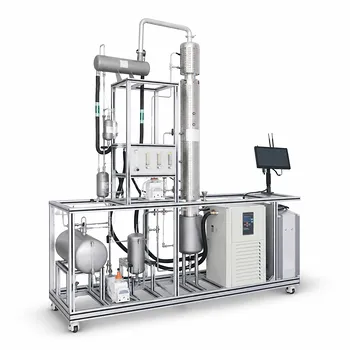
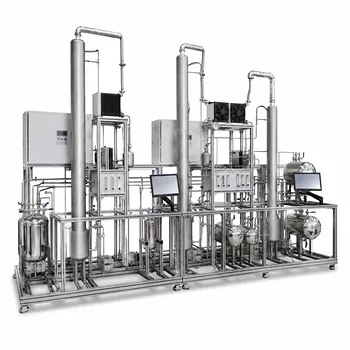
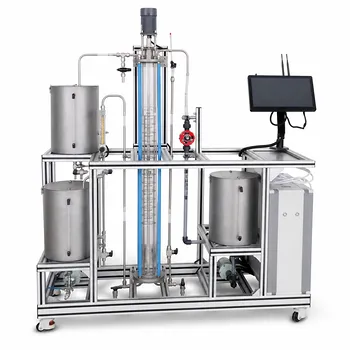
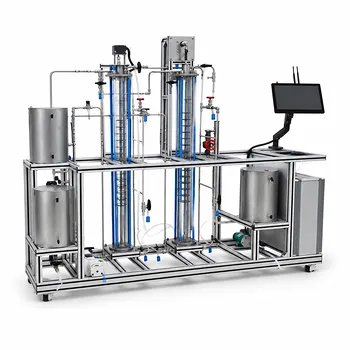
To study the separation of azeotropic mixtures in a pilot plant, you need a column equipped with precise multi-point temperature monitoring, multiple feed ports for both the raw feed and the entrainer, and a finely adjustable reflux control system. These features are non-negotiable because the azeotrope itself is a point where liquid and vapor compositions become identical—traditional distillation alone cannot break it. The design must empower you to map the temperature profile across the column, pinpoint the optimal injection location for the mass-separating agent, and dynamically manipulate the reflux ratio to achieve target purity under ever-changing conditions.
The core purpose of an azeotropic distillation pilot plant is not just to separate—it’s to make the invisible liquid-liquid-vapor equilibrium visible. Every design choice, from the number of temperature sensors to the flexibility of the feed system, serves to give you real-time, quantitative control over the ternary interactions that make breaking an azeotrope possible.
The Non-Negotiable Core: Instrumentation and Flexibility
The primary reference highlights three irreducible design requirements. Without these, you are running a blind experiment.
Precision Temperature Profiling at Multiple Stages
Azeotropic systems exhibit flat temperature zones near the pinch point. Mapping this profile is the key to identifying the azeotropic composition and entrainer effect.
You need thermocouples or RTDs spaced along the column height, not just at the top and bottom. The data these sensors provide allows calculation of stage efficiency, detection of entrainer breakthrough, and direct comparison with thermodynamic models. This turns the pilot plant into a research tool, not just a demonstration unit.
Multiple Feeding Ports for Both Feed and Entrainer
A single fixed feed point makes the column a prisoner of its initial assumption. You must be able to shift the feed locations to optimize separation while the experiment is running.
The raw azeotropic mixture and the entrainer often enter at different heights—typically the entrainer near the top to create a new low-boiling ternary azeotrope that carries water overhead. To study the process, you require multiple valved ports on the column shell. This lets you test how the feed tray location impacts the minimum reflux ratio and bottom product purity, and it enables you to isolate the effect of entrainer flow rate independent of the main feed.
An Adjustable Reflux Control System
Purity and thermodynamic efficiency are tied to the reflux ratio. A pilot plant must allow smooth, controllable variation of reflux to map the performance landscape.
A manual or automated reflux splitter (timed solenoid or valve) is essential. You’ll use it to find the minimum reflux condition, push the column toward high-purity production runs, or study the onset of flooding. Without this control, you can’t perform the core calculation that determines the number of theoretical stages required for the desired separation.
Expanding the System: Mimicking Industrial Azeotropic Configurations
A single distillation column in isolation teaches vapor-liquid equilibrium. But to truly study azeotropic separation, you often need to configure the pilot plant as a multi-column system with a decanter, replicating the industrial workflow.
The Three-Column, Two-Liquid-Phase Setup
For a classic ethanol-water-benzene system, a single column shows the principle; three interconnected columns unlock the process. The pilot plant should allow modular reconnection of columns, condensers, and decanters.
In the first column, pure ethanol leaves the bottom while a ternary vapor (with entrainer and water) goes overhead. The vapor is condensed and flows to a decanter, where it splits into a solvent-rich phase and a water-rich phase. The solvent phase recycles to the first column, while the water phase feeds a second column that strips the entrainer. A third column cleans the final water. Including a decanter in the pilot plant scale is critical for studying vapor-liquid-liquid equilibria (VLLE), phase-separation dynamics, and the impact of entrainer recycle purity on overall yield.
Vapor-Overhead Heat Integration
Energy consumption is a major deep need in studying azeotropic distillation. To convert the pilot plant into a true process optimization tool, integrate a heat recovery loop.
A supplementary reference describes using the latent heat from the first column’s overhead vapor to preheat or boil a downstream feed stream. Even at pilot scale, installing a secondary heat exchanger that condenses the overhead vapor against a cold process stream lets you measure the trade-off between capital cost and utility savings. This teaches the core principle of azeotropic heat integration without requiring a full industrial steam network.
Beyond the Design: The Operational Phenomena You Must Observe
A well-designed pilot plant is useless if you ignore the physical events happening inside the column. Studying azeotropic separation demands direct observation of hydraulic and mass-transfer limits.
Mapping Flooding, Weeping, and Entrainment
These hydrodynamic phenomena define the operating window. The column must be transparent at the bench scale or have multiple differential pressure transmitters at pilot scale.
By systematically raising the vapor or liquid load, you can identify the loading point, then the flood point. With azeotropic systems, the presence of two liquid phases on a tray changes froth height and jet-flood behavior. This real-world behavior is impossible to predict from VLE data alone, making it a vital part of the learning objective.
Heuristics for Sequencing Multiple Separations
If the azeotropic mixture involves more than two components, you’ll eventually study column sequencing. The pilot plant should let you test heuristic rules: remove high-volume components first, isolate corrosive species early, and leave the hardest (closest-boiling) separation for the last column.
This avoids the trap of running a small column at an astronomically high reflux ratio for the most difficult split, which can hide flooding and inefficiency. The modular feed locations and inter-column piping must let you rearrange the column sequence to validate these industrial guidelines.
Understanding the Trade-offs: Extractive vs. Azeotropic Distillation
Your deep need isn't just to build a column; it’s to choose the right separation strategy. The pilot plant configuration shifts significantly between these two methods, and you must understand the trade-offs.
Energy and Mode Flexibility
Azeotropic distillation requires vaporizing the entrainer, consuming more energy, but it works well in batch mode for multi-product pilot studies.
Extractive distillation uses a high-boiling solvent that stays in the liquid phase, saving energy and protecting heat-sensitive components, but it is inherently a continuous operation.
If your pilot plant must support both academic batch experiments and small-scale continuous production, the azeotropic route with a heated entrainer feed system and condensers sized for the extra vapor load is more flexible. If your focus is energy benchmarking for a specific industrial process with a non-volatile solvent, an extractive distillation column with a high-capacity reboiler and a solvent recovery section is the right tool. Your pilot plant’s feed preheating and reboiler duty specifications will directly reflect this choice.
Equipment and Measurement Pitfalls
When switching from one method to another, operators often miss that extractive distillation alters the column pressure drop profile due to the liquid-phase solvent increasing the overall liquid load. Pressure taps must be placed across every tray or packing section to detect this shift. Similarly, in azeotropic distillation, a poorly sized decanter can short-circuit the separation, sending entrainer into the water waste. A pilot plant decanter must be oversizeable and have clear sight glasses to observe the emulsion layer.
How to Configure Your Pilot Plant for Maximum Learning
Your configuration depends on your primary research or teaching goal. Design the system around the question, not the other way around.
- If your primary focus is fundamental VLLE data collection: Prioritize a single, highly instrumented column with a decanter, as many temperature points as possible, and a transparent section. This lets you map the ternary diagram accurately.
- If your primary focus is process optimization and energy studies: Build a multi-column system with modular re-piping, vapor-overhead heat integration capabilities, and individual reflux control on each column to test sequencing heuristics and energy recovery.
- If your primary focus is comparing entrainer options and modes: Size the feed system for both volatile entrainers (azeotropic) and non-volatile solvents (extractive). Include a solvent recovery column and ensure the reboiler can handle the higher liquid circulation rates of extractive mode.
- If your primary focus is hydrodynamic visualization: Use a glass column, run it with the chosen azeotropic system, and deliberately push it into flooding and weeping to build an intuitive understanding that no simulation can provide.
A well-configured azeotropic distillation pilot plant becomes a physical calculator for thermodynamics, giving you the data you need to unlock separations that textbooks say are impossible.
Summary Table:
| Key Design Feature | Function in Pilot Plant | Research/Educational Value |
|---|---|---|
| Multi-Point Temp Monitoring | Maps the column temperature profile | Identifies pinch points & entrainer breakthroughs |
| Multiple Feed & Entrainer Ports | Allows variable injection locations | Optimizes feed tray configuration & reflux ratios |
| Adjustable Reflux Control | Dynamically manipulates the reflux ratio | Defines minimum reflux limits & operating windows |
| Decanter Integration | Separates organic & aqueous phases | Enables the study of Vapor-Liquid-Liquid Equilibria (VLLE) |
| Modular Column Setup | Simulates multi-column industrial loops | Teaches process sequencing & heat integration |
Scale Up Your Chemical Engineering Research & Training with LABPARK
Are you looking to build or upgrade your laboratory's distillation capabilities? LABPARK provides high-quality, customizable Educational and Vocational Unit Operations Pilot Plants in chemical engineering, bioprocess & biotech, and environmental & water treatment.
Designed specifically for universities, research institutes, and enterprises, our pilot plants empower you to bridge the gap between thermodynamic theory and industrial reality. From standard setups to advanced multi-column configurations, we deliver the precision and flexibility your research demands.
Ready to configure your system? Contact LABPARK Today to discuss your project requirements and receive a detailed technical proposal.
Related Products
- Multi-Functional Special Distillation Educational Pilot Plant
- Continuous Sieve-Plate Distillation Pilot Plant for Unit Operations Laboratory Education
- Continuous Batch Extractive Distillation Educational Pilot Plant
- Multi-Modal Distillation Unit Operations Training Pilot Plant
- Dual-Mode Rectification Pilot Plant for Practical Training Unit Operations
People Also Ask
- Why does simple distillation yield higher efficiency than flash distillation? Key thermodynamic differences.
- How does double temperature difference control improve distillation pilot plants? Stabilize purity.
- Why is the acentric factor important in pilot plants? Fluid property prediction.
- How Batch vs Continuous Configuration Affects Distillation Pilot Plant Versatility & Footprint
- How to Integrate Spectroscopy in Distillation Pilot Plants for Advanced Process Control