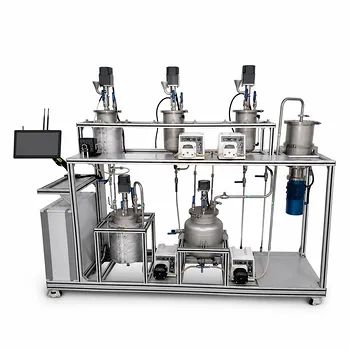
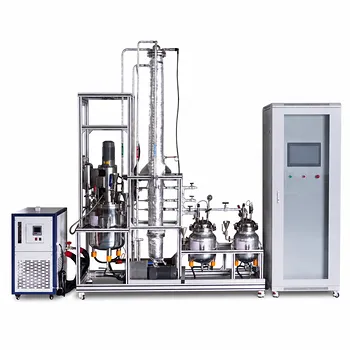
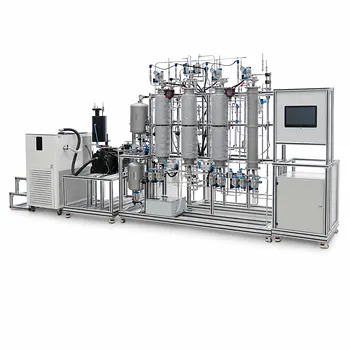
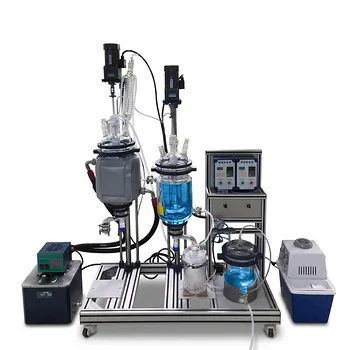
Precise temperature control and effective agitation are the twin pillars of a successful PVC suspension polymerization pilot plant. For a teaching unit operations facility, the essential configurations center on a jacketed reactor with variable‑speed agitation and optimized baffles, a high-accuracy temperature control loop capable of maintaining ±0.2 °C, and a complete downstream train for particle separation, drying, and unreacted vinyl chloride monomer (VCM) recovery. Getting these elements right turns a complex, highly exothermic dispersion process into a safe, reproducible educational platform that teaches core reaction engineering, heat transfer, and process control principles in one integrated system.
The central challenge is managing the intense exotherm while preserving the stability of the monomer droplets suspended in water. Success hinges on a reactor that provides uniform shear and rapid heat removal, a control system that anticipates and reacts to temperature changes within a fraction of a degree, and closed‑loop handling of VCM to meet both safety and learning objectives.
Reactor Design and Agitation
Suspension polymerization succeeds only when the monomer phase remains dispersed as stable, discrete droplets throughout the reaction. This places strict demands on the reactor’s mechanical design and hydrodynamic behavior.
Variable‑Speed Agitation and Baffle Design
The reactor must be equipped with a variable‑speed agitator and carefully sized baffles. Agitation performs two critical jobs: it disperses the liquid VCM into small droplets and it promotes heat transfer by continuously moving the bulk fluid past the cooling surfaces. Fixed‑speed drives are insufficient because the required shear changes with droplet size, viscosity evolution, and desired final particle morphology. Baffles prevent vortexing and convert tangential flow into top‑to‑bottom mixing, eliminating dead zones where coalescence could occur.
Maintaining Droplet Stability
Without proper hydrodynamics, droplets coalesce, leading to uncontrolled agglomeration and a useless product. The agitator type (typically a pitched‑blade turbine or marine impeller on a teaching‑scale unit) and its tip speed must be selected to provide enough shear for dispersion without breaking the protective colloid film that stabilizes each droplet. Pilot‑scale reactors for teaching should include a window or sight glass so students can visually observe the dispersion quality at the start of the run, linking theory to observable process behavior.
Temperature Control: The Critical Parameter
The molecular weight of PVC is determined almost entirely by the polymerization temperature, not by any chain transfer agent addition. A deviation of just half a degree shifts the K‑value significantly, making temperature the most demanding control variable in the entire plant.
The ±0.2 °C Tolerance
The reaction operates in the narrow range of 45 °C to 65 °C with a required accuracy of ±0.2 °C. At the peak exotherm, the heat generation can spike dramatically. A jacketed glass or steel vessel with a high‑surface‑area cooling circuit is the baseline requirement, but the real precision comes from the cooling water flow control. The flow must be modulated with a fast‑acting control valve on the jacket supply or return line, and the temperature sensor must be in direct contact with the reacting mixture, not just the jacket fluid.
Implementing Cascade Control
For an educational pilot plant, a cascade control strategy is ideal. The master loop measures the reactor internal temperature and sends a setpoint to a slave loop that controls the jacket temperature or cooling water flow. This configuration compensates for variations in cooling water temperature and pressure while teaching students advanced control architecture. At minimum, the data acquisition system should log both the reactor and jacket temperatures at 1‑second intervals so students can analyze the dynamic heat balance.
Downstream Processing and VCM Recovery
A teaching plant that stops at the reactor misses the real‑world challenges of product isolation and monomer recovery, both of which carry profound safety and economic implications.
Particle Separation and Drying
After polymerization, the slurry contains PVC particles and water plus residual monomer. A centrifuge or pressure filter separates the solid resin beads from the aqueous phase. The choice of equipment should prioritize ease of cleaning and visibility (e.g., a small basket centrifuge with a transparent lid) so that students can observe the dewatering cycle. The damp cake must then be dried in a fluidized bed or tray dryer at temperatures below the glass transition point to avoid particle agglomeration.
Unreacted Monomer Recovery
Vinyl chloride is both a hazardous carcinogen and a valuable material. The pilot plant must include a monomer recovery system that captures unreacted VCM from the reactor headspace, the slurry let‑down tank, and the dryer exhaust. This typically involves a condensation train (chilled water followed by a low‑temperature condenser) or an absorption column. The system not only ensures a safe working environment but also gives students the opportunity to calculate monomer conversion, material balance closure, and the environmental impact of the process.
Integrating the Pilot Plant Control System
The control philosophy for an educational unit operations plant must be robust enough to protect equipment and personnel while remaining open enough for students to experiment with different tuning and strategies.
Applying Fundamental Control Rules
Standard process control rules directly shape the P&ID of the PVC pilot plant. One control valve per stream prevents fighting between loops, so the cooling water circuit must have a single modulating valve. The VCM feed line should be governed by a flow regulator that also sets the overall material balance. Any gas‑liquid interface, such as the level in a recovery knock‑out drum, requires a dedicated level controller with the control valve placed on the pump discharge, not the suction, to preserve hydraulics.
Material Balance and Feed Control
The main water charge is usually batch‑wise, but the VCM monomer may be metered continuously in some teaching exercises to simulate semi‑batch operation. The overall material balance is established by the flow controller on the monomer feed line, which then cascades to ratio controllers for any additives. This setup teaches students how industrial plants reconcile batch and continuous operations while maintaining strict stoichiometric and thermal constraints.
Trade‑offs and Educational Pitfalls
Designing for pedagogy introduces a tension between industrial realism and operational simplicity. Ignoring these trade‑offs leads to a plant that is either too dangerous to use or too sterile to teach.
- Safety vs. Visibility: A fully enclosed, automated plant is safer but turns students into passive observers. Using borosilicate glass reactors and transparent rotameters increases engagement but demands robust fume extraction and VCM monitoring.
- Automation vs. Manual Skill: An advanced DCS with pre‑tuned cascade loops protects the reaction but denies students the experience of manually tuning a temperature loop. The best systems provide both a “protected mode” and a “tuning sandbox” where students can safely oscillate a loop and learn from the consequences.
- Utility Sizing: A common oversight is underestimating the peak cooling water demand. The plant’s utilities (chilled water, electrical supply for the agitator drive, instrument air) must be sized for the maximum exotherm rate, not the average. Inadequate cooling water pressure during the peak exotherm will cause a temperature runaway even if the control logic is perfect.
- VCM Handling Complexity: Real monomer recovery loops require low‑temperature condensation or absorption, which adds capital cost. However, omitting this step wastes VCM and poses exposure risks that are unacceptable in a teaching lab.
Making the Right Choices for Your Teaching Objectives
The configuration of the plant must align with what you most want your students to learn. Use the following guide to prioritize your investment.
- If your primary focus is reaction kinetics and polymer fundamentals: Invest heavily in the reactor’s temperature measurement and agitation system. A glass vessel with a high‑accuracy RTD, a transparent jacket, and a simple manual‑to‑cascade selectable loop will give students deep insight into the exotherm and molecular weight control.
- If your primary focus is advanced process control: Configure the plant with multi‑loop capability from the start. Implement cascade control on the jacket, ratio control on additive dosing, and provide a programming interface for students to write custom split‑range or feedforward algorithms.
- If your primary focus is holistic unit operations and process safety: Prioritize the complete downstream train and VCM recovery. Include a centrifuge, dryer, and condensation system with an integrated gas detection and emergency shutdown system. The control system should include permissive interlocks that prevent opening the reactor until VCM concentration is below a safe threshold.
- If your primary focus is scale‑up and industrial relevance: Choose a pilot reactor that mimics an industrial geometry (e.g., slightly taller aspect ratio, true baffle design) and equip it with a DCS that mirrors plant‑level historian and alarm management tools. Use the same type of dispersing agents and initiators found in full‑scale production so students see real particle size distributions.
Deliberately choosing what students touch versus what remains behind a panel turns a complex vinyl chloride polymerization line into one of the most powerful teaching tools in chemical engineering education.
Summary Table:
| System Component | Key Configuration | Educational Value |
|---|---|---|
| Reactor & Agitation | Jacketed vessel, variable-speed agitator, and optimized baffles | Teaches droplet stability, shear, and fluid dynamics |
| Temperature Control | Cascade control loop (±0.2°C accuracy) with fast-acting valves | Teaches exotherm management, dynamics, and loop tuning |
| Downstream & Recovery | Visible centrifuge, dryer, and closed-loop VCM recovery | Teaches separation, mass balance, safety, and emissions control |
Bring Industrial-Scale Learning to Your Lab
Ready to equip your students with real-world process engineering skills? LABPARK provides premium Educational and Vocational Unit Operations Pilot Plants in chemical engineering, bioprocess & biotech, and environmental & water treatment. Tailored for universities, research institutes, and enterprises, our systems offer the perfect balance of hands-on visibility and advanced control.
Contact LABPARK today to customize a pilot plant tailored to your curriculum and safety requirements!
Related Products
- Polymerization Granulation and Pellet Processing Educational Unit Operations Pilot Plant
- Ethyl Acetate Synthesis Unit Operations Pilot Plant for Practical Training
- Solid Waste Pyrolysis and Refining Educational Pilot Plant for Unit Operations
- Natural Product Extraction Unit Operations Training Pilot Plant
- High-Gravity Emulsification and Mass Transfer Educational Pilot Plant
People Also Ask
- How do educational unit operations pilot plants address safety and waste management when scaling up?
- How do educational unit operations pilot plants bridge theory and design? Bridge the Engineering Gap
- What role do educational pilot plants play in scaling green chemistry? Bridging the Lab-to-Industry Gap
- Why Compare Predicted and Experimental Excess Enthalpy? Key to Accurate Pilot Plant Scale-up
- When to transition from PID to adaptive control in pilot plants? Key process indicators.