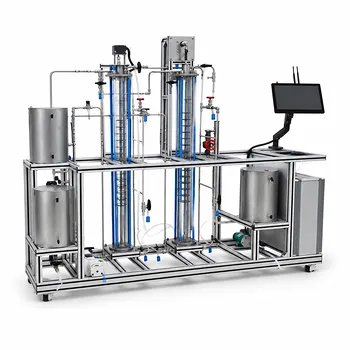
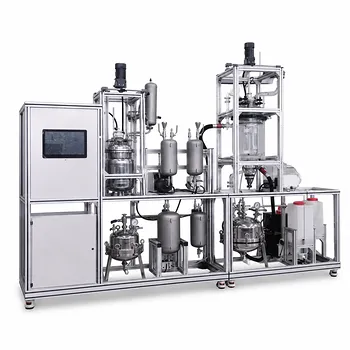
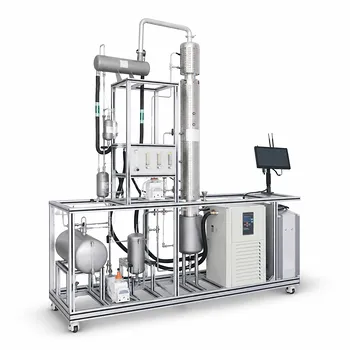
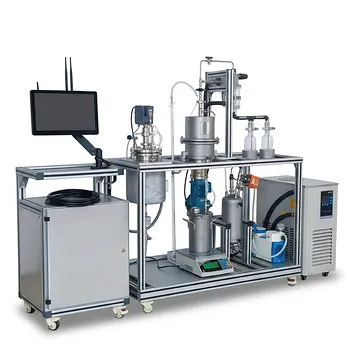
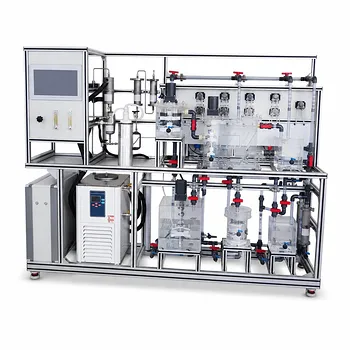
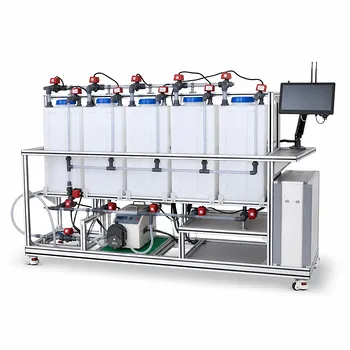
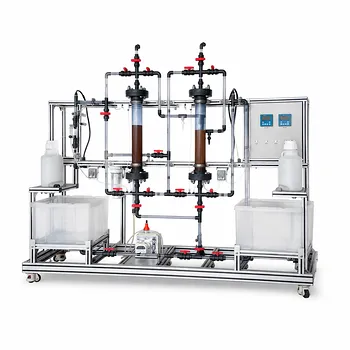
The core pilot-plant units for demonstrating silver hydrometallurgy are a liquid–solid extraction (leaching) system, a stirred-tank precipitation reactor, and an integrated filtration unit. Together, these mimic the two pivotal process steps: selectively dissolving silver from the ore and then recovering it as a metallic precipitate.
While many unit operations exist, the classic teaching line‑up—leaching pilot plant, stirred‑tank reactor, and filtration pilot plant—directly mirrors the industrial sequence. They allow systematic optimization of dissolution kinetics, chemical displacement, and solid–liquid separation under conditions that bridge the gap between bench‑scale chemistry and plant‑scale reality.
The Leaching Stage: Liquid–Solid Extraction Pilot Plant
Why a dedicated leaching pilot plant is essential
Silver rarely exists in a free‑milling form; it is locked inside sulfide matrices or complex ores. The leaching pilot plant is where the first critical transformation occurs: converting insoluble silver minerals into a soluble species that can be handled entirely in the liquid phase.
How it simulates industrial dissolution
The unit typically consists of a packed column or a series of agitated vessels where crushed ore is contacted with a lixiviant—most commonly a dilute cyanide solution or, in sulfate‑based routes, hot water/sulfuric acid. Students can vary particle size, temperature, reagent concentration, and residence time to map leaching kinetics.
Key parameters you can study
Using a pilot‑scale leaching rig, the influence of mass transfer, pore diffusion, and chemical reaction rate becomes tangible. You can measure the extraction yield versus time and identify whether leaching is diffusion‑ or reaction‑controlled—a insight that directly shapes reactor sizing in a full‑scale plant.
The Precipitation Reactor: Stirred‑Tank Reductive Displacement
The role of the stirred tank in silver recovery
Once silver is in solution—for instance, as a silver–cyanide complex—it must be converted back to a solid metal. A stirred‑tank reactor serves as the controlled environment where a reducing agent, such as copper shavings or zinc dust, is added to displace and precipitate metallic silver.
Why mixing and residence time matter
The precipitation reaction is fast but sensitive to local concentration gradients. A pilot‑scale stirred vessel lets you examine impeller speed, baffling, and feed point location to avoid hot spots that cause passivation or incomplete precipitation. By measuring the final silver recovery and particle size distribution, you tie mixing efficiency directly to product quality.
Bridging to the next step
At this stage, the contents are a slurry of finely divided silver particles suspended in a spent lixiviant. The immediate challenge becomes how to isolate those particles without losing yield—which leads directly to the filtration pilot plant.
The Filtration Pilot Plant: Turning Slurry into Solid Product
Demonstrating solid–liquid separation at scale
An integrated filtration pilot plant—often a vacuum filter, pressure filter, or a laboratory‑scale filter press—receives the slurry from the precipitation reactor. Its job is to produce a clean filtrate (which may be recycled) and a silver‑rich filter cake that can be assayed or smelted.
What makes filtration a teachable unit operation
Students measure filtration rate, cake resistance, and media blinding. By altering precipitation conditions, they see first‑hand how crystal size and shape influence downstream separation. This closes the feedback loop: a poorly designed precipitation step creates a gelatinous precipitate that clogs the filter, underscoring the interdependence of unit operations.
Understanding the Trade‑offs in Pilot‑Scale Silver Extraction
Batch versus continuous operation
Most educational pilot plants run in batch mode for simplicity. However, industrial circuits often operate continuously with series of leaching tanks and a thickener. Batch data must be translated carefully; constant‑composition kinetics measured in a small, well‑mixed vessel can mislead if you ignore the residence time distribution of a cascade.
Safety and reagent handling
Leaching with cyanide demands rigorous safety protocols, even at pilot scale. The pilot plant must include secondary containment, gas detection, and emergency scrubbers. These constraints mean that the equipment is more than a process demonstrator—it’s a tool for embedding safe‑by‑design thinking.
The representativeness gap
Silver ores are heterogeneous. A pilot study using a high‑grade concentrate may not predict performance with a low‑grade, fine‑grained ore. Always cross‑check the mineralogy and consider adding a front‑end crushing/grinding pilot unit if the feed size is a variable.
How to Apply This to Your Laboratory or Training Program
- If your primary focus is leaching kinetics: Invest in a modular leaching pilot plant that allows you to switch between packed‑bed columns and agitated vessels, and pair it with real‑time analytical feedback.
- If your primary focus is precipitation control and purity: Build your setup around a jacketed stirred‑tank reactor with precise reagent dosing, and add an inline turbidity sensor to monitor the precipitation endpoint.
- If your primary focus is overall process integration: Link the leaching, precipitation, and filtration units into a closed‑loop system, and challenge students to optimize the entire line against a target silver recovery and filtrate clarity.
The right pilot‑plant configuration turns abstract extraction chemistry into a tangible design challenge, equipping you with the data and intuition to scale silver recovery with confidence.
Summary Table:
| Unit Operation | Pilot Plant Equipment | Key Parameters & Process Metrics |
|---|---|---|
| 1. Leaching Stage | Packed column / agitated vessels | Kinetics, extraction yield, mass transfer, reagent concentration |
| 2. Precipitation | Stirred-tank reactor | Mixing efficiency, recovery rate, impeller speed, residence time |
| 3. Filtration | Vacuum/pressure filter or filter press | Filtration rate, cake resistance, solid-liquid separation efficiency |
Scale Up Your Chemical Engineering Lab with LABPARK
Are you looking to bridge the gap between classroom chemistry and industrial reality? LABPARK provides premium Educational and Vocational Unit Operations Pilot Plants in chemical engineering, bioprocess & biotech, and environmental & water treatment designed specifically for universities, research institutes, and enterprises.
From modular leaching systems to advanced stirred-tank reactors and filtration units, our equipment helps your students and researchers master practical process optimization with ease.
Contact LABPARK today to find the perfect pilot plant solution for your institution!
Related Products
- Comprehensive Liquid-Liquid Extraction Pilot Plant for Engineering Education
- Natural Product Extraction Unit Operations Training Pilot Plant
- Continuous Batch Extractive Distillation Educational Pilot Plant
- Rising and Falling Film Evaporation Educational Unit Operations Pilot Plant
- Solid Waste Pyrolysis and Refining Educational Pilot Plant for Unit Operations
People Also Ask
- How do pilot plants differentiate physical vs chemical extraction? Enhance Chemical Engineering Training
- How are ternary phase diagrams and LLE data applied in extraction experiments? Optimize Pilot Plant Scale-up
- How to Validate BIPs for LLE Pilot Plants? Steps to Align Simulations with Reality
- In a liquid-liquid extraction pilot plant, how is a ternary-phase diagram utilized to determine solvent feed requirements?
- How Do Selectivity & Distribution Coefficients Influence LLE Pilot Plant Solvent Choice?