The answer is that unit operations pilot plants serve as the essential physical bridge between textbook theory and industrial reality for the entire copper extraction process. For teaching and research, they provide a safe, controlled, and measurable environment where students and researchers can sequentially link and study the complex chemical and physical transformations required to convert copper ore into blister copper. The core value lies in moving beyond isolated lab tests to understand the critical interdependencies between stages like flotation, roasting, smelting, and converting.
The overwhelming volume of data available online can often obscure the fundamental principles. The key challenge is not just understanding each copper extraction step in isolation, but grasping how a decision at one stage cascades through the entire multi-stage process, impacting efficiency, quality, and environmental controls. Unit operations pilot plants are the definitive physical tool for mastering this system-level thinking.
Deconstructing the Multi-Stage Copper Process with Pilot Plants
Copper extraction from a sulfidic ore like chalcopyrite is not a single event. It is a carefully choreographed sequence of physical and chemical operations. A pilot plant is the only practical way to replicate this entire chain in an academic setting.
From Ore to Metal: The Sequential Journey
The primary reference correctly outlines the major stages. We start with an ore body and must progressively concentrate and chemically convert it.
The first challenge is physical separation. Run-of-mine ore has far too little copper to be processed directly. Flotation, a unit operation, uses chemical reagents to render copper minerals hydrophobic, allowing them to be separated from the waste rock (gangue) in a slurry.
The next phase is chemical conversion. The resulting concentrate is primarily an iron-copper sulfide. It cannot go directly to a smelter. Roasting, a gas-solid reaction unit operation, partially oxidizes the sulfides at high temperature. This transforms some iron sulfide to an oxide form and removes sulfur as gaseous SO2.
The core of the process is smelting. The roasted material is fed into a high-temperature furnace. This is the smelting unit operation. Here, iron oxides react with silica flux to form a molten slag, while copper remains bound with sulfur as a molten mixture called copper matte.
The final transformation is converting. The molten matte is transferred to a converter, the final reactor. By blowing air through it, the remaining sulfur is oxidized to SO2, and the copper is finally liberated as blister copper, a roughly 98-99% pure metal ready for electrorefining.
The Pilot Plant’s Role in Teaching System Integration
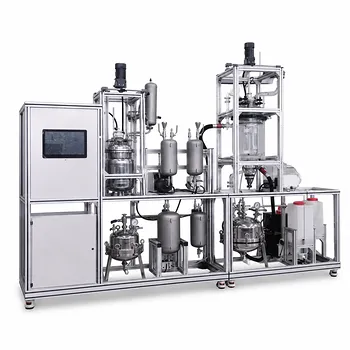
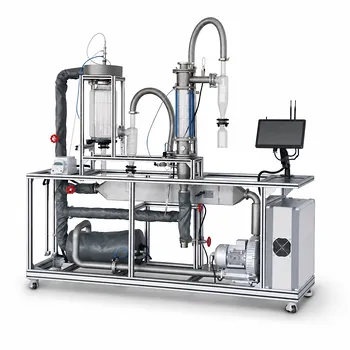
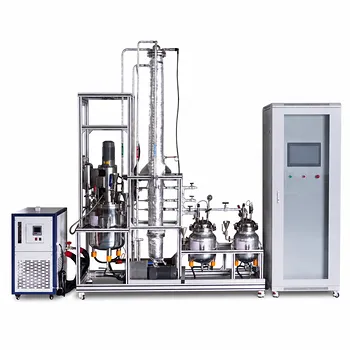
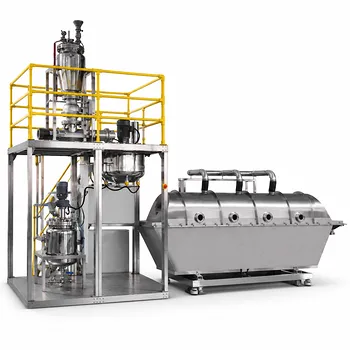
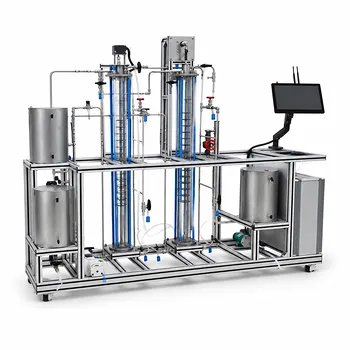
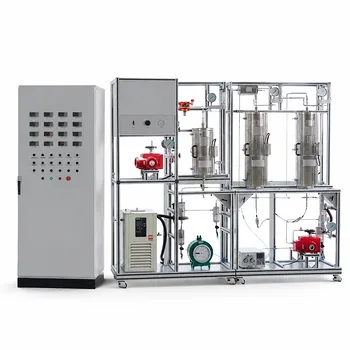
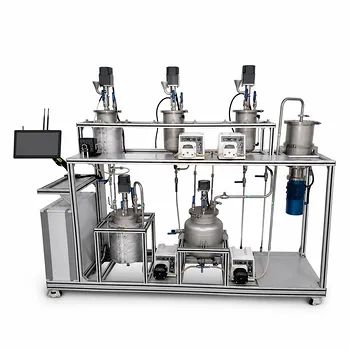
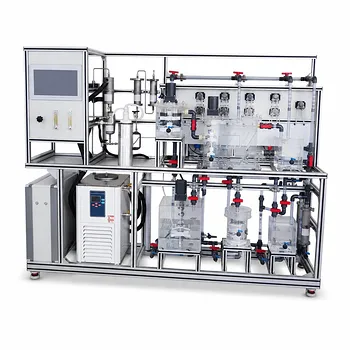
A teaching pilot plant shrinks these massive industrial operations to a bench or small-room scale. This scaling is not just about safety; it’s about visibility and manageability.
It makes mass and energy balances tangible. In a simulator, a number is just a number. In a pilot plant, calculating a mass balance for the smelting step means physically weighing the input concentrate and flux, then weighing the output slag and matte. The discrepancy forces a student to confront real-world measurement error and material losses. Energy balance calculations become concrete when you measure the cooling water temperature rise versus the electrical heating input.
It teaches the critical analysis of thermodynamic efficiency. A researcher can deliberately change a single parameter—like the roasting temperature or the air-to-fuel ratio in the converter—and directly measure the change in sulfur removal efficiency or copper loss to the slag. This hands-on experimentation with kinetics and thermodynamics grounds abstract concepts like Gibbs free energy and activity coefficients in observable reality. The pilot plant generates the data that makes these models come alive.
Connecting Process Knowledge to Quality Control and Design
The supplementary references provide a framework for how these pilot-scale activities translate into advanced process design and control skills, which are directly applicable to copper pyrometallurgy.
You can apply Quality by Design (QbD) principles to an ore. A copper concentrate is your primary "raw material." Its particle size distribution and mineralogical composition are critical material attributes. Using the pilot plant, students can execute a Design of Experiments (DoE) to model how a "noise factor" like fluctuating silica content in the concentrate impacts the "critical quality attribute" of slag viscosity and, therefore, copper entrainment. This moves problem-solving from a reactive fix to a proactive, predictive design of the operating space.
Emissions control becomes an integrated experiment. The roasting and converting stages produce sulfur dioxide (SO2), a primary industrial pollutant that is also a precursor to sulfuric acid. A well-designed pilot plant will incorporate an off-gas scrubbing unit. A research project could study how varying the oxygen enrichment during converting impacts the off-gas SO2 concentration, forcing students to simultaneously balance metallurgical efficiency, energy consumption, and environmental performance. This is the essence of modern sustainable process design.
Understanding the Trade-offs and Common Pitfalls
A unit operations pilot plant is a powerful tool, but its value depends on how it is used. A common mistake is treating it as just a large-scale demonstration.
A pilot plant will not perfectly reproduce industrial conditions. The dominant heat loss from a small, electrically heated furnace is completely different from the autogenous smelting environment of a large industrial flash furnace. A student who fails to critically assess this difference will draw invalid scale-up conclusions. The data requires careful interpretation, not blind acceptance.
The wealth of data can be a pitfall. Modern pilot plants, integrated with Process Analytical Technology (PAT) tools like in-line gas analyzers and thermal imaging, can overwhelm a user with time-series data. The risk is a shift from fundamental analysis to "data fishing." The pedagogical goal must remain focused on constructing a logical cause-and-effect narrative from the data, not just generating complex multivariate models for their own sake. The insight gained is the true deliverable, not merely the data.
How to Apply This to Your Project
The design and use of a unit operations pilot plant should be guided by your primary goal. The approach for an undergraduate teaching lab is distinctly different from that of a PhD-level research project.
- If your primary focus is hands-on teaching of process fundamentals: Configure the pilot plant for stability and clear cause-and-effect. Students should perform simple mass balances on the flotation and roasting columns, physically weighing inputs and outputs to internalize yield calculations and the concept of the "closing" mass balance.
- If your primary focus is advanced process control research: Integrate PAT tools fully and focus on the reactor sections. Use the smelter or converter to study dynamic control loops, programming responses to simulated disturbances like a drop in feed grade to train models for real-time process verification.
- If your primary focus is sustainable process design and optimization: Design all experiments around the interconnected inputs and outputs. A study on roasting temperature must include a definitive measurement of off-gas quality and energy consumption, mapping a full design space that explicitly links a processing decision to its environmental and economic trade-offs.
The value of the unit operations pilot plant is as a forcing function for holistic, systems-level thinking, turning the multi-stage extraction of copper into an integrated intellectual challenge rather than a series of disconnected textbook chapters.
Summary Table:
| Metallurgical Stage | Unit Operation | Pilot Plant Value for Teaching & Research |
|---|---|---|
| Flotation | Physical Separation | Demonstrates ore concentration, reagent dosing, and slurry management. |
| Roasting | Gas-Solid Reaction | Explores thermodynamics of partial oxidation and SO2 gas emission control. |
| Smelting | High-Temp Furnace | Provides hands-on data for executing real-world mass and energy balances. |
| Converting | Gas-Liquid Reaction | Highlights dynamic process control and the production of blister copper. |
Bring Industrial Reality into Your Laboratory with LABPARK
Are you looking to bridge the gap between textbook theory and industrial application? LABPARK provides state-of-the-art Educational and Vocational Unit Operations Pilot Plants in chemical engineering, bioprocess & biotech, and environmental & water treatment.
Designed specifically for universities, research institutes, and enterprises, our pilot plants help you:
- Deliver hands-on training with tangible mass and energy balances.
- Conduct advanced research on process optimization and emissions control.
- Equip students and researchers with critical, systems-level engineering skills.
Ready to elevate your teaching and research capabilities? Contact LABPARK today to find the perfect pilot plant solution for your institution!
Related Products
- Gallium and Indium Selective Extraction Educational Pilot Plant
- Natural Product Extraction Unit Operations Training Pilot Plant
- Multi-Functional Special Distillation Educational Pilot Plant
- Methane Cracking Educational Unit Operations Pilot Plant
- Continuous Batch Extractive Distillation Educational Pilot Plant
People Also Ask
- How do pilot plants differentiate physical vs chemical extraction? Enhance Chemical Engineering Training
- What is the significance of the isopycnic line in liquid-liquid extraction? Avoid Column Flooding
- How do droplet motion states affect kD in extraction pilot plants? Optimize Mass Transfer
- Why is predicting multicomponent LLE from binary data more challenging than VLE? Master your pilot plant design.
- How are ternary phase diagrams and LLE data applied in extraction experiments? Optimize Pilot Plant Scale-up