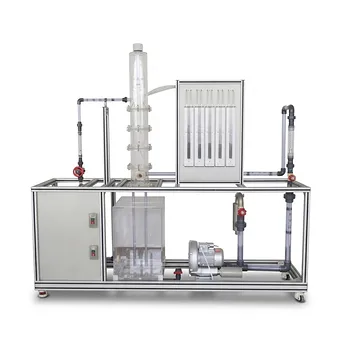
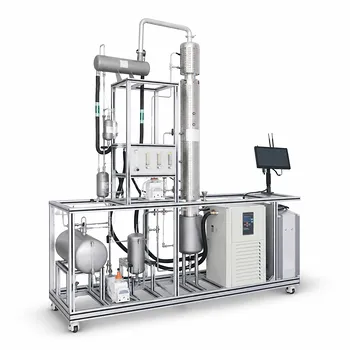
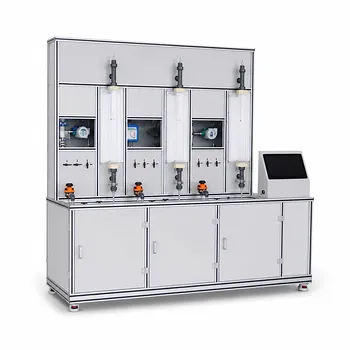
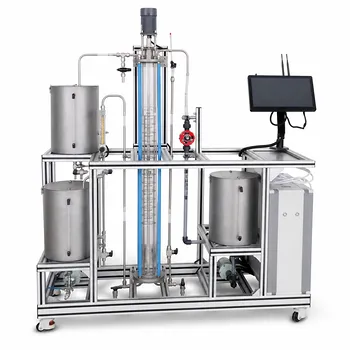
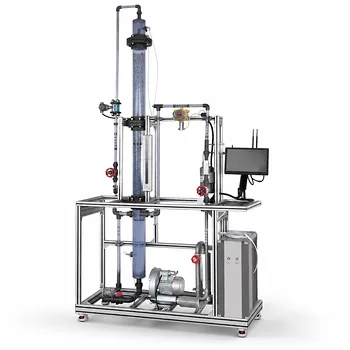
The three critical parameters are the number of theoretical stages, the overall tray efficiency, and the tray spacing. The total effective height of a plate column is not a guess—it is a direct function of how many ideal separation steps your mixture requires, how imperfect your physical trays are, and the physical distance you maintain between them. For a pilot-plant column with a small diameter (0.3 to 0.5 meters), the standard tray spacing typically falls within a 200 to 300 mm range.
Determining column height is an exercise in bridging ideal thermodynamic models and physical reality. The deep need of an educational pilot plant is not just to perform a separation, but to make the invisible physics of mass transfer visible, safe, and maintainable for students.
Deconstructing the Column Height Calculation
The physical height of the column is the result of a simple formula, but each variable contains layers of engineering judgment. Your goal is to teach students how to navigate that judgment.
The Foundational Equation
The effective column height ($Z$) is calculated as $Z = (N_p - 1)H_T$.
- $N_p$ is the number of actual physical plates required. One is subtracted because the height is determined by the distance between the trays, not the trays themselves.
- $H_T$ is the tray spacing.
This formula forces students to reconcile the idealized model with the practical limitations of the equipment.
The Critical Role of Tray Efficiency ($E_T$)
The number of actual trays ($N_p$) is always larger than the theoretical stages ($N_T$). This gap is defined by the overall tray efficiency: $E_T = N_T / N_p$.
- Why it Matters: Tray efficiency teaches that equilibrium is rarely achieved on a single plate due to mass transfer limitations.
- Educational Value: Students must learn to estimate $E_T$ using empirical correlations, such as the A.I.Ch.E. method, which considers fluid viscosity, relative volatility, and tray hydrodynamics.
Balancing Observation and Safety with Tray Spacing ($H_T$)
The choice of 200-300 mm spacing in a pilot plant is a battle between physics and pedagogy.
- The Physics: Adequate spacing prevents entrainment, where high vapor velocities carry liquid droplets to the tray above, destroying separation efficiency.
- The Pedagogy: A pilot plant must allow for visual observation. If trays are too close, it becomes impossible to view weeping, froth height, or flooding. You must ensure there is sufficient clearance for viewports and internal maintenance access.
Understanding the Trade-offs and Practical Constraints
Choosing the wrong combination of these parameters can turn an educational tool into a safety hazard or a useless black box.
The Manual vs. Mechanistic Design Dilemma
While tray efficiency correlations exist, they are estimates.
- Risk: A column designed solely on paperwork may flood or weep, failing to demonstrate stable operations.
- Mitigation: A well-instrumented pilot plant with differential pressure cells across the column section is vital. It allows students to correlate the theoretical design point with the actual hydraulic limit.
Cost Implications of Geometry
Tray spacing has a significant, non-linear impact on capital cost, quantified by a cost factor ($F_s$).
- Reducing spacing packs more trays into a fixed height, increasing the column’s separation power but doubling the manufacturing cost factor for the internals.
- In an educational setting, using standard spacing for sieve trays keeps the cost factor baseline low, allowing the budget to be allocated to better instrumentation rather than expensive column steel.
The Packed Column Alternative
It’s crucial for students to understand why a plate column is chosen over a packed column, which uses an entirely different calculation ($Z = N_T \times \text{HETP}$).
- Packed columns are excellent for teaching continuous pressure drop but offer poor visual feedback of internal hydrodynamics.
- Plate columns (sieve or bubble-cap) are superior for demonstrating discrete phase contacting. They allow students to visually diagnose operational limits like weeping or flooding, which builds deep, intuitive diagnostic skills.
Observation as a Design Parameter
The primary reference’s mention of “visual observation access” is not a minor feature—it is a core design constraint for a training plant.
- Placement: The tray spacing must accommodate a borosilicate glass viewport at the active froth level.
- Lighting: Internal lighting is often required to clearly see the two-phase mixing, turning an opaque steel vessel into a transparent learning environment.
Making the Right Choice for Your Educational Goal
The final design depends heavily on which part of the chemical engineering curriculum you are trying to illuminate.
- If your primary focus is demonstrating mass transfer fundamentals: Prioritize a plate column with 300 mm spacing to ensure clear, unobstructed visual access to the bubbling regime. Correlate the observed froth height with the calculated tray efficiency.
- If your primary focus is process control and dynamics: A column with standard 200-250 mm spacing and quick-response temperature sensors is acceptable. The tighter spacing allows for more theoretical stages in a manageable lab height, giving students a more complex, multi-variable system to tune with the reflux ratio.
- If your primary focus is equipment sizing and economic trade-offs: Challenge students to perform a parametric study. Have them calculate the total column cost difference for a 12-inch vs. 24-inch tray spacing using the cost factors for sieve plates and stainless steel construction, connecting their thermodynamic model directly to a capital expenditure decision.
The height and spacing of a pilot-plant column are therefore not fixed answers but derived results of a learning objective—use them to transform a separation problem into a powerful lesson in practical engineering compromise.
Summary Table:
| Parameter | Definition / Formula | Typical Value (Pilot Scale) | Educational & Design Impact |
|---|---|---|---|
| Theoretical Stages ($N_T$) | Number of ideal equilibrium stages required for separation | Varies by mixture & purity targets | Establishes the baseline process design. |
| Tray Efficiency ($E_T$) | Ratio of theoretical to actual stages ($E_T = N_T / N_p$) | System-dependent empirical estimate | Demonstrates mass transfer limits and deviations from ideal equilibrium. |
| Tray Spacing ($H_T$) | Physical distance between individual plates | 200 - 300 mm | Prevents liquid entrainment and provides clearance for visual observation windows. |
| Effective Height ($Z$) | Calculated height of tray section: $Z = (N_p - 1)H_T$ | Scaled to fit laboratory height limits | Balances capital cost, building constraints, and system complexity. |
Bring Mass Transfer and Unit Operations to Life in Your Lab
Designing the perfect educational column requires balancing rigorous thermodynamic principles with real-world operating limits. LABPARK designs and manufactures high-performance Educational and Vocational Unit Operations Pilot Plants in chemical engineering, bioprocess & biotech, and environmental & water treatment for universities, research institutes, and enterprises.
Our custom-engineered plate and packed columns feature optimized tray spacing, integrated differential pressure instrumentation, and high-visibility viewport glass so your students can clearly observe weeping, entrainment, and flooding in real time.
Ready to elevate your department's practical engineering curriculum? Contact our technical specialists today to discuss your laboratory's pilot plant requirements!
Related Products
- Plate Column Hydrodynamics Tray Demonstration Educational Pilot Plant
- Continuous Sieve-Plate Distillation Pilot Plant for Unit Operations Laboratory Education
- Dual-Mode Rectification Pilot Plant for Practical Training Unit Operations
- Two Phase Flow Pattern Velocity Resistance Measurement Educational Pilot Plant
- Educational Rotary Disc Liquid-Liquid Extraction Pilot Plant
People Also Ask
- How to update chemometric calibration models in pilot plants? Best practices for process engineers.
- How does nuclear yield inefficiency translate to chemical engineering education? Optimize kinetics with pilot plants.
- How can educational pilot plants be used to teach process safety and risk assessment in chemical engineering curricula?
- Why Correct Sig Figs & Rounding Matter in Educational Pilot Plants: Ensure Data Accuracy
- Why Calculate Sieve Tray Pressure Drop? Optimize Distillation Pilot Plant Performance