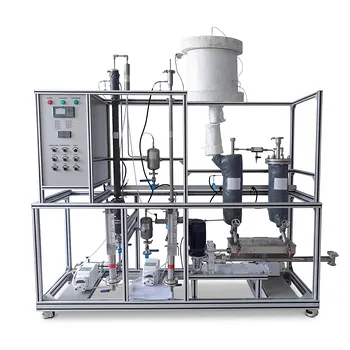
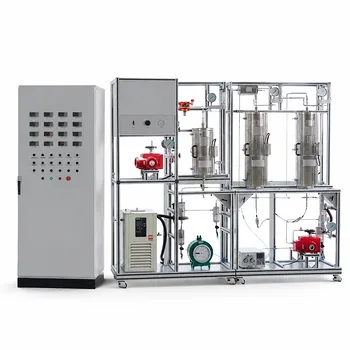
At the heart of a glycerol steam reforming (GSR) pilot plant lies precise control over three core process parameters: the glycerol-to-water feed ratio, operating temperature, and system pressure.
The plant must also incorporate high-temperature‑resistant reactor materials, adjustable gas flow controls, and flexible catalyst beds that allow researchers to vary the loading of nickel or noble metal catalysts. These elements directly dictate hydrogen yield, catalyst life, and the overall safety of the unit.
GSR is a highly endothermic, coking‑prone reaction. A well‑configured pilot plant therefore marries accurate thermal management with a tunable steam‑to‑carbon environment, enabling researchers to systematically study how process choices impact conversion, selectivity, and catalyst stability.
Critical Process Parameters: What You Must Govern
The Glycerol‑to‑Water (Steam‑to‑Carbon) Ratio
The feed ratio is the primary lever for suppressing coke and driving the water‑gas shift reaction.
Too little steam starves the reforming reaction of the oxidant needed to gasify carbon deposits, leading to rapid catalyst deactivation. Conversely, an excessively high steam ratio wastes energy and dilutes the product hydrogen.
In glycerol reforming, the optimal balance must be determined experimentally.
Unlike benchmark hydrocarbons, where a steam‑to‑carbon (S/C) ratio of around 3 is common, glycerol’s stoichiometry and decomposition pathways demand that the pilot plant allow wide‑range, precise adjustment of the liquid feed mixture.
Operating Temperature
GSR’s strong endothermicity means conversion rises sharply with temperature—but so does the risk of catalyst sintering and coking.
The pilot plant must deliver uniform, high‑grade heat at precisely the right level. Multi‑zone furnace or microchannel‑style heating systems are essential, as they supply the necessary reaction enthalpy while preventing temperature gradients that can cause hot spots and accelerated deactivation.
Data from analogous reforming studies show that even a 20–30°C shift can alter hydrogen yield and carbon monoxide selectivity dramatically.
The controller must therefore be able to hold the reactor at a setpoint with minimal fluctuation, enabling reproducible academic and industrial‑relevant experiments.
System Pressure
High pressure shifts equilibrium in the multistep GSR network and influences catalyst deactivation behavior.
The pilot plant reactor, piping, and safety relief devices must be rated for elevated pressures—often several tens of bar—while still permitting easy catalyst access.
Pressure control also affects downstream separation and the net energy balance, making it a key variable that researchers need to vary intentionally, not merely withstand.
Essential Design Factors for a GSR Pilot Plant
High‑Temperature Reactor Materials and Construction
The reactor chamber must be fabricated from alloys that retain mechanical integrity and resist corrosion under hot, steam‑laden conditions.
Standard stainless steels may fail due to hydrogen embrittlement or oxidation; high‑nickel superalloys or ceramic‑lined vessels are common choices.
The design must also allow for thermal expansion and provide safe, quick‑opening flanges for catalyst loading changes.
Adjustable Gas Flow and Liquid Feed Systems
Precision mass‑flow controllers for both gaseous products and liquid feedstock are non‑negotiable.
These components let the operator set exact space velocities—the relationship between feed rate and catalyst volume—which directly governs residence time and hydrocarbon slip.
Integrated vaporizers that completely atomize the glycerol‑water mixture before it reaches the catalyst bed prevent channeling and localized coking.
Catalyst Bed Architecture and Supports
The pilot plant must accept removable catalyst inserts that hold different mesh sizes and geometries.
Nickel‑based catalysts are often the first choice for cost‑effective hydrogen production, while noble metals (Pt, Rh) offer higher activity and better resistance to carbon.
The bed support itself plays a critical role: advanced oxides like Al₂O₃, CeO₂, or ZrO₂ promote steam‑carbon reactions that scavenge coke precursors.
The ability to test multiple catalyst loadings and support formulations in the same rig is what transforms a simple reactor into a research‑grade GSR pilot plant.
Online Gas Analysis and Safety Interlocks
Continuous monitoring of the product stream is vital for capturing transient effects and catalyst deactivation curves.
A gas chromatograph or mass spectrometer should measure hydrogen, carbon monoxide, carbon dioxide, and unconverted methane.
Safety systems—including over‑temperature cutoffs, pressure relief valves, and hydrogen leak detectors—must be integrated into the control architecture, as hydrogen is both the target product and a significant hazard.
The Hidden Battle: Managing Coke Formation
Why GSR Is More Coking‑Prone than Methane Reforming
Glycerol’s molecular structure, with three hydroxyl groups, encourages the formation of unsaturated intermediates that easily polymerize into solid carbon on catalyst surfaces.
Unlike simple methane, glycerol decomposes thermally into a complex mixture of oxygenates and olefins, each a potential coke precursor.
Pilot plants must therefore incorporate features that combat this tendency.
A higher steam‑to‑carbon ratio and the use of rare‑earth oxide supports (CeO₂, ZrO₂) provide lattice oxygen that continuously gasifies nascent carbon deposits, extending catalyst life.
The Temperature‑Coking Trade‑off
While higher temperatures drive hydrogen production, they also accelerate the Boudouard reaction and hydrocarbon cracking, both of which deposit solid carbon.
A GSR pilot plant designed with precise, multi‑zone temperature control allows the researcher to profile the bed axially, keeping the inlet zone hot enough for rapid vaporization but cooler than the reforming zone to minimize early coke formation.
This flexibility is needed because the coking “window” varies with catalyst composition and space velocity, making it a critical experimental variable rather than a fixed design parameter.
Making the Right Choice for Your Pilot Plant Goal
When configuring a GSR‑capable pilot plant, let the primary research or teaching objective guide the final specification.
- If your primary focus is maximizing hydrogen yield: Prioritize a multi‑zone furnace with tight PID control and a high‑activity nickel catalyst doped with a ceria‑zirconia support. Pair this with a high‑accuracy S/C ratio liquid delivery system.
- If your primary focus is studying catalyst deactivation: Ensure the rig offers easy, repeatable catalyst sampling and an online mass spectrometer. Build in the ability to vary S/C ratio and temperature independently so you can map deactivation kinetics.
- If your primary focus is teaching chemical engineering unit operations: Select a reactor with a transparent pressure window or detailed sensor array, and design the control panel to expose students to the real‑time interplay between feed ratio, temperature, and product purity. Safety interlocks should be visible but non‑intrusive.
A GSR pilot plant that balances these design factors transforms raw glycerol—a biodiesel waste stream—into a valuable hydrogen source, while giving engineers the deep, hands‑on insight needed to tackle the grand challenge of sustainable fuel processing.
Summary Table:
| Key Parameter / Factor | Critical Role in GSR | Management & Design Strategy |
|---|---|---|
| Steam-to-Carbon Ratio | Suppresses carbon deposition & drives reaction | Precise liquid feed blending & atomizing vaporizers |
| Operating Temperature | Supplies reaction enthalpy; prevents coking | Multi-zone heating with tight PID setpoint control |
| System Pressure | Shifts equilibrium & affects catalyst deactivation | Pressure-rated vessels & integrated safety relief systems |
| Catalyst Bed | Determines selectivity & hydrogen yield | Removable inserts with Ni/noble metals on CeO₂/ZrO₂ |
Optimize Your Chemical Engineering Lab with LABPARK
Looking to deploy advanced research or teaching setups? LABPARK provides state-of-the-art Educational and Vocational Unit Operations Pilot Plants in chemical engineering, bioprocess & biotech, and environmental & water treatment. Designed specifically for universities, research institutes, and enterprises, our solutions ensure precise parameter control, reliable safety interlocks, and flexible configurations to meet your academic and industrial needs.
Ready to elevate your engineering capabilities? Contact our technical experts today to discuss your custom pilot plant specifications.
Related Products
- Steam Methane Reforming Hydrogen Production and Purification Educational Pilot Plant
- Methane Cracking Educational Unit Operations Pilot Plant
- Multi-Functional Special Distillation Educational Pilot Plant
- Solid Waste Pyrolysis and Refining Educational Pilot Plant for Unit Operations
- Green Anhydrous Ethanol Refining Practical Training Pilot Plant
People Also Ask
- How Do Temp, Pressure & S:C Ratio Affect Methane Reforming? Optimize Your Pilot Reactor
- How to Integrate WGS & Purification in Steam Reforming Pilot Plants to Protect Fuel Cells from CO Poisoning
- What are the differences between steam reforming and ATR in pilot plants? Key Design Guide
- How is carbon deposition controlled in steam reforming? The Critical Role of S/C Ratio
- What is the difference between allothermal and autothermal steam reforming in pilot plants?