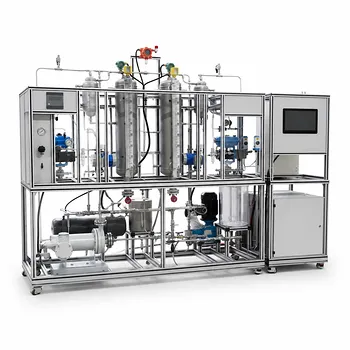
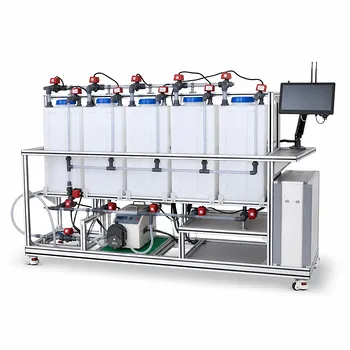
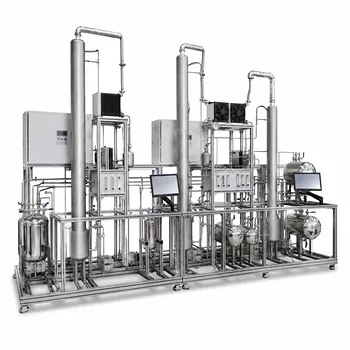
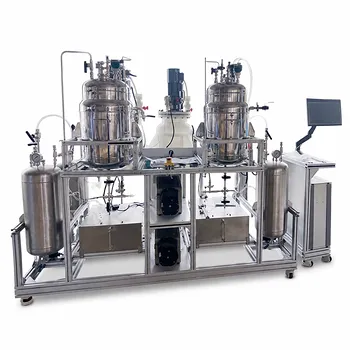
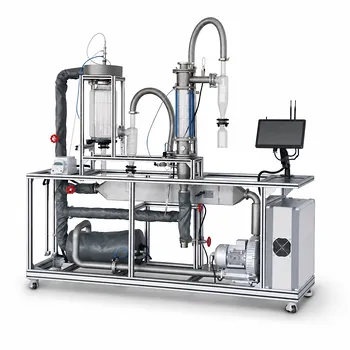
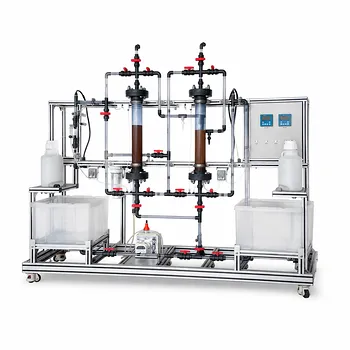
A chlor-alkali pilot plant turns theory into measurable insight. It lets you directly evaluate electrode reactions and ion discharge order, quantify current efficiency against Faraday’s laws, deconstruct cell voltage into decomposition voltage, overvoltage, and ohmic drops, and monitor side reactions that degrade performance and product purity.
The unit operations pilot plant makes abstract electrochemical concepts tangible. It reveals how competing reaction kinetics, mass transport limitations, and material choices combine to determine the energy consumption, product purity, and long-term stability of industrial chlor‑alkali cells.
Mapping the Key Electrochemical Parameters
Observing Discharge Order and Electrode Reactions
At the cathode, hydrogen ions discharge preferentially, generating hydrogen gas and sodium hydroxide. At the anode, chloride ions oxidize to chlorine. The pilot plant allows you to verify this thermodynamic and kinetic selectivity under realistic current densities.
You can deliberately alter brine composition or electrode material to see how the discharge order shifts when side reactions become kinetically favored. This teaches the fundamental competition between thermodynamics and kinetics at polarized interfaces.
Validating Faraday’s Laws and True Current Efficiency
By measuring the actual mass or volume of chlorine, hydrogen, and caustic soda produced, you calculate the real‑world current efficiency. The difference between the theoretical yield (from Faraday’s law) and the measured yield exposes parasitic losses.
These losses are rarely due to measurement error alone. They reveal the extent of side reactions—oxygen evolution, chlorate formation, or back‑migration of hydroxyl ions—that steal current from the main products.
Deconstructing Cell Voltage for Energy Efficiency
The total cell voltage is the sum of the thermodynamic decomposition voltage, activation overvoltage at both electrodes, concentration overvoltage, and IR drops through the electrolyte and separator. The pilot plant breaks these apart.
You can test different electrode materials (graphite, DSA‑coated titanium) and observe how their catalytic activity changes overvoltage at a given current density. By varying electrolyte temperature and flow, you see the direct impact of ohmic resistance on the voltage–current relationship.
Monitoring Side Reactions and Electrode Degradation
Anodic side reactions produce oxygen and hypochlorous acid, which chemically attack graphite anodes. The pilot plant lets you track the buildup of chlorate and active chlorine species, linking their concentration to electrode corrosion rates and product purity.
Checking anolyte and catholyte pH, temperature, and composition over time gives a live view of mass balances gone awry. This is where students learn why industrial cells tightly control pH and temperature—suppressing side reactions is an economic necessity, not a footnote.
Understanding the Trade-offs and Hidden Limitations
The Price of High Current Density
Pushing current density higher increases production rate but also amplifies overvoltage and ohmic losses. In a pilot plant, you see the tangent: beyond a certain point, the marginal energy cost per kilogram of product rises sharply because mass transport cannot keep up and concentration polarization sets in.
This is where the comparison between membrane and diaphragm cell modules becomes critical. The membrane’s dramatically lower resistance and ability to prevent hydroxyl back‑migration boost current efficiency, but it comes with a stricter demand on brine purity and differential pressure control.
Thermal Management and pH as Efficiency Levers
Operating the cell at 85–95°C lowers electrolyte resistance, but it accelerates side reactions like chlorate formation and shortens electrode life. The pilot plant shows that the temperature setpoint is a compromise between energy efficiency and product purity.
Acidifying the feed brine (pH 3–5) neutralizes back‑migrating OH⁻, suppressing chlorate. Yet over‑acidification can promote chlorine evolution at the expense of caustic purity. Hands‑on pH profiling teaches that dynamic equilibrium control is just as important as the electrode coating.
Safety as a Process‑Design Parameter
Hydrogen‑air mixtures are explosive; chlorine is toxic. The pilot plant’s differential pressure control (negative in anode, positive in cathode) and gas scrubbing systems are not just add‑ons—they directly constrain operating windows. If a side reaction triggers a pressure spike, you see how the automated shutdown logic interacts with the electrochemical process itself.
How to Apply This to Your Curriculum or R&D Setup
A pilot plant delivers maximum value when its operation is tied directly to the question you want to answer.
- If your primary focus is teaching electrochemical fundamentals: Design experiments that isolate one variable at a time—electrode material, current density, or electrolyte temperature—and have students calculate current efficiency and voltage breakdowns to build a mental model of cell losses.
- If your primary focus is industrial process optimization: Use the pilot plant to map the energy‑cost landscape across current densities and separator types. Emphasize the trade‑off between production rate and specific energy consumption, and train operators to interpret pressure, pH, and chlorate trends as leading indicators of instability.
- If your primary focus is product purity and cell longevity: Extend runs to correlate side‑reaction byproduct concentrations with electrode degradation rates. Stress the role of brine purity and acid dosing as the long‑term lever to protect capital investment in anodes and membranes.
A chlor‑alkali pilot plant transforms a textbook equation into a living system where efficiency, stability, and safety are inseparable; mastering its parameters is the fastest route to sound electrochemical engineering judgment.
Summary Table:
| Key Parameter | Evaluation Method in Pilot Plant | Educational & Industrial Value |
|---|---|---|
| Current Efficiency | Compare actual yields of Cl₂, H₂, and NaOH against Faraday's law | Exposes parasitic side reactions and current losses |
| Cell Voltage Breakdown | Measure thermodynamic voltage, activation overvoltage, and ohmic IR drops | Identifies energy saving opportunities and electrode efficiency |
| Discharge Order | Alter brine feed composition and electrode materials | Demonstrates thermodynamic vs. kinetic selectivity at interfaces |
| Electrode Degradation | Track chlorate and active chlorine buildup over extended runs | Correlates side reactions with cell longevity and product purity |
Ready to bring hands-on electrochemical engineering to your institution? LABPARK provides premium Educational and Vocational Unit Operations Pilot Plants in chemical engineering, bioprocess & biotech, and environmental & water treatment. We help universities, research institutes, and enterprises bridge the gap between textbook theory and industrial practice with safe, scalable, and highly interactive training systems.
Contact LABPARK today to discuss your curriculum requirements or request a custom pilot plant quote!
Related Products
- Alkaline Membrane Water Electrolysis Educational Pilot Plant Unit Operations Training System
- Electrochemical Water Treatment Educational Unit Operations Pilot Plant
- Electrolytic Hydrogen Production Educational Unit Operations Pilot Plant
- Multi-Reactor Educational Pilot Plant for Reaction Engineering Unit Operations
- Dual-Mode Rectification Pilot Plant for Practical Training Unit Operations
People Also Ask
- How do chemical engineering pilot plants demonstrate electrolysis? Bridge Theory & Industrial Scale
- How do alkaline and PEM electrolysis technologies differ in pilot plant operations?
- Why is the selection of electrode materials critical when configuring or operating educational electrolysis pilot plants?
- Bipolar vs Monopolar Electrolysis: Key Configuration Details to Analyze in Pilot Plants
- Which Electrolysis Pilot Plant Parameters Ensure Safety & Efficiency? Key Controls Explained