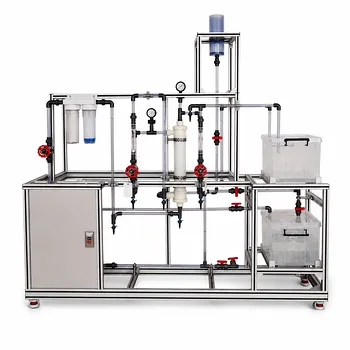
Electrodialysis (ED) is an electrically driven membrane process that uses alternating cation- and anion-exchange membranes and a direct current (DC) field to separate ions from water. In a training pilot plant, the core operating parameters to monitor are applied DC voltage and current, stream flow rates, and the conductivity of the feed and product water. Monitoring these teaches the direct link between electrical energy input and desalination performance, while preventing membrane damage.
The working principle of ED is elegantly simple: an applied electric field pushes dissolved salt ions through selective membranes, leaving behind purified water. To run a training pilot plant safely and effectively, you must monitor electrical input, hydraulic balance, and salinity reduction—these three data points reveal everything about the health, efficiency, and educational value of the system.
How Electrodialysis Works: The Electrical Membrane Separation
The process transforms electrical energy directly into chemical separation. Its beauty lies in simplicity: no phase change, no high pressure, just ions moving toward oppositely charged electrodes through engineered barriers.
The Architecture of Ion-Exchange Membranes
An ED stack alternates cation-exchange membranes (allowing only positively charged ions to pass) and anion-exchange membranes (allowing only negatively charged ions to pass). These membranes are placed between a single anode (+) and cathode (-).
Each membrane acts like a selective gate. Fixed charged groups on the membrane surface and within its pores repel ions of the same charge while attracting and transporting counter-ions. This selectivity is what makes separation possible.
How Ions Migrate Under a DC Electric Field
When a DC voltage is applied, an electric field forms across the stack. Cations (like Na⁺) migrate toward the cathode, and anions (like Cl⁻) migrate toward the anode.
As they move, they encounter the alternating membranes. Cations easily pass through cation-exchange membranes but are blocked by the next anion-exchange membrane. Anions do the opposite. This forced migration pattern creates alternating chambers.
Creating Concentrated Brine and Purified Water
The result is a series of dilute compartments (where ions are removed) and concentrate compartments (where the migrating ions become trapped). The feed water flows through both sets, producing a purified, desalinated stream and a concentrated brine stream.
In a training pilot plant, students can physically trace these two output streams, making an otherwise abstract electrochemical concept tangible and observable in real time.
Critical Operating Parameters for a Training Pilot Plant
A training environment demands that every measured variable tells a pedagogical story. The parameters you choose to monitor must directly illustrate the separation principle while ensuring the equipment operates safely and reliably.
1. Applied DC Voltage and Current
Voltage provides the driving force for ion migration. Current is a direct measure of the number of ions moving across the membranes per second. Together, they define power consumption and separation rate.
Crucially, you must teach operation below the limiting current density. Exceeding this threshold depletes ions at the membrane surface faster than they can be replenished, triggering water splitting. This produces H⁺ and OH⁻ ions, causing pH shifts, scale formation, and wasted energy. Monitoring the current-voltage curve to identify this limit is a foundational lesson.
2. Concentrate and Dilute Stream Flow Rates
Flow rates maintain hydraulic balance across the membrane stack. Keeping the dilute and concentrate streams at controlled, often equal, velocities minimizes dangerous pressure differentials that can warp or rupture membranes.
Adequate flow also promotes turbulence, reducing the thickness of the diffusion boundary layer near the membrane surface. This enhances ion mass transfer and allows a higher safe operating current. For students, adjusting flow rates while observing conductivity changes makes the concept of concentration polarization tangible.
3. Feed and Permeate Conductivity
Conductivity is the most direct, real-time indicator of desalination efficiency. By measuring the feed water conductivity and comparing it to the dilute stream (permeate) conductivity, you instantly calculate the percentage of salt removed.
This single parameter closes the loop between theory and practice. Students can see that higher applied current increases ion transport and lowers permeate conductivity—until they approach the limiting current, at which point efficiency plateaus or drops.
Understanding the Trade-offs in ED Operation
Every operational decision in an ED pilot plant involves an engineering trade-off. Making these explicit is what transforms routine monitoring into genuine process understanding.
Electrical Energy vs. Pumping Energy
Pushing flow rates higher reduces the risk of concentration polarization and can increase the limiting current density. But higher flow requires more pump energy. The optimal operating point balances the electrical energy for separation against the hydraulic energy for fluid transport.
Desalination Speed vs. Membrane Integrity
Using a successive (series) flow configuration speeds up salt removal in a single pass. However, this creates uneven pressure distribution, increasing the risk of membrane deformation or tearing. Most training systems favor a parallel flow arrangement within a single stack to prioritize equipment longevity and demonstrate stable, reproducible results.
Separation Purity vs. Current Efficiency
Running at a high current density increases desalination speed, but also brings operation dangerously close to the limiting current. Slight fluctuations can then trigger water splitting, reducing current efficiency and damaging membranes. The educational value is clear: students learn that maximum output is not the same as optimal output.
How to Apply This to Your Training Program
Define your primary learning objective, and then structure your monitoring and control lessons around that goal.
- If your primary focus is fundamental understanding: Prioritize conductivity and current measurements. Have students plot desalination efficiency against applied current to map the system’s operating envelope.
- If your primary focus is process optimization: Emphasize the trade-off between flow rate, pressure drop, and limiting current density. Challenge students to find the minimum total energy consumption point.
- If your primary focus is industrial safety and reliability: Center your curriculum on flow and pressure monitoring to prevent mechanical failure, and teach the warning signs of water splitting (unusual pH shifts in effluent) to protect membrane life.
Mastering these three parameters—electrical input, hydraulic balance, and salinity output—gives every operator a complete mental model of the electrodialysis process, turning the pilot plant into a powerful teacher.
Summary Table:
| Parameter | What It Measures | Why It Matters for Training |
|---|---|---|
| DC Voltage & Current | Ion migration driving force & rate | Teaches limiting current density; prevents membrane damage. |
| Flow Rates | Fluid velocity & hydraulic balance | Minimizes pressure differentials; controls polarization. |
| Conductivity | Inlet and outlet salinity levels | Provides real-time measurement of desalination efficiency. |
Elevate Your Water Treatment Training with LABPARK
Maximize your students' and researchers' hands-on learning with premium process equipment. LABPARK provides advanced Educational and Vocational Unit Operations Pilot Plants in chemical engineering, bioprocess & biotech, and environmental & water treatment for universities, research institutes, and enterprises.
Our pilot plants are designed to safely demonstrate critical parameters like voltage, flow rates, and conductivity, giving users a complete mental model of complex chemical processes.
Contact LABPARK today to request a quote or customize a pilot plant for your laboratory.
Related Products
- Electrolytic Hydrogen Production Educational Unit Operations Pilot Plant
- Electrolyte Distillation Purification and Formulation Educational Pilot Plant
- Alkaline Membrane Water Electrolysis Educational Pilot Plant Unit Operations Training System
- Water Electrolysis Hydrogen Production and Storage Educational Pilot Plant
- Electrochemical Water Treatment Educational Unit Operations Pilot Plant
People Also Ask
- In educational chemical engineering pilot plants, why use absorption and adsorption before reforming?
- How do chemical engineering unit operations pilot plants demonstrate catalytic high-purity hydrogen production from methane?
- SMR, POX, or ATR? Trade-offs in Hydrogen Production Educational Pilot Plants
- How do educational unit operations pilot plants address safety and waste management when scaling up?
- How do educational unit operations pilot plants bridge theory and industrial process development? Hands-On Learning