Ensuring reliable, bubble-free liquid removal in a microchannel separator hinges on one parameter: differential pressure.
Active differential pressure control is the engineering technique that maintains the precise, tiny pressure difference between the gas and liquid sides, keeping it safely below the capillary breakthrough point. Without it, the separator can abruptly fail—allowing gas to escape through the liquid outlet or liquid to contaminate the gas stream. In a process pilot plant, this active regulation turns a delicate microfluidic principle into a robust, repeatable unit operation.
The true significance of active differential pressure control goes beyond holding a static setpoint. It dynamically enforces a slight negative bias on the liquid side relative to the gas side, adapting in real time to pressure fluctuations, flow changes, and temperature shifts. This is what prevents capillary barriers from being overwhelmed during routine experimental transients.
The Crucial Role of the Capillary Barrier
How a Porous Wick Separates Phases
Inside the microchannel, a thin, permeable wick structure acts as the exclusive flow path for the liquid. The liquid wets the porous material and is retained inside it by capillary forces, while the gas flows through the adjacent open channel. By imposing a controlled pressure gradient, the liquid can be drawn out along the wick without the two phases ever mixing directly.
The Breakthrough Limit: A Hard Ceiling
The pore throats of the wicking material can only withstand a certain pressure difference before they fail. If the gas pressure overcomes this breakthrough limit—typically only a few kilopascals (e.g., <4.4 kPa or 0.72 psi)—gas will punch through the liquid barrier and exit with the liquid. Similarly, a reverse spike can force liquid into the gas stream. Active control holds the differential below this hard ceiling, while intentionally keeping a slight negative pressure on the liquid side to siphon liquid correctly.
Why Active Control is Non‑Negotiable in a Pilot Plant
The Stakes: Data Integrity and Safety
Pilot‑scale process separation demands trustworthy composition measurements and consistent mass balances. A single gas bubble in the liquid outlet line can corrupt analytical readings or destabilize downstream pumps. In hazardous environments, the resulting uncontrolled mixing can escalate to a safety risk. Active differential pressure monitoring is the primary line of defense.
Passive Capillary Forces Are Static; Real Processes Are Dynamic
A wick can separate phases beautifully under steady lab conditions. But pilot plants experience intentional upsets: feed composition ramps, pressure setpoint changes, or startup flow surges. Each one momentarily alters the pressure balance on both sides of the barrier. Active control reacts within milliseconds to re‑establish the safe differential window, something no passive wick can do on its own.
Pressure Dependence of the Stability Window
The required differential pressure is not a fixed number—it grows with the system’s operating pressure. Experimental data show that at 45 psia, separation becomes unstable below roughly 4.4 inches of water differential. At 70 psia, that threshold climbs to about 5.3 inches of water. Without a control loop that biases its target as pressure rises, the separator will drift into an unstable region. Active control compensates for this shift, allowing one device to run reliably across a broad pressure range.
Understanding the Trade‑offs and Control Challenges
Sensor Latency and Actuator Hysteresis
The differential pressure being controlled is so small that even sensor drift or valve stiction can cause oscillation. Over‑correcting a fraction of a pascal too far can briefly exceed the breakthrough limit, negating the protection. A robust loop requires fast‑responding differential transmitters and actuation that is precise at extremely low flows.
Over‑Constriction Can Flood the Wick
Aggressive liquid removal reduces the pressure in the liquid line, which increases the differential pressure. If the control logic clamps too hard, the wick can locally dry out. This creates a low‑resistance gas path that defeats the barrier completely. A successful active strategy must balance prevention of gas breakthrough against maintaining enough liquid hold‑up to keep the wick fully primed.
Setpoint Tuning Fatigue
The safe operating window shifts not only with system pressure but also with subtle changes in liquid surface tension or wick ageing. Active control is not a “set and forget” strategy; it demands periodic verification of the breakthrough point and may require adaptive gain scheduling if the plant is meant for long, unattended campaigns.
Making the Right Choice for Your Pilot Plant Setup
- If your primary focus is running at a single steady‑state condition: A carefully tuned single‑loop controller with a fixed differential setpoint can provide excellent reliability once the breakthrough pressure is experimentally mapped.
- If your experiments frequently ramp pressure or switch feedstocks: Invest in a pressure‑compensated control scheme that shifts the differential target based on real‑time system pressure. This prevents the separator from drifting into instability as conditions change.
- If your priority is maximizing liquid removal capacity without gas carryover: Deploy fast electronic controllers paired with direct‑acting proportional valves to tighten the control band, and implement a soft minimum limit to avoid wick dry‑out.
Active differential pressure control transforms a neat microfluidic effect into an industrial‑scale pilot tool. When properly implemented, it delivers the separation precision your process data depends on.
Summary Table:
| Aspect / Parameter | Description & Function | Critical Threshold / Behavior |
|---|---|---|
| Capillary Barrier | Porous wick separating phases via capillary forces | Breakthrough limit (typically < 4.4 kPa) |
| Active Control Role | Dynamically adapts to dynamic flow, temperature, and pressure shifts | Prevents gas breakthrough & liquid carryover |
| Pressure Dependency | Stability window shifts upward as system operating pressure increases | e.g., 4.4 in. H2O at 45 psia vs. 5.3 in. H2O at 70 psia |
| Key Challenges | Sensor latency, valve hysteresis, and risk of wick dry-out | Requires high-speed controllers & precise tuning |
Optimize Your Process Separation with LABPARK
Are you looking to scale up your microfluidic operations or build robust process separation systems?
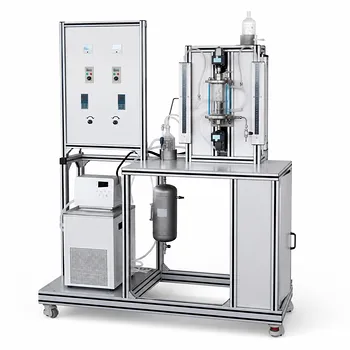
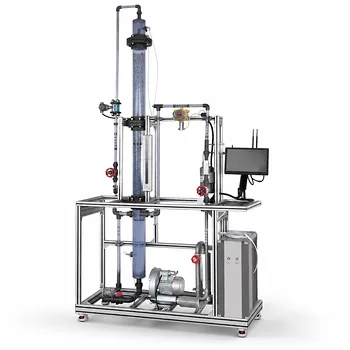
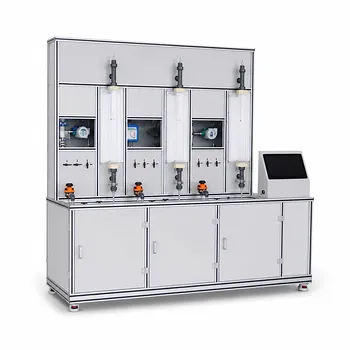
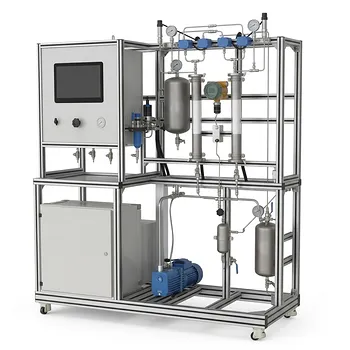
LABPARK provides state-of-the-art Educational and Vocational Unit Operations Pilot Plants tailored for universities, research institutes, and enterprises. Our systems are designed for high precision and reliability across key fields:
- Chemical Engineering (including advanced microchannel and extraction technologies)
- Bioprocess & Biotech
- Environmental & Water Treatment
Ensure exceptional data integrity, process stability, and safety in your lab. Contact our experts today to find the perfect pilot plant solution for your research and training needs!
Related Products
- Gas-Solid Heterogeneous Separation Demonstration Educational Unit Operations Pilot Plant
- Gallium and Indium Selective Extraction Educational Pilot Plant
- Bench Scale Dual Column Gas Separation and Capture Educational Pilot Plant
- Multi-Component Gas Pressure Swing Adsorption Pilot Plant for Unit Operations Education
- Dual-Drive Stirred Gas-Liquid Mass Transfer Coefficient Determination Pilot Plant
People Also Ask
- Why is pressure drop characterization critical in separation pilot plants? Key operational insights.
- What are the key thermodynamic considerations for gas mixture modeling? Expert Guide
- What are the primary operational objectives and physical requirements when running heterogeneous separation pilot plants?
- What are the trade-offs in olefin-paraffin separation? Optimize Pilot Plant Performance
- What are the material limitations of gas separation pilot plants? Key factors to consider.