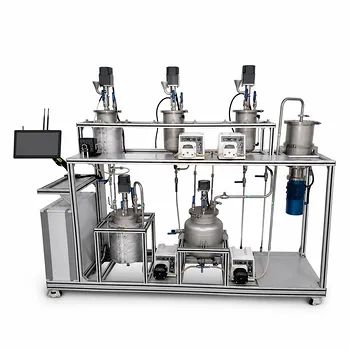
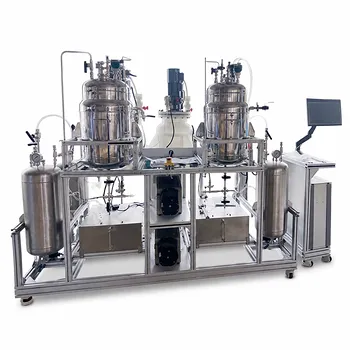
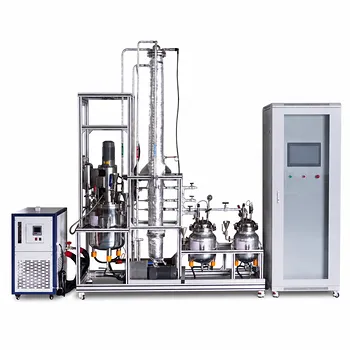
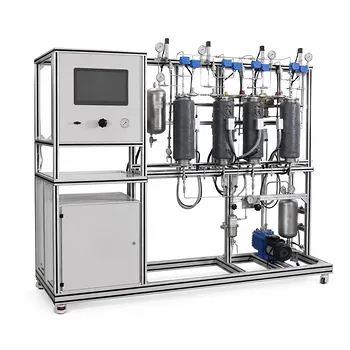
The defining role is to transform theoretical potential into verifiable, scalable reality. Environmental and bioprocess pilot plants serve as the critical bridge between benchtop discoveries and full-scale industrial deployment. They provide a controlled, yet realistic, platform to test complex chemical preprocessing, biological treatments, and downstream separation steps, turning heterogeneous waste and biomass into reliable feedstocks, energy, or bio-based products while generating the hard data needed for life cycle assessments.
While lab experiments prove a concept, a pilot plant validates its future. Its true purpose is to identify and neutralize the operational, economic, and environmental risks inherent in scaling up downstream waste recovery and biomass conversion, long before committing the capital for a commercial facility.
Bridging the Gap Between Laboratory Promise and Industrial Reality
The journey from a successful beaker-scale reaction to a functioning circular economy is treacherous. Theoretical yields mean little when faced with the non-homogeneous nature of real-world waste. Pilot plants de-risk this journey by simulating industrial conditions on a manageable scale.
Confronting Real-World Feedstock Complexity
Benchtop research often uses idealized, homogeneous substrates. A pilot plant forces you to work with the messy reality of biomass and waste streams, which have highly functionalized and variable compositions.
A single process line is rarely sufficient. Integrated pilot facilities can run multiple unit operations—hydrolysis, anaerobic fermentation, gasification, and combustion—in parallel. This is essential for handling different biomass fractions and evaluating the full value cascade from a single feedstock.
Generating Life Cycle and Energy Balance Data
Theoretical calculations like the combustion heat of ethanol provide a baseline, nothing more. A pilot plant allows you to measure the net energy ratio—the actual energy output versus the total energy input across the entire production-to-utilization lifecycle.
This includes energy consumed in preprocessing, heating, agitation, and downstream purification. Without this data, you cannot determine if a waste-to-energy or biofuel process is a genuine environmental solution or an energy-losing proposition.
The Anatomy of a Pilot Plant: Key Evaluative Functions
These facilities are not just bigger labs; they are dynamic proving grounds where the fundamental principles of downstream recovery are stress-tested. Their role is to answer a series of non-negotiable questions about a technology’s viability.
Optimizing Biological Treatment and Conversion
For biomass conversion, pilot plants are essential for scaling aerobic fermentation and anaerobic digestion. They allow precise control and monitoring of critical parameters like pH, dissolved oxygen, nutrient feeding strategies, and agitation rates.
This level of control optimizes biocatalyst stability and product yield. More importantly, it provides the data required to design the aeration and mass transfer systems for industrial-scale deep-tank fermenters.
Validating Downstream Separation and Purification
Converting waste into a crude product is only half the battle. The real value is unlocked in downstream processing. Pilot plants allow the rigorous testing of continuous filtration, multistage liquid-liquid extraction, and membrane separation.
This is where you learn to isolate sensitive or unstable active ingredients from large volumes of complex fermentation broth. You also develop protocols for capturing new pollutants, such as nanomaterials, by testing specialized processes like advanced oxidation and sedimentation under realistic hydraulic conditions.
Integrating Multiple Treatment Streams
Waste recovery never generates just one effluent stream. Robust environmental pilot plants must incorporate non-specific water treatment unit operations to clean the diverse wastewater produced by parallel conversion processes.
This integrated approach tests the entire treatment train, validating that the process doesn’t merely shift an environmental burden by generating toxic secondary wastes while solving the primary one.
Reducing Risk Through Data-Driven Optimization
The core business value of a pilot plant is risk reduction. It replaces costly assumptions with empirical certainty, protecting against catastrophic scale-up failures.
Establishing Safe Operational Envelopes
Pilot-scale operation defines the safe boundaries for temperature, pressure, and concentration. It reveals the early signs of biocatalyst inhibition, membrane fouling, or unwanted side reactions that are invisible in a lab flask but disastrous in a commercial reactor.
Training and Protocol Development
A pilot plant serves as an invaluable training ground for operators who will eventually run the full-scale facility. They learn the nuances of continuous operation and develop the standardized safety and maintenance protocols required for regulatory compliance.
Understanding the Trade-offs
An objective assessment must acknowledge the limitations. A pilot plant is a powerful tool, but it is not a perfect crystal ball.
The primary downside is the significant capital and operational cost. Running a pilot plant requires a skilled multidisciplinary team, consumes raw materials, and generates waste that itself must be managed. Furthermore, certain phenomena like long-term catalyst aging or the complex rheology of slurries in very large columns cannot be perfectly replicated at pilot scale. The data, while essential, remains a sophisticated approximation, and the linear scaling of some parameters must be validated with caution.
Making the Right Choice for Your Goal
How you design and utilize a pilot plant campaign depends entirely on the core question you need to answer.
- If your primary focus is proving the economic viability of a biofuel: Prioritize an integrated pilot plant that can run the complete production-to-combustion cycle to generate a full mass and energy balance and measure the actual net energy ratio.
- If your primary focus is developing a high-value biological product: Focus on downstream purification scalability, using the plant to optimize continuous extraction and filtration sequences needed to stabilize your target molecule from large broth volumes.
- If your primary focus is an environmental compliance solution for a toxic waste stream: Configure the pilot plant as a treatment train to prove you can consistently meet discharge limits without generating harmful secondary by-products, especially when dealing with emerging contaminants like nanoparticles.
Pilot plants transform the ambition of a circular economy from a theoretical concept into a demonstrated, industrially grounded practice.
Summary Table:
| Evaluative Function | Key Parameters Tested | Operational & Scaling Benefit |
|---|---|---|
| Biological Treatment | pH, DO, feed rates, agitation | Optimizes biocatalyst stability & yield |
| Downstream Separation | Filtration, extraction, membranes | Validates product purity & fouling risks |
| Stream Integration | Effluent clean-up, recycle loops | Ensures environmental compliance & net energy |
Accelerate Your Scale-Up Journey with LABPARK
Transitioning from benchtop concepts to industrial reality requires robust, reliable testing. LABPARK provides advanced Educational and Vocational Unit Operations Pilot Plants in chemical engineering, bioprocess & biotech, and environmental & water treatment.
Designed specifically for universities, research institutes, and enterprises, our pilot plants help you accurately evaluate downstream waste recovery, optimize biomass conversion, and train future industry experts.
Ready to de-risk your process engineering? Contact our technical team today to find the perfect pilot plant solution for your facility!
Related Products
- Bio-fermentation Ethanol Production Practical Training Unit Operations Pilot Plant
- Natural Product Extraction Unit Operations Training Pilot Plant
- High-Gravity Emulsification and Mass Transfer Educational Pilot Plant
- Fixed-Bed Chemical Reaction and Gas Dust Tar Removal Unit Operations Pilot Plant
- Continuous Batch Extractive Distillation Educational Pilot Plant
People Also Ask
- Why Use PTFE & Hastelloy in Chemical Pilot Plants? Prevent Corrosion & Ensure Safety
- Why Compare Predicted and Experimental Excess Enthalpy? Key to Accurate Pilot Plant Scale-up
- Why is the chemical plant startup schedule crucial? De-risk scale-up with pilot plants.
- When to transition from PID to adaptive control in pilot plants? Key process indicators.
- Why must batch and fed-batch fermentation pilot plants be designed to accommodate changing rheological conditions?