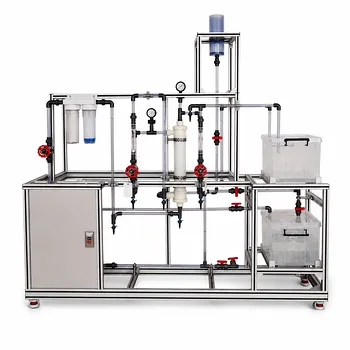
In a pilot plant, the ion transport number tells you how ions move in a perfect world, while current efficiency reveals what actually happens. The ion transport number captures solely the current carried by a specific ion through migration, measured in the absence of concentration gradients. Current efficiency, on the other hand, accounts for all transport mechanisms—migration, diffusion, and osmosis—under real operating conditions. For evaluating membrane performance in an electrodialysis pilot plant, current efficiency is the indispensable, practical metric because it directly quantifies the net separation you can truly achieve.
While the ion transport number isolates migration under idealized lab conditions, current efficiency embraces diffusion and osmotic effects, making it the definitive measure of real-world membrane performance. In a pilot plant, trusting current efficiency over transport numbers prevents costly overestimation of separation and guides reliable scale-up.
The Theoretical Foundation: Ion Transport Number
Defining t_i: Migration in Isolation
The ion transport number ($t_i$) is the fraction of the total electric current carried by a single ion species. It describes pure migration, where ions move solely under the influence of an electric field.
This metric assumes that all other driving forces, particularly diffusion caused by concentration differences, are completely eliminated. It’s a property of the ion’s mobility within the membrane’s structure under an idealized voltage gradient.
How It’s Measured in the Lab
Transport numbers are traditionally determined using methods like the Hittorf experiment. These experiments carefully suppress concentration gradients to ensure migration is the dominant transport mode.
In educational pilot plants, students often measure transport numbers to grasp the fundamental selectivity of ion-exchange membranes. The goal is to understand the intrinsic preference of a membrane to carry cations over anions—or vice versa—in a controlled, diffusion-free setting.
Why Pure Migration is an Incomplete Picture
A pilot plant never operates without concentration gradients. As soon as you desalinate a stream or concentrate a brine, strong concentration differences build up across the membrane.
These gradients trigger back-diffusion of ions from the concentrate to the diluate and osmotic water transport. The ion transport number simply cannot account for these inevitable, parasitic processes that erode separation efficiency.
The Real-World Metric: Current Efficiency
Defining η_i: The Sum of All Transport
Current efficiency ($\eta_i$) is the fraction of the total electrical current that results in the net transport of a target ion from one solution to the other. It captures the practical outcome of all simultaneous transport phenomena.
While migration pushes ions where you want them to go, diffusion often pushes them back. Current efficiency gives you the net result, telling you what percentage of the applied electrical energy actually performs useful separation work.
The Hidden Role of Diffusion and Osmosis
In any operating electrodialysis stack, ions leak back across membranes due to the large concentration difference between the concentrate and diluate channels. Water also moves osmotically, diluting the concentrate and reducing overall driving force.
Current efficiency inherently bundles these losses into one actionable number. A membrane with a perfect transport number of 0.98 for a counter-ion can still exhibit a current efficiency of only 0.75 if diffusion losses are severe at high brine concentrations.
Why Current Efficiency Dictates Pilot Plant Performance
Pilot plants exist to generate data for process design, energy consumption estimates, and scalability. Only current efficiency directly translates into the specific energy per kilogram of salt removed and the product purity you can sustain.
Using transport numbers to predict pilot-scale performance will lead to over-optimism. Current efficiency tells the unvarnished truth about your stack’s ability to overcome real-world thermodynamic penalties, guiding decisions on flow rates, current density limits, and membrane pair selection.
Understanding the Trade-offs
When Transport Number Misleads
A membrane with a high transport number can look exceptional in datasheets. But if that membrane has poor permselectivity under a strong concentration gradient, its current efficiency in a high-recovery application will plummet.
Relying on the migration-only metric can cause engineers to select membranes that underperform in the pilot plant and later fail in full-scale systems. The gap between $t_i$ and $\eta_i$ widens as you push toward higher water recoveries and larger salinity differences.
The Risk of Overestimating Separation
Designing a plant using transport numbers instead of current efficiency leads to underestimating membrane area and energy consumption. You might size a stack without sufficient membrane pairs, only to find the product water never reaches the target quality during commissioning.
This mistake is notoriously expensive. Pilot plants exist precisely to measure current efficiency under your specific water chemistry, temperature, and flow conditions—variables that a clean laboratory transport number cannot summarize.
Leveraging Both Metrics for Insight
Transport numbers are not useless; they serve as a baseline to isolate migration efficiency. By comparing the transport number (measured in a special diffusion-free test) with the current efficiency in your pilot plant, you can quantify the contribution of diffusion to your overall losses.
This comparison becomes a powerful diagnostic tool. If the gap is large, it tells you that reducing concentration gradients or adjusting membrane spacer design could dramatically improve your net separation without changing the membrane chemistry itself.
Making the Right Choice for Your Pilot Plant Evaluation
Your focus should always align with the decision you need to make. Use the following goal-based recommendations to guide your next step.
- If your primary focus is selecting a membrane material: Start by comparing transport numbers to confirm the intrinsic migration selectivity. But always validate with a short pilot test measuring current efficiency at your target recovery rate.
- If your primary focus is sizing an electrodialysis plant: Rely exclusively on current efficiency data from your pilot runs, measured under steady-state concentration gradients. Ignore transport numbers for design calculations.
- If your primary focus is troubleshooting poor separation: Compare your measured current efficiency against the membrane’s known transport number. A large gap pinpoints diffusion or osmotic water transport as the primary culprit, directing your remediation efforts.
- If your primary focus is teaching fundamental principles: Use transport number measurements to illustrate how membrane charge repels co-ions. Then transition to current efficiency experiments to reveal the unavoidable role of diffusion, bridging the gap from textbook theory to industrial reality.
Current efficiency is the lens through which real-world performance comes into focus. It transforms a flawless laboratory parameter into a truthful predictor of what your pilot plant—and your future full-scale installation—will actually deliver.
Summary Table:
| Feature | Ion Transport Number ($t_i$) | Current Efficiency ($\eta_i$) |
|---|---|---|
| Definition | Fraction of total current carried by a single ion species. | Net transport of target ions relative to total applied electrical energy. |
| Transport Mechanisms | Pure Migration only. | Migration, Back-Diffusion, and Osmosis. |
| Operating Conditions | Idealized lab environment (no concentration gradients). | Real-world pilot plant conditions (active concentration gradients). |
| Primary Value | Identifies intrinsic membrane selectivity. | Quantifies actual separation efficiency and specific energy consumption. |
| Scale-up Reliability | Low (tends to overestimate performance). | High (reflects real-world thermodynamic penalties). |
Optimize Your Electrodialysis Research and Scale-Up with LABPARK
Transitioning from laboratory theory to real-world process design requires reliable, empirical data. LABPARK provides state-of-the-art Educational and Vocational Unit Operations Pilot Plants across chemical engineering, bioprocess & biotech, and environmental & water treatment to help universities, research institutes, and enterprises achieve precise performance metrics.
Our advanced pilot plant systems enable you to accurately measure current efficiency under real operating conditions, preventing costly design errors and optimizing your separation processes.
Ready to elevate your engineering curriculum or research capabilities? Contact LABPARK today to find the ideal pilot plant solution for your institution.
Related Products
- Electrolytic Hydrogen Production Educational Unit Operations Pilot Plant
- Electrolyte Distillation Purification and Formulation Educational Pilot Plant
- Alkaline Membrane Water Electrolysis Educational Pilot Plant Unit Operations Training System
- Water Electrolysis Hydrogen Production and Storage Educational Pilot Plant
- Electrochemical Water Treatment Educational Unit Operations Pilot Plant
People Also Ask
- In educational chemical engineering pilot plants, why use absorption and adsorption before reforming?
- How do chemical engineering unit operations pilot plants demonstrate catalytic high-purity hydrogen production from methane?
- SMR, POX, or ATR? Trade-offs in Hydrogen Production Educational Pilot Plants
- How do educational unit operations pilot plants address safety and waste management when scaling up?
- How do educational unit operations pilot plants bridge theory and industrial process development? Hands-On Learning