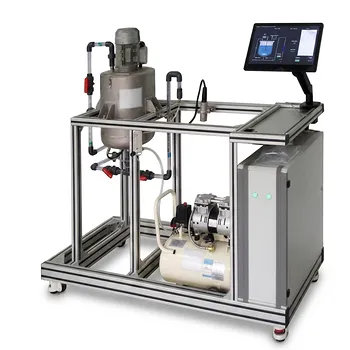
Optical rotation converts a molecular property—chirality—into a measurable angle change, making it possible to track sucrose hydrolysis in real time. The sugar solution rotates plane-polarized light; as sucrose breaks down into glucose and fructose, the net rotation shifts from positive (dextro) to negative (levo). Because this angle change is directly proportional to the extent of reaction, a simple polarimeter can replace time-consuming chemical titrations and deliver continuous kinetic data from a bioprocess unit.
The core principle is chiroptical inversion: sucrose is dextrorotatory, but its hydrolysis yields a mixture that is strongly levorotatory due to the large negative optical activity of fructose. Monitoring the rotation angle as it passes through zero and approaches a final steady value gives a direct, real‑time signal that tracks the reaction’s progress, enabling straightforward first‑order kinetic analysis without breaking the sterile loop.
The Physics Behind Optical Rotation
Chirality and Plane‑Polarized Light
A molecule is optically active when it is chiral—non‑superimposable on its mirror image.
Sucrose, glucose, and fructose all contain multiple chiral carbon atoms, so each interacts with plane‑polarized light, rotating the plane of oscillation by a characteristic amount.
Specific rotation ([\alpha]^{20}_D) quantifies this ability under standard conditions (20 °C, sodium D‑line).
A positive value means the plane turns clockwise (dextrorotatory); a negative value means it turns counter‑clockwise (levorotatory).
Why the Rotation Changes During Hydrolysis
Sucrose is a disaccharide with a specific rotation of +66.37°.
When it hydrolyzes, one molecule of sucrose produces one molecule of glucose (([\alpha]^{20}_D = +52.7°)) and one molecule of fructose (([\alpha]^{20}_D = -92°)).
The resulting equimolar mixture has an average specific rotation around −19.65°—a levorotatory value.
Therefore, as the reaction proceeds, the net optical rotation of the solution moves from a large positive number, crosses zero, and finally plateaus at a negative limit. This is the classic sucrose inversion.
From Light Rotation to Reaction Kinetics
The Direct Proportionality to Concentration
In dilute solutions, the observed rotation angle (\alpha) is linearly related to concentration.
For binary mixtures of a reactant and a product, the change in rotation (\alpha_t - \alpha_0) is directly proportional to the amount of sucrose that has been consumed at time (t).
This means a simple polarimeter reading can give an instantaneous progress variable without withdrawing samples for wet chemistry.
Inline or offline polarimeters integrated with a pilot bioreactor turn the reactor itself into a kinetic instrument.
Calculating the Rate Constant
Sucrose hydrolysis follows first‑order kinetics when water is in large excess.
The rotation data yield the fraction of sucrose remaining: (\frac{\alpha_t - \alpha_\infty}{\alpha_0 - \alpha_\infty}).
Plotting the logarithm of this fraction against time gives a straight line whose slope is the first‑order rate constant (k).
The entire measurement can be automated, eliminating subjective endpoint titrations and providing more data points for accurate kinetics.
Understanding the Trade‑offs
Temperature Sensitivity
Specific rotation changes with temperature; a 1 °C drift can shift the reading by several tenths of a degree.
Precise work requires a jacketed polarimeter tube or an inline sensor with thermal compensation, which adds complexity to the bioprocess skid.
Mutarotation Dynamics
Freshly dissolved glucose and fructose exist in multiple anomeric forms that equilibrate over time, temporarily altering the measured rotation.
If measurements are taken too quickly after sampling, the rotation may not reflect the true equilibrium composition, introducing systematic error.
Interference and Clarity
Polarimetry demands an optically clear solution—air bubbles, cell debris, or suspended solids scatter the light and degrade the signal.
In complex fermentation broths, this limits the technique to clarified or cell‑free streams, often requiring a sampling loop with a filtration step.
Making the Right Choice for Your Bioprocess Unit
Apply this principle strategically based on your primary goal:
- If your primary focus is kinetic accuracy: Use a temperature‑controlled flow cell and allow at least an hour for mutarotation to stabilize before reading each sample.
- If your primary focus is process intensification: Deploy an inline polarimeter with automated baseline correction and model‑based compensation for temperature drift.
- If your primary focus is education and simplicity: Choose an offline manual polarimeter with a jacketed tube; it gives students a tangible, visual demonstration of inversion without complex automation.
- If your primary focus is sterility and speed: Integrate a non‑invasive polarimetric probe directly into the recycle loop, avoiding sample withdrawal altogether.
You now have a physical principle that transforms a simple angle measurement into a window on reaction dynamics—use it to turn your bioreactor into a research‑grade kinetic tool.
Summary Table:
| Substance / State | Specific Rotation ([\alpha]^{20}_D) | Optical Property |
|---|---|---|
| Sucrose (Reactant) | +66.37° | Dextrorotatory (Clockwise) |
| Glucose (Product) | +52.7° | Dextrorotatory (Clockwise) |
| Fructose (Product) | -92.0° | Levorotatory (Counter-clockwise) |
| Equimolar Mixture (Final) | ~ -19.65° | Levorotatory (Inverted) |
Bring Real-Time Bioprocess Analytics to Your Lab
Teaching kinetic analysis and scaling up bioprocesses requires reliable, hands-on equipment. LABPARK provides state-of-the-art Educational and Vocational Unit Operations Pilot Plants in chemical engineering, bioprocess & biotech, and environmental & water treatment. Designed specifically for universities, research institutes, and enterprises, our pilot plants help students and researchers easily visualize and analyze complex chemical kinetics.
Ready to elevate your training and research capabilities? Contact LABPARK today to find the ideal pilot plant solution for your facility!
Related Products
- High-Gravity Emulsification and Mass Transfer Educational Pilot Plant
- Multifunctional Membrane Separation Educational Pilot Plant with Ultrafiltration, Nanofiltration, Reverse Osmosis
- Bio-fermentation Ethanol Production Practical Training Unit Operations Pilot Plant
- Hot Filtration Educational Unit Operations Pilot Plant Laboratory System
- Agitation and Mixing Educational Unit Operations Pilot Plant
People Also Ask
- How to update chemometric calibration models in pilot plants? Best practices for process engineers.
- Why is Peng-Robinson preferred over SRK? Enhance thermodynamic modeling in educational pilot plants.
- Why is continuous measurement preferred over manual sampling in pilot plants? Get real-time kinetic insights.
- How does temperature affect mass transfer rates in chemical engineering educational pilot plants?
- Why Compare Membrane-Reservoir Models with Pilot Plant Data? Ensure Successful Process Scale-Up