Water splitting in mixed-bed electrodeionization (EDI) is not a malfunction—it is a deliberate, localized electrochemical event that converts water molecules into hydrogen and hydroxyl ions directly inside the resin bed. The phenomenon occurs at the physical contact points between anion-exchange and cation-exchange resin beads, where ion depletion raises electrical resistance and triggers water dissociation. This in-situ acid–alkali generation continuously regenerates the ion-exchange resins, eliminating the need for external chemicals and sustaining low electrical resistance and high current efficiency in pilot and full-scale systems.
While water splitting in EDI might sound like a side reaction, it is actually a controlled and essential operating principle of mixed-bed systems. By exploiting the resin-to-resin contacts as microscopic bipolar interfaces, the process self-regenerates the ion-exchange media, making long-term, chemical-free deionization possible.
The Electrochemical Mechanism at Resin Contact Points
Mixed-bed EDI relies on an electric field applied across compartments filled with intermixed cation- and anion-exchange resins. Current flows through the conducting resins and the interstitial water. The crucial mechanism unfolds where a cation bead physically touches an anion bead.
How Ion Depletion Creates the Splitting Zone
At an A-to-C contact, the current must switch from anion conduction to cation conduction.
Anions arriving at the anion bead surface are drawn into the bead, while cations nearby are pulled into the cation bead. This simultaneous extraction strips the interstitial liquid of virtually all free ions in that micro-region.
The local solution concentration drops to an ultrapure level – near the theoretical limit of deionised water.
With no mobile ions to carry the current, the electrical resistance of that thin liquid film skyrockets. The voltage drop across this high-resistance gap rises sharply, creating the energetic condition needed for water splitting.
Why Water Dissociates at the Depleted Contact
Water molecules can dissociate into H⁺ and OH⁻ when a sufficient potential gradient is applied across a narrow, ion-depleted zone.
The thermodynamic potential for water splitting is about 0.83 V at 25 °C, but the actual overpotential depends on the electrode materials and the local field strength. In the resin contact gap, the combination of extreme dilution and high field intensity makes water dissociation kinetically favorable.
The products of splitting are immediately sequestered by the nearest resin beads.
The hydrogen ion (H⁺) migrates into the cation-exchange bead, converting it to the fully regenerated H⁺ form. The hydroxyl ion (OH⁻) moves into the anion-exchange bead, converting it to the OH⁻ form. Thus, the very event that would normally be a parasitic loss becomes a regeneration pulse.
How Water Splitting Transforms System Performance
Water splitting is not just a curiosity; it fundamentally changes the performance profile of a mixed-bed EDI pilot system. Its effects cascade through electrical, chemical, and operational dimensions.
Continuous Regeneration Eliminates Chemical Dosing
The acid and base needed to keep ion-exchange resins active are produced exactly where they are needed—right at the resin surface.
This eliminates the need for periodic off-line chemical regeneration cycles using concentrated acids and caustic solutions. For a pilot plant, this means continuous, unattended operation with no hazardous chemical handling.
The process sustains a steady-state population of highly conductive H⁺- and OH⁻-form resins.
Because H⁺ and OH⁻ ions are intrinsically more mobile than other cations or anions, the regenerated beads exhibit much lower electrical resistance than their salt-form counterparts. The entire bed maintains a low voltage drop, reducing the energy consumption of the EDI stack.
Enhanced Current Efficiency and Water Purity
Current efficiency improves because a significant portion of the applied electric work goes into splitting water, whose ions directly regenerate the media.
Instead of using current only to transport impurities out of the feed water, the system also dedicates energy to maintaining the resin’s active form. This dual use of current pushes the overall ion-removal capacity higher without a proportional increase in power consumption.
The resulting product water achieves high resistivity with extremely low silica, boron, and TOC leakage.
Because any residual weakly-ionised species (like silica) encounter freshly regenerated anion resins, their removal is highly efficient. This makes mixed-bed EDI with controlled water splitting a go-to choice for polishing loops in pilot ultrapure water production.
Maintaining a Stable Ion-Lean Environment
The acid and base generated locally suppress the pH excursion that would otherwise occur near membranes in a depleted solution.
Water splitting buffers the micro-environment, preventing extreme local pH conditions that could stress ion-exchange membranes or promote scaling. The result is a more robust, longer-lasting system with fewer fouling events.
Understanding the Trade-offs
While water splitting is engineered into mixed-bed EDI, it is not without limitations. Uncontrolled or excessive splitting can introduce new challenges that pilot operators must manage.
Risk of Local Overheating and Gas Evolution
If the current density is pushed too high, the rate of water splitting can lead to Joule heating in the highly resistive contact zones.
Local temperature increases may degrade the mechanical integrity of resin beads or accelerate membrane ageing. Furthermore, at extreme voltages, side reactions can evolve hydrogen and oxygen gases, creating noise in resistivity sensors and potentially obstructing spacer channels.
Potential for Scaling and pH Extremes
In feed waters containing hardness ions, excessive OH⁻ production at anion resin sites can create alkaline micro-zones that precipitate calcium or magnesium salts.
This risk is generally low in well-designed pilot systems with proper pretreatment (e.g., reverse osmosis permeate), but still requires monitoring. Operators must balance the regeneration benefit against the possibility of mineral scaling on resin surfaces.
Resin Degradation Over Very Long Runs
Repeated, intense hydration/dehydration cycles at the contact points may cause physical wear and fragmentation of resin beads.
While modern EDI-grade resins are engineered to withstand such conditions, pilot studies running for thousands of hours should include periodic resin integrity checks to ensure the mixed bed’s uniformity is maintained.
Making the Right Choice for Your Goal
Managing water splitting effectively depends on aligning your operating philosophy with the desired outcomes. For a pilot-scale mixed-bed EDI system, consider these goal-driven recommendations:
- If your primary focus is maximum water quality with minimal chemical inventory: Design the system to operate at a moderate current density where resin-contact water splitting is active but not excessive. This maintains a high proportion of H⁺/OH⁻-form resins and continuous regeneration without excessive heat or gas.
- If your primary focus is energy efficiency and lowest operating cost: Tighten pretreatment (RO permeate, CO₂ degassing) to minimise the ionic load on the EDI, then run at a current setpoint that just surpasses the mass-transfer limiting current. This ensures splitting occurs only where needed, keeping voltage and power consumption low.
- If your primary focus is long-term reliability and minimal maintenance: Monitor voltage-current curves and differential pressure regularly. A gradual increase in stack resistance despite stable flow and feed conductivity may signal resin degradation or scaling from unbalanced splitting; proactive cleaning or current adjustment will extend the pilot’s service life.
By treating water splitting as a manageable design parameter rather than a disturbance, mixed-bed EDI pilot systems achieve a unique balance of self-regeneration, high purity, and operational simplicity that no other continuous deionisation process can match.
Summary Table:
| Phase / Aspect | Electrochemical Process | Impact on EDI Performance |
|---|---|---|
| Ion Depletion | Local solution concentration drops to ultrapure levels at A-to-C resin contact points. | Triggers high local electrical resistance and voltage gradient. |
| Water Dissociation | Water splits into $H^+$ and $OH^-$ under high field intensity. | Generates regeneration ions ($H^+$/$OH^-$) in-situ without external chemicals. |
| Resin Regeneration | $H^+$ and $OH^-$ ions migrate into respective cation/anion beads. | Lowers bed resistance, improves current efficiency, and ensures high water purity. |
| Operational Trade-offs | Excessive splitting can cause Joule heating or mineral scaling. | Requires monitoring of current density and feed water hardness to prevent degradation. |
Optimize Your Water Treatment Research with LABPARK
Are you looking to master electrodeionization (EDI) and advanced water purification technologies in your lab or training facility?
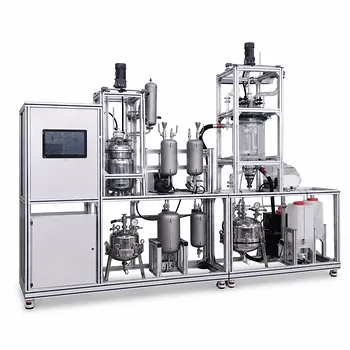
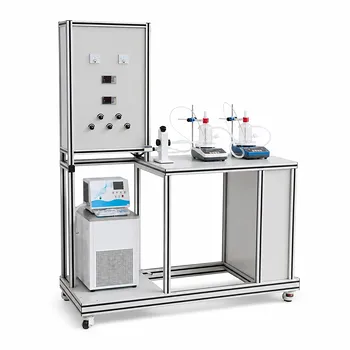
LABPARK provides state-of-the-art Educational and Vocational Unit Operations Pilot Plants in chemical engineering, bioprocess & biotech, and environmental & water treatment. Designed specifically for universities, research institutes, and enterprises, our pilot systems offer hands-on experience with real-world electrochemical processes, ensuring your research and training are at the cutting edge.
Contact LABPARK Today to discover how our custom pilot plant solutions can elevate your operations!
Related Products
- Multi-Reactor Educational Pilot Plant for Reaction Engineering Unit Operations
- Multi-Functional Drying Educational Unit Operations Pilot Plant
- Electrolyte Distillation Purification and Formulation Educational Pilot Plant
- Electrolytic Hydrogen Production Educational Unit Operations Pilot Plant
- Alkaline Membrane Water Electrolysis Educational Pilot Plant Unit Operations Training System
People Also Ask
- How do reactor pilot plants define QbD design space? Master chemical process scale-up.
- When configuring a reactor unit operations pilot plant for highly exothermic reactions, how to prevent thermal runaway?
- How do metal ion-catalyzed reaction mechanisms inform chemical engineering pilot plant design? From kinetics to scale-up
- What are the barriers to process intensification & how do pilot plants help?
- What role do educational pilot plants play in scaling green chemistry? Bridging the Lab-to-Industry Gap