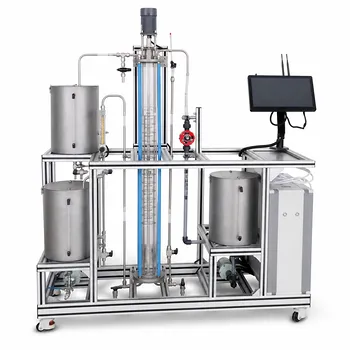
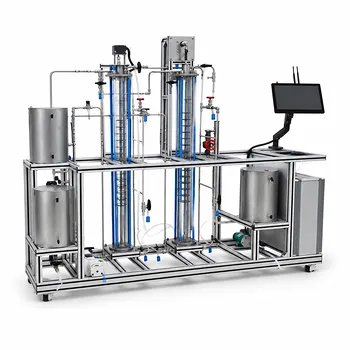
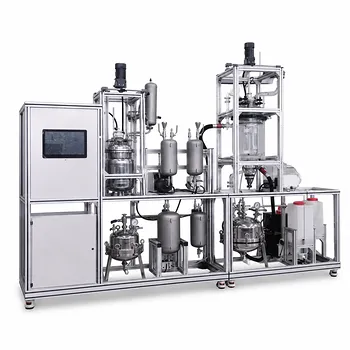
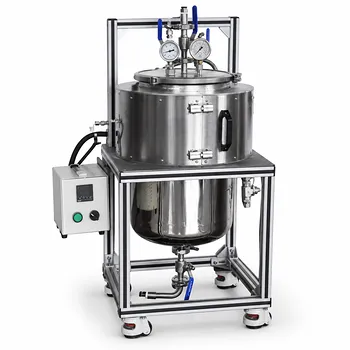
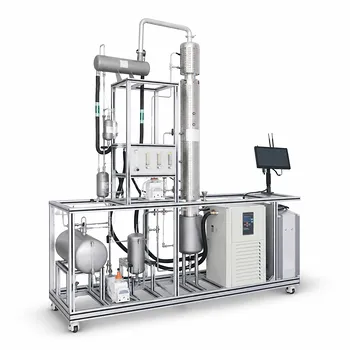
The ability to observe continuous, counter-current mass transfer in real time. This is the core value a continuous counter-current rotary extractor brings to a solid-liquid extraction pilot plant. It transforms extraction from a series of static batch experiments into a dynamic, steady-state process, allowing students and researchers to directly study how operating variables—like solid feed rate, rotation speed, and solvent spray pattern—govern extraction efficiency and stage-wise concentration distributions.
A rotary extractor is more than just equipment; it is a bridge. It connects the idealized world of theoretical stage calculations to the messy, continuous reality of industrial solid-liquid extraction, making it one of the most powerful teaching and research tools in the unit operations laboratory.
Moving Beyond the Batch Paradigm
The Fundamental Limitation of Batch Learning
Traditional undergraduate labs often rely on simple batch extractions—soaking a solid in a solvent, then filtering. This teaches basic mass transfer but completely misses the defining characteristic of most large-scale processes: continuity.
Batch experiments are transient and labor-intensive to run in sequence. Attempting to simulate a multi-stage counter-current process with a series of beakers or flasks is so tedious and error-prone that it obscures the underlying principles.
How the Rotary Extractor Enables Steady-State Analysis
A rotary extractor operates continuously. Solids are fed into rotating sectors, sprayed sequentially with solvent, and discharged—all while the system reaches a steady state. This allows students to measure constant outlet concentrations, a task impossible in a batch flask.
The rotating design inherently creates a counter-current flow of solids and solvent. This becomes an intuitive, physical demonstration of why the counter-current principle maintains a high mass transfer driving force, minimizing solvent use while maximizing solute recovery.
Unlocking Advanced Research Capabilities
Decoupling the Critical Process Variables
The real research value lies in isolating the variables. On a pilot-scale rotary extractor, a researcher can systematically change the solid feed rate, the solvent spray rate, and the rotation speed while holding other factors constant.
This experimental freedom allows for the creation of clear cause-and-effect models. You can determine, for example, whether mass transfer is limited by solvent contact time (rotation speed) or by the local solute loading in the solvent (spray rate per stage).
Mapping Stage-Wise Concentration Profiles
One of the most valuable data sets is the concentration of solute in the solvent at each individual stage along the extractor. This empirical profile can be plotted and directly compared against the step-wise predictions from graphical or mathematical models.
This comparison allows for the calculation of actual stage efficiency versus a theoretical ideal. It’s the moment where abstract McCabe-Thiele-type thinking for leaching becomes a tangible, measurable reality, illuminating the real-world impact of imperfect contact.
Bridging Theory and Industrial Reality
The pilot plant mirrors industrial units in miniature, incorporating mechanical factors like chamber division and solid transport. Students confront non-idealities head-on, such as channeling of the solvent, solids bed compaction, or carryover.
These operational insights are never found in a textbook. The experience of running this continuous equipment provides a fundamental understanding of how true industrial extractors function, directly preparing students for careers in process engineering.
Understanding the Trade-offs
The Challenge of True Steady State
While the goal is steady-state analysis, achieving and confirming it on a small pilot unit can be difficult. Fluctuations in solids feeding or solvent delivery mean the system may never perfectly stabilize, requiring students to engage in meaningful statistical data analysis to interpret their results.
Instrumentation and Data Interpretation
The value of the unit is proportional to its sensor suite. Without in-line concentration sensors, sampling is manual and destructive, which can disturb the system's dynamics. This teaches its own lesson about plant instrumentation, but it adds a layer of complexity to research design and can obscure the very mass transfer phenomena being studied.
Making the Right Choice for Your Goal
How you leverage this equipment depends entirely on your educational or research objective.
- If your primary focus is fundamental understanding: Use the extractor as a visual, hands-on proof of the counter-current principle. Focus on measuring the steady-state outlet conditions and confirming the huge leap in efficiency over a single-stage batch setup.
- If your primary focus is process optimization research: Design a factorial experiment around the key variables—rotation speed, feed rate, and solvent ratio. Your goal is to map the response surface for extraction yield and map it against the theoretical stage model to pinpoint the dominant limiting factor.
- If your primary focus is scale-up and industrial relevance: Center the investigation on stage efficiency. Plot the measured stage-wise profile, calculate the gap from the theoretical ideal, and discuss why that gap exists, connecting it to the design of commercial rotary extractors.
By strategically incorporating this one piece of equipment, a pilot plant transforms from a mere teaching lab into a miniature research center, delivering an education that is as deeply practical as it is theoretically rigorous.
Summary Table:
| Feature | Educational Value | Research & Industrial Value |
|---|---|---|
| Steady-State Analysis | Visualizes continuous, counter-current mass transfer | Enables accurate kinetic and flow modeling |
| Variable Control | Shows real-time effects of feed rate & rotation | Decouples process variables for optimization |
| Stage-Wise Profiling | Connects McCabe-Thiele theory to actual stages | Measures real vs. theoretical stage efficiency |
Elevate Your Chemical Engineering Lab with LABPARK
Are you looking to bridge the gap between theoretical calculations and industrial reality for your students and researchers? LABPARK provides premium Educational and Vocational Unit Operations Pilot Plants in chemical engineering, bioprocess & biotech, and environmental & water treatment.
Designed specifically for universities, research institutes, and enterprises, our pilot plants deliver the reliability, precise instrumentation, and hands-on experience your institution needs to excel.
Contact LABPARK today to customize your pilot plant solutions!
Related Products
- Educational Rotary Disc Liquid-Liquid Extraction Pilot Plant
- Comprehensive Liquid-Liquid Extraction Pilot Plant for Engineering Education
- Continuous Batch Extractive Distillation Educational Pilot Plant
- Gallium and Indium Selective Extraction Educational Pilot Plant
- Multi-Functional Special Distillation Educational Pilot Plant
People Also Ask
- How do density and IFT affect liquid-liquid extraction pilot plants? Optimize Column Performance
- How are ternary phase diagrams and LLE data applied in extraction experiments? Optimize Pilot Plant Scale-up
- In a liquid-liquid extraction pilot plant, how is a ternary-phase diagram utilized to determine solvent feed requirements?
- How Do Selectivity & Distribution Coefficients Influence LLE Pilot Plant Solvent Choice?
- How to Validate BIPs for LLE Pilot Plants? Steps to Align Simulations with Reality