The simple difference is that HHV gives you the total energy content of the fuel, while LHV tells you how much of that energy can actually raise the temperature of the combustion gases. Higher Heating Value (HHV) includes the latent heat released when water vapor condenses back to liquid; Lower Heating Value (LHV) does not. Since the water produced in a flame remains as vapor at the extreme temperatures of combustion, the energy that actually contributes to the gas temperature is the LHV. This directly determines the adiabatic flame temperature—the theoretical maximum temperature the products can reach if no heat is lost.
Core Takeaway: In any combustion process where the exhaust leaves as hot gas, the water in that exhaust does not condense. Therefore, LHV is the energy truly available to heat the products, and it is the correct basis for calculating the adiabatic flame temperature. Using HHV for this purpose would predict a temperature that is physically impossible under those conditions.
Unpacking the Two Heating Values
Higher Heating Value (HHV): The Total Energy Payload
HHV, also known as gross heating value, measures all the heat released when a fuel burns completely and the water product is condensed to a liquid state. This means it captures not only the sensible heat from the reaction but also the latent heat of vaporization released during the phase change. In essence, HHV treats the combustion as if you recover every possible bit of thermal energy, including what is “locked” in the steam.
Lower Heating Value (LHV): The Usable Heat for Gas-Phase Processes
LHV, or net heating value, assumes all water formed during combustion stays as vapor. It subtracts the latent heat of vaporization from HHV because that energy never entered the gas stream as sensible heat. For any application where the exhaust does not condense—such as a boiler without a condensing heat exchanger, a furnace, or a combustion pilot plant—LHV represents the realistic heat that can do useful work or raise temperatures.
The Simple Formula Connecting Them
The mathematical link is straightforward:
HHV = LHV + n · ΔHv(H₂O, 25°C)
Here, n is the number of moles of water produced, and ΔHv is the latent heat of vaporization of water at the reference temperature.
This equation shows exactly how much energy becomes unavailable for heating when water stays in the vapor phase.
In pilot plant experiments, comparing HHV and LHV immediately reveals the energy loss due to moisture in the flue gas.
From Heat Release to Flame Temperature
What Adiabatic Flame Temperature Actually Means
The adiabatic flame temperature (T_ad) is the theoretical ceiling: the temperature the combustion products would reach if the reaction goes to completion, all released energy heats only those products, and zero heat escapes to the surroundings. It is an idealized benchmark, but a powerful one, because it defines the worst-case thermal stress a combustion system will ever see. Engineers use this value not as an operating target, but as a design limit for materials, cooling systems, and safety interlocks.
The Direct Link: Why LHV Sets the True Temperature Ceiling
The adiabatic flame temperature is calculated from an energy balance: the heat released by the reaction equals the enthalpy rise of the products. Crucially, the heat available is the heat that can actually appear as sensible energy in those hot gases. At flame temperatures, water is a vapor—it cannot condense and give up its latent heat. Therefore, the energy that feeds the temperature rise is exactly the LHV, not the HHV. Any attempt to build the T_ad calculation on HHV would include phantom energy that never materializes as sensible heat, predicting a temperature that is higher than what physics allows.
Understanding the Trade-offs and Practical Implications
The Efficiency Trap: Why HHV Can Mislead
Using HHV when exhaust water remains vapor inflates apparent efficiency. Boilers and furnaces are frequently quoted with HHV-based efficiencies to show higher numbers, but actual net efficiency is governed by LHV. Unless the system includes a condensing heat exchanger that extracts the latent heat, any efficiency based on HHV represents energy you never capture. In education and pilot-plant design, comparing HHV- and LHV-based efficiencies teaches a critical lesson: what you cannot condense is lost, not recovered.
Material Selection and Safety: The T_ad Reality Check
The adiabatic flame temperature based on LHV is the true thermal stress your combustion chamber walls, refractory liners, and alloys must withstand. Designing to an inflated T_ad derived from HHV would force over-specification of materials and unnecessary cost, while still not protecting against the real limit. A correctly calculated LHV-based T_ad informs the selection of refractory materials that can survive the peak gas temperature, the sizing of cooling jackets, and the calibration of high-temperature safety interlocks. It anchors safe pilot plant operation by ensuring that all protective measures are matched to the genuine worst-case scenario.
The Broader Energy Balance Perspective
LHV governs the gas-phase thermal event, but HHV remains essential whenever condensation can be exploited. In combined heat and power systems with flue gas condensation, the HHV-to-LHV gap represents recoverable energy that can boost total system efficiency. The decision to use one value over the other always reduces to one question: Will the water vapor condense? If yes, HHV becomes relevant for total heat recovery. If no—and that is the case for the flame itself—LHV is the only honest reference.
Making the Right Choice for Your Calculation or Design
Your choice of heating value shapes everything from efficiency reporting to equipment survival. Align your reference with your actual physical process.
- If your primary focus is evaluating boiler or furnace efficiency with a non-condensing exhaust: Use LHV. It gives you the net efficiency that reflects the real usable heat, avoiding the false premium of latent heat you cannot access.
- If your primary focus is designing combustion chamber materials and setting safety interlocks: Base your adiabatic flame temperature calculation on LHV. This delivers the true peak gas temperature, ensuring your refractory, alloys, and cooling systems are properly rated without costly overdesign.
- If your primary focus is teaching fundamental thermodynamics or analyzing a condensing system: Compare HHV and LHV side by side. The difference quantifies the energy locked in the steam, making the concepts of latent heat and condensation losses immediately visible to students or stakeholders.
Your combustion system’s true performance and safety margins are written in LHV. Anchor your calculations there, and you will never mistake a theoretical energy bonus for a real flame.
Summary Table:
| Feature | Higher Heating Value (HHV) | Lower Heating Value (LHV) |
|---|---|---|
| Water State | Condensed (Liquid) | Vapor (Gas) |
| Latent Heat of Vaporization | Included in energy value | Excluded (subtracted from HHV) |
| Flame Temp. (T_ad) Role | Overestimates actual temperature | Accurate basis for gas-phase calculations |
| Primary Application | Total heat recovery (condensing boilers) | Standard boilers, furnaces, and pilot plants |
Master Combustion Unit Operations with LABPARK
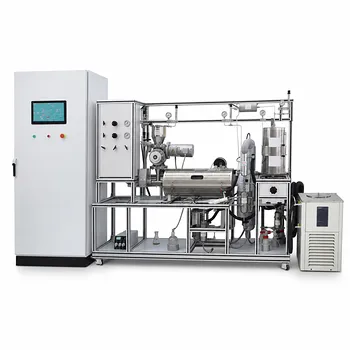
Bridge the gap between thermodynamic theory and real-world engineering. LABPARK provides state-of-the-art Educational and Vocational Unit Operations Pilot Plants in chemical engineering, bioprocess & biotech, and environmental & water treatment.
Designed specifically for universities, research institutes, and enterprises, our pilot plants allow students and researchers to safely study combustion kinetics, energy balances, and heat recovery processes in a controlled environment. Enhance your educational curriculum and research capabilities today.
Contact LABPARK to find the perfect pilot plant solution for your lab!
Related Products
- Methane Cracking Educational Unit Operations Pilot Plant
- Gas-Solid Heterogeneous Separation Demonstration Educational Unit Operations Pilot Plant
- Solid Waste Pyrolysis and Refining Educational Pilot Plant for Unit Operations
People Also Ask
- How do ethane vs naphtha cracking influence teaching pilot plant analytical configurations? Key Design Guide
- Why is a multibed configuration necessary for exothermic reactions? Optimize your pilot plant trajectory.
- What role do pilot plants play in waste reduction & resource recovery? Scale processes safely and optimize economics.
- What role do chemical engineering pilot plants play in teaching core unit operations? Bridging Theory and Practice
- How do environmental pilot plants facilitate bioremediation study? Scale cleanup processes.