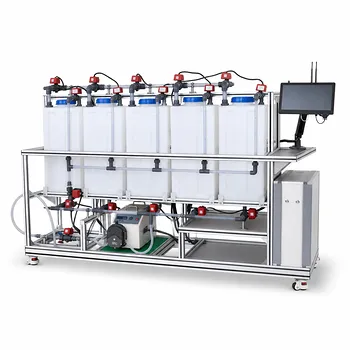
A plant designed to let students test Faraday’s laws must do more than simply split water—it must turn every ampere‑second into a data point they can trust. The heart of the design is a system that delivers a known, steady electrical charge while capturing the resulting products with enough precision to measure the theoretical yield. For gas evolution, this means a sealed, graduated collection apparatus with active pressure‑equalization and integrated temperature sensing. For metal deposition, it means transparent cells where the cathode can be weighed before and after, all backed by a power supply that meters charge in Coulomb or Ampere‑hour units.
The primary learning outcome is verifying that the mass or volume of a reaction product is directly proportional to the charge passed. To make that verification possible, the educational plant must feature four non‑negotiable elements: a traceable constant‑current source with integrated charge totalizer, transparent graduated reaction chambers with pressure‑equalization, built‑in temperature and pressure monitoring, and modular electrode assemblies. Without these, students are left calculating from manufacturer’s data sheets instead of observing the law themselves.
The Measurement Loop That Makes Faraday Tangible
Students can only confirm Faraday’s laws if they can accurately measure the two sides of the equation: electrical input and chemical output. The plant’s design must close that loop with minimal systematic error.
Precision Current Control and Charge Integration
A basic lab power supply is not enough. The plant must incorporate a regulated current source that can maintain a set current (e.g., 0.1 A to 2 A) even as cell resistance changes due to gas bubbles or temperature drift. More importantly, it should include a coulombmeter or ampere‑hour integrator that displays the total charge passed. This eliminates the need for students to manually time and integrate fluctuating readings—removing a major source of human error and making the linear relationship of Faraday’s first law directly visible.
Transparent, Graduated Gas Collection with Pressure Equalization
For gas evolution, a simple inverted graduated cylinder in a water bath is often misleading. The internal gas pressure can easily deviate from atmospheric, skewing volume readings. The educational plant must therefore incorporate a leveling tube or adjustable reservoir that allows the liquid column inside the collection tube to be matched to the liquid level outside. This ensures the gas sample is exactly at atmospheric pressure before the volume is read. The collection tube itself should be fabricated from clear borosilicate glass with precise, permanent graduation marks, and all joints must be gas‑tight using ground‑glass or O‑ring seals to prevent leakage of the low‑volume gas evolved.
Integrated Environmental Monitoring
Gas volume is only meaningful when corrected to standard conditions. A dedicated temperature sensor (thermocouple or RTD) placed in the collection tube or the water jacket must log the actual gas temperature. Alongside a barometric pressure reading, this allows students to correct for water vapor pressure and thermal expansion using the ideal gas law. Without this built‑in monitoring, the calculated molar volume or equivalent weight will always contain a bias that obscures the verification of Faraday’s second law.
Flexible Electrode Configurations
To demonstrate that the nature of the electrode reaction determines the amount of product, the plant should accommodate interchangeable electrode materials. For instance, having a setup where students can switch from copper deposition (two‑electron process) to silver deposition (one‑electron process) under identical charge conditions makes the concept of electrochemical equivalent concrete. Transparent cell windows let students observe the uniformity of the deposit and assess side reactions like dendrite growth, which can later be correlated with a current efficiency calculation.
Understanding the Trade‑offs and Common Pitfalls
A design that is too simplistic fails as a quantitative tool, but one that is over‑engineered can paralyze a teaching lab. The best educational plant is one where the trade‑offs are visible and can themselves become a teaching point.
- Sealed vs. simple gas containment: Full gas‑tightness with precision piston seals guarantees result accuracy but makes setup and cleaning time‑consuming. A practical compromise is using a semi‑sealed system with a thin layer of inert sealing liquid that allows some fraction of edge diffusion. The resulting 1–2 % leakage can then be turned into a class discussion on uncertainty budgets.
- Built‑in sensors vs. student‑managed instruments: Integrating temperature and pressure sensors directly into the cell reduces mistakes but can hide the physical meaning of the corrections. A plant that exposes the sensor wires and data logger software encourages students to program the ideal gas law themselves, deepening their understanding of why a 3 °C change alters the predicted hydrogen volume by nearly 1 %.
- Ampere‑hour meter vs. graphic data logging: A simple digital totalizer display gives immediate, satisfying confirmation of the linear relationship, while a data‑logging ammeter with PC output allows students to see transient spikes and analyze the effect of bubble screening on instantaneous current density. The latter adds complexity but is invaluable for advanced courses that explore current efficiency.
Making the Right Choice for Your Teaching Goals
The exact layout of the electrolysis plant should reflect the primary skill you want students to walk away with. Use the following goals to select which features to prioritize.
- If your primary focus is high‑precision gas stoichiometry: Insist on a twin‑chamber gas collection apparatus with laser‑etched graduated tubes, pressure‑equalization reservoirs for both anodic and cathodic gases, and individual temperature probes in each gas envelope. This configuration allows a direct, quantitative verification of the 2:1 H₂:O₂ volume ratio and the calculation of the Faraday constant.
- If your primary focus is the classic metal deposition experiment: Opt for a shallow, optically clear cell with a large‑area cathode that can be easily removed, dried, and weighed on an analytical balance. Prioritize a power supply with an extremely stable current output and a precision charge integrator, as the mass gain will be directly compared to the theoretical gram‑equivalent weight.
- If your primary focus is exploring process efficiency and real‑world losses: Incorporate sensors for pH and solution conductivity into the design. This allows students to measure how the cell voltage deviates from the theoretical decomposition voltage and to calculate voltage efficiency. The trade‑off is a more complex hydraulic loop and a need for sensor calibration training.
Ultimately, the best educational unit operation is one that turns a beautifully simple proportionality—mass ∝ charge—into an unarguable, student‑measured fact. By embedding the necessary metrology into the plant itself, you remove the invisible obstacles that separate a demonstration from a true verification.
Summary Table:
| Key Design Feature | Technical Specification | Educational Purpose |
|---|---|---|
| Precision Current Control | Regulated current source with coulombmeter | Eliminates human timing error; directly displays charge passed |
| Graduated Gas Collection | Sealed borosilicate tubes with leveling reservoirs | Guarantees gas is measured at true atmospheric pressure |
| Environmental Monitoring | Integrated temp/pressure sensors (RTD/barometer) | Allows students to apply the ideal gas law to volume data |
| Modular Electrode Assembly | Interchangeable metals (e.g., Copper, Silver) | Demonstrates how reactant valence affects deposition mass |
Optimize Your Teaching Lab with LABPARK
To help students successfully bridge the gap between theory and physical observation, high-precision training equipment is essential. LABPARK provides advanced Educational and Vocational Unit Operations Pilot Plants in chemical engineering, bioprocess & biotech, and environmental & water treatment designed for universities, research institutes, and enterprises.
Our electrolysis and chemical pilot plants are engineered with integrated metrology and transparent components, allowing students to generate clean, reliable data.
Contact LABPARK today to find the perfect pilot plant configuration for your educational goals!
Related Products
- Electrolytic Hydrogen Production Educational Unit Operations Pilot Plant
- Alkaline Membrane Water Electrolysis Educational Pilot Plant Unit Operations Training System
- Electrochemical Water Treatment Educational Unit Operations Pilot Plant
- Water Electrolysis Hydrogen Production and Storage Educational Pilot Plant
- Rising and Falling Film Evaporation Educational Unit Operations Pilot Plant
People Also Ask
- In educational chemical engineering pilot plants, why use absorption and adsorption before reforming?
- How do chemical engineering unit operations pilot plants demonstrate catalytic high-purity hydrogen production from methane?
- SMR, POX, or ATR? Trade-offs in Hydrogen Production Educational Pilot Plants
- How do educational unit operations pilot plants address safety and waste management when scaling up?
- How do educational unit operations pilot plants bridge theory and industrial process development? Hands-On Learning