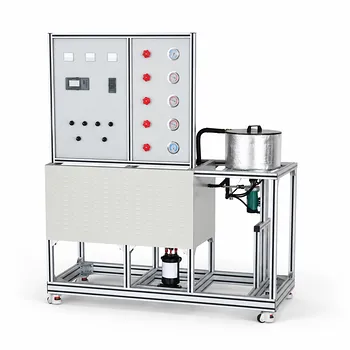
The immediate, practical answer is that a fast loop sample conditioning system lets you control the sample's physical state, protect the sensor, and perform calibration without ever shutting down the pilot plant. It avoids the fouling, temperature instability, and blocked reference measurements that plague direct in‑reactor insertion probes.
While direct insertion probes eliminate transport delay, they often sacrifice the very analytical accuracy and uptime that pilot plants need. The fast loop’s ability to condition the sample—controlling pressure, temperature, and cleanliness—turns a fragile measurement into a robust, calibratable, and maintainable process analytical technology.
Moving the Sensor Out of the Reactor Solves the Core Fouling and Access Problem
Direct probes live inside the reactor or transfer line. They see everything the process throws at them, and in a pilot plant, that often means frequent fouling, temperature swings, and no easy way to check if the signal is still valid.
Why In‑Reactor Probes Struggle in Pilot Environments
Process flows can create dead spots around the probe tip, accelerating coating and biological or polymer build‑up. At the same time, high temperatures degrade optical components and can even cause stray blackbody radiation that corrupts the spectrum. Meanwhile, fluctuating pressures risk blowing out window seals or pulling the window inward during vacuum upsets, risking contamination.
The Fast Loop Decouples the Sensor from Extreme Process Conditions
By pulling a small side‑stream through a conditioned loop, you place the sensor in a controlled, low‑stress environment. You can install flow cells with windows that never see the full reactor temperature or pressure, and you can add back‑pressure regulators to prevent the sudden pressure drops that cause cavitation and bubbles—the number‑one optical noise source.
Calibration and Reference Measurements Become Routine, Not Events
Pilot plants live on reliable reference data to validate models and scale‑up predictions. Direct probes make referencing an ordeal because you cannot easily insert a standard without stopping the process.
Standardizing Without Process Interruption
A fast loop lets you switch the sample cell inlet to a reference or calibration fluid while the reactor keeps running. You can verify the sensor’s response, run a blank, or inject a spike standard in minutes, building the trust needed for quantitative spectroscopy.
The Temperature‑Stability Advantage
Spectroscopic signals are temperature‑sensitive, yet direct probes often sit in streams with ±10°C swings. A fast loop can include a thermostatic jacket or heat exchanger, holding the sample at exactly the right temperature—crucial for NMR where temperature fluctuations degrade magnetic field homogeneity, or for NIR where subtle peak shifts matter.
Protecting the Sensor Is Also Protecting Your Data
The supplementary references note a sobering statistic: in many chemical and petrochemical installations, over 80% of maintenance problems originate in the sampling system. That’s often because a poor design introduces dead legs, cold spots, or fails to filter out trouble.
Filtration Keeps Optics and Magnetic Fields Clean
For techniques like NMR, even trace paramagnetic particulates (like rust) distort the magnetic field and ruin spectra. Fast loops let you install a filter right before the flow cell, removing the iron fines or catalyst particles that a bare in‑reactor probe would inevitably accumulate.
Turning Unplanned Maintenance into Scheduled Servicing
When a direct probe fouls mid‑campaign, you either lose the data or risk a shutdown. A fast loop can often be isolated and cleaned—a five‑minute job that doesn’t touch the reactor, keeping your pilot plant’s runtime high and the cost of ownership low.
Understanding the Trade‑offs
No solution is perfect, and fast loops introduce their own constraints you must manage consciously.
- Transport delay: The sample takes seconds to reach the sensor. For blind, safety‑critical control loops, that latency may be unacceptable, and a direct probe might still win.
- Sample representativeness: A poorly designed loop can add dead volumes, cause phase separation, or cool heavy streams enough to drop out waxes. You must heat or dilute the loop as needed to preserve the exact physicochemical state.
- Added complexity: Pumps, tubing, filters, and back‑pressure valves demand a sound design upfront. If you ignore this, you’ll simply trade in‑reactor fouling for maintenance headaches in the sample system itself.
Making the Right Choice for Your Pilot Plant
Your decision turns on whether you prioritize uptime and quantitative accuracy or zero‑millisecond response.
- If your primary focus is robust, calibratable measurements over a long campaign: Design a fast loop that controls pressure, temperature, and cleanliness. You’ll save countless hours of troubleshooting and gain reference data you can trust.
- If your primary focus is capturing sub‑second reaction transients where any delay is dangerous: A direct insertion probe may be justified, but you must budget for frequent cleaning and the fact that your absolute accuracy will suffer.
- If your pilot plant runs heavy or waxy streams or generates particulates: The fast loop with upstream filtration and heating is effectively mandatory—without it, direct probes will fail quickly and silently.
Ultimately, the fast loop doesn’t just make the measurement work; it makes the measurement reliable, maintainable, and defensible—turning your spectrometer into a true process analytical tool rather than a fragile lab curiosity in a reactor port.
Summary Table:
| Feature | Fast Loop Sample Conditioning | Direct In-Reactor Probes |
|---|---|---|
| Fouling Control | High; easily isolated & cleaned without shutdown | Low; prone to coating, requires plant shutdown |
| Temp & Pressure | Stable; controlled via jackets & regulators | Fluctuating; risks spectral noise & window damage |
| Calibration | Routine; allows reference fluid injection | Difficult; cannot easily insert standards inline |
| Sensor Protection | High; inline filtration removes particulates | Low; direct exposure to harsh process elements |
Optimize Your Process Analytics with LABPARK
Ready to build a reliable and robust pilot plant? LABPARK provides state-of-the-art Educational and Vocational Unit Operations Pilot Plants in chemical engineering, bioprocess & biotech, and environmental & water treatment. Designed specifically for universities, research institutes, and enterprises, our systems ensure precise process control, easy maintenance, and maximum scale-up accuracy.
Don't let instrumentation fouling and calibration drift compromise your research data. Contact LABPARK today to discover how our custom-engineered pilot plant solutions can elevate your laboratory’s capabilities!
Related Products
- Residence Time Distribution and Reactor Flow Characteristics Determination Educational Pilot Plant
- Educational Compression Refrigeration Performance Determination Unit Operations Pilot Plant
People Also Ask
- Why is temperature regulation via a cooling jacket a critical feature in CSTR pilot plants used for laboratory training?
- What parameters to monitor transitioning from Batch to CSTR? Master Pilot Plant Setup
- How does steady-state multiplicity affect the operation and safety of exothermic reactions within a CSTR pilot plant? - Guide
- What is the significance of CSTR chaotic behavior? Master Reactor Safety
- How does CSTR cooling jacket design influence stability? Control reactor oscillations.