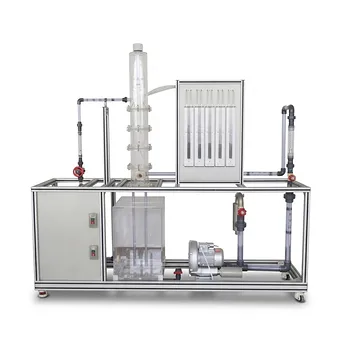
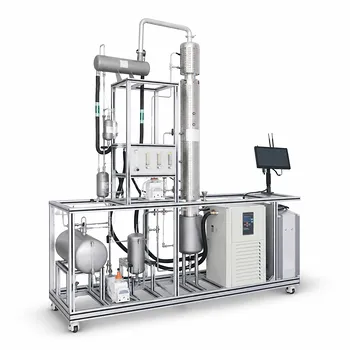
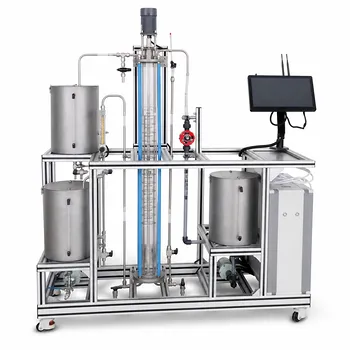
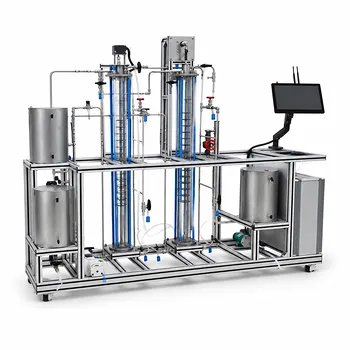
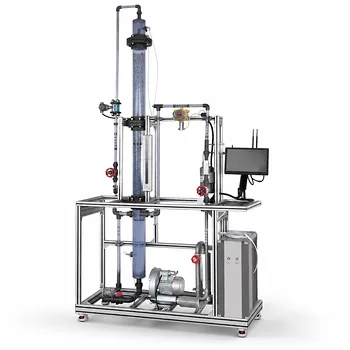
The fundamental operational difference between plate and packed columns in training comes down to how the gas and liquid phases interact: plate columns force a step-by-step, stage-by-stage mixing and separation, while packed columns enable a smooth, continuous contact along the entire height of the packing material.
For a chemical engineering student, plate columns are a physical representation of a staircase—each tray is a distinct equilibrium step. Packed columns, conversely, are a continuous ramp where the concentration gradient changes smoothly. This core distinction—discrete versus continuous contact—is the foundation for every other operational, maintenance, and efficiency consideration you'll encounter.
The Core Operating Principle: Staged vs. Continuous Contact
The heart of the operational difference lies in how mass transfer is achieved. The primary reference correctly identifies this as the defining characteristic, transforming how you visualize and calculate separation.
The Staged Contact of Plate Columns
In a plate column, the liquid flows horizontally across a tray. The vapor bubbles up from below through perforations or caps.
This forces the vapor and liquid to intimately mix and then separate on each individual tray. The concentration of the more volatile component will jump to a new, higher value as you move up from one tray to the next, creating a distinct step-change. For training, this makes tracking the separation visually and mathematically intuitive, as each tray represents one theoretical plate.
The Continuous Contact of Packed Columns
A packed column functions differently. Liquid is distributed over the top of a bed of structured or random packing and flows downward as a thin film.
Vapor travels upward through the voids in the packing, and mass transfer occurs continuously across the gas-liquid interface of the film. There are no discrete stages. Instead, the composition changes gradually from the bottom to the top of the column, and its performance is measured by Height Equivalent to a Theoretical Plate (HETP).
Key Performance Differences in an Educational Setting
Beyond the fundamental contact principle, several practical performance differences shape how these columns are used in a unit operations lab.
Pressure Drop Characteristics
One of the most measurable differences students will encounter is pressure drop. Packed columns offer a significantly lower pressure drop per theoretical stage compared to plate columns.
This makes them the ideal choice for demonstrating vacuum distillation, where minimizing pressure drop is critical to preventing thermal degradation of sensitive compounds. A packed column's design, with its open void spaces, inherently restricts gas flow less than the torturous path and liquid head on a tray.
Liquid Holdup and Operational Stability
Liquid holdup refers to the volume of liquid retained within the column at any given time. Plate columns have a substantially higher liquid holdup because of the liquid inventory required on each tray for bubbling to occur.
This high holdup is a major advantage for student operators. It acts as a buffer, making the plate column far less sensitive to fluctuations in feed rate or composition. For basic experiments focused on stable operation and sample collection, a plate column is more forgiving and easier to stabilize. Packed columns, with their low liquid holdup, respond rapidly to changes but can be harder for novices to troubleshoot.
Separation Efficiency Per Unit Height
For a given column height, a packed column will typically achieve a much higher degree of separation. This is because packings can provide many theoretical stages per meter of height.
In contrast, a plate column's efficiency is physically limited by tray spacing, often achieving fewer than two stages per tray. While the total height of a plate column might be taller for the same job, its discrete stages are invaluable for physically sampling and understanding the composition profile step-by-step, which is often the primary educational goal.
Understanding the Practical Trade-offs
Selecting the right column is an act of balancing these characteristics. A configuration that excels in one area will have a distinct weakness in another, and an expert engineer must understand both.
The Liquid Distribution Dilemma
The high efficiency of a packed column is entirely dependent on good liquid and vapor distribution. If the initial liquid distribution is poor, the liquid can channel down the wall or through specific paths in the packing, severely reducing the surface area available for mass transfer.
Plate columns are inherently self-distributing. The downcomers on each tray physically collect and re-distribute liquid to the tray below, making them far less prone to maldistribution and ensuring consistent stage performance, a key point for repeatable student results.
Sensitivity to Solids and Foulants
The physical structure of the internals dictates cleaning and fouling resistance. Plate columns, especially those with simple sieve trays, have relatively open spaces and can often handle some solids content. They are also easier to physically inspect and clean, as each tray can be accessed via manways.
Packed columns are highly susceptible to fouling. Solids can clog the small interstitial spaces in the packing, leading to increased pressure drop and flooding. They are absolutely not recommended for services involving suspended solids or substances prone to polymerization, making them a poor choice for certain demonstration feedstocks.
Making the Right Choice for Your Training Goal
The choice between a plate and packed column in a pilot plant should be directly tied to the specific learning objective or research goal.
- If your primary focus is visualizing stage-by-stage equilibrium: A plate column is your definitive choice. Its discrete trays allow students to measure the temperature and composition step-change, making theoretical plate calculations tangible.
- If your primary focus is demonstrating low-pressure-drop processes: A packed column is essential. Its hydrodynamic profile makes it the superior tool for vacuum distillation or absorption experiments where pressure drop is a critical design parameter.
- If your primary focus is operational simplicity and robustness: A plate column's high liquid holdup provides a buffer against operational errors, making it the ideal, stable platform for introductory labs where rapid stabilization is needed.
- If your primary focus is mimicking specific industrial kinetics: A packed column, like a trickle-bed reactor configuration, is the required choice for studying continuous mass transfer kinetics on thin liquid films, which directly mirrors processes like hydrodesulfurization.
The operational division between these columns is not about which is universally better, but about which physical mechanism—the discrete equilibrium staircase or the continuous gradient ramp—most capably answers your specific engineering question.
Summary Table:
| Operational Feature | Plate Columns | Packed Columns |
|---|---|---|
| Contact Type | Staged / Discrete trays | Continuous / Packing film |
| Pressure Drop | Higher | Lower (Ideal for vacuum) |
| Liquid Holdup | Higher (More stable/forgiving) | Lower (Faster response) |
| Fouling Sensitivity | Lower (Easier to clean) | Higher (Prone to clogging) |
| Primary Training Focus | Visualizing equilibrium stages | Low-pressure drop & kinetics |
Optimize Your Engineering Curriculum with LABPARK
Selecting the right distillation setup is key to effective student training. LABPARK designs and manufactures high-quality Educational and Vocational Unit Operations Pilot Plants in chemical engineering, bioprocess & biotech, and environmental & water treatment for universities, research institutes, and enterprises.
We help you bridge the gap between theory and industry practice with robust, safe, and highly visual training systems. Contact us today to request a quote and customize a pilot plant solution for your lab!
Related Products
- Plate Column Hydrodynamics Tray Demonstration Educational Pilot Plant
- Continuous Sieve-Plate Distillation Pilot Plant for Unit Operations Laboratory Education
- Dual-Mode Rectification Pilot Plant for Practical Training Unit Operations
- Educational Rotary Disc Liquid-Liquid Extraction Pilot Plant
- Constant Pressure Filtration Educational Unit Operations Pilot Plant
People Also Ask
- How to update chemometric calibration models in pilot plants? Best practices for process engineers.
- How does nuclear yield inefficiency translate to chemical engineering education? Optimize kinetics with pilot plants.
- How can educational pilot plants be used to teach process safety and risk assessment in chemical engineering curricula?
- Why Correct Sig Figs & Rounding Matter in Educational Pilot Plants: Ensure Data Accuracy
- Why Calculate Sieve Tray Pressure Drop? Optimize Distillation Pilot Plant Performance