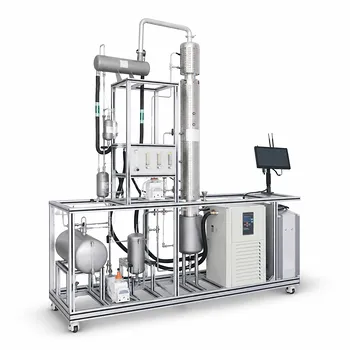
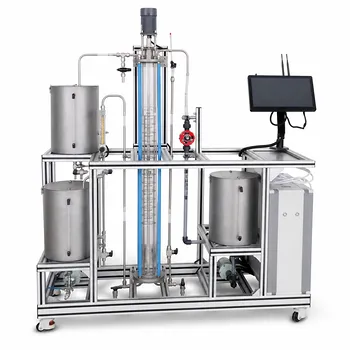
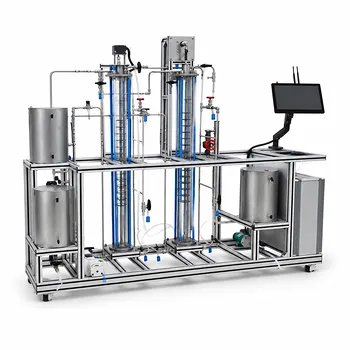
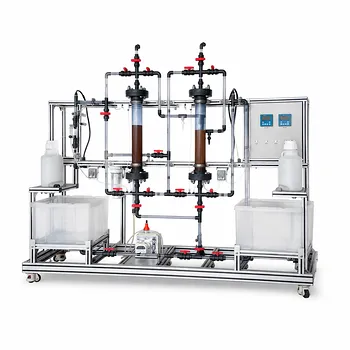
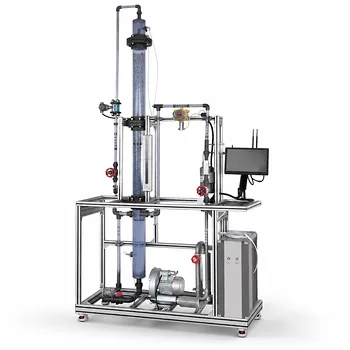
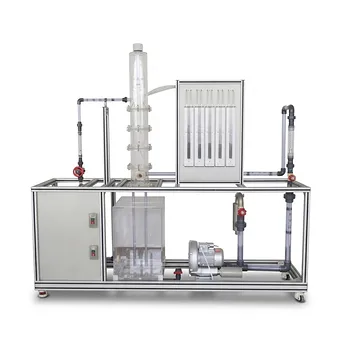
Choosing between a trayed and packed column for an educational distillation pilot plant is fundamentally a decision about what you want your students to see, measure, and internalize.
If your primary goal is to teach stage-by-stage equilibrium calculations, plate efficiency, and vividly demonstrate hydraulic phenomena like flooding or weeping, a trayed column is the superior choice. If your focus is on continuous-contact mass transfer, low-pressure-drop vacuum distillation, or HETP analysis, a packed column provides the ideal learning platform. For maximum pedagogical value, the best solution is often a pilot plant that allows you to swap internals or that houses both types—giving students a direct, side-by-side understanding of how design constraints shape separation performance.
The choice between trays and packing in an educational pilot plant is not about which technology is “better” in absolute terms. It’s a deliberate decision to spotlight specific mass transfer principles. Trays excel at making discrete stage concepts and column hydraulics tangible, while packing makes continuous contact and pressure-drop efficiency the hero. The highest-impact teaching lab will either employ interchangeable columns or run both types in parallel.
Matching Column Internals to Your Educational Blueprint
Every decision in a pilot plant should be traceable back to a learning outcome. Start by mapping the concepts your curriculum demands to the column type that makes them most observable and measurable.
Demonstrating Fundamental Mass Transfer Mechanisms
Trayed columns are built on stage-wise contact. Gas and liquid mix, approach equilibrium, and then separate on each physical plate. This makes them perfect for illustrating the McCabe‑Thiele method, stage efficiency, and how a concentration profile develops step by step. Students can physically count trays and see how far the real system deviates from an ideal stage.
Packed columns operate on continuous contact. Instead of discrete jumps, composition changes smoothly along the height of the packing. This is ideal for teaching transfer-unit concepts (NTU, HTU), HETP, and the kinetics behind interphase mass transfer. It shifts the conversation from “number of plates” to “height of packing needed for a given separation.”
Making Invisible Phenomena Visible
One of the greatest advantages of a trayed column in education is visual access. Through sight glasses or transparent column sections, students can watch liquid levels on a plate, diagnose the onset of weeping (liquid dripping through perforations), or observe entrainment as the column approaches flood. These real-time, visual cues cement hydraulic principles far more effectively than any textbook diagram.
Packed columns, by contrast, hide most of their magic. You rely on pressure-drop meters and temperature profiles to infer liquid distribution and flooding. While this teaches valuable instrument-based process diagnostics, it sacrifices the immediate visual learning that trays provide.
Designing Experiments Around Pressure Drop and Turndown
Pressure drop is a critical design parameter. Packed columns typically produce a significantly lower pressure drop per theoretical stage than trayed columns. This makes them the go-to choice if your pilot plant must demonstrate vacuum distillation or heat-sensitive separations, where keeping bottoms temperature low is essential.
Operating flexibility (turndown ratio) tells a different story. Trayed columns, especially those with valve or bubble cap trays, maintain stable efficiency over a much wider range of liquid and vapor loads than packed columns. If a key educational objective is to show how a column responds to feed rate fluctuations without losing separation quality, a trayed column will give you a far larger experimental window.
The Constraints That Shape Your Choice
Practicalities like cost, column diameter, and maintenance will narrow your options long before theory does.
The Diameter Rule of Thumb
Pilot‑plant columns used in teaching are almost always small in diameter—typically under 0.6 meters (24 inches). Packed columns are generally more cost‑effective and easier to install at this scale. Small‑diameter tray columns are possible, but plate fabrication becomes disproportionately expensive relative to the shell cost. If your budget is tight and your column diameter is fixed at pilot scale, random or structured packing will almost always win on upfront cost.
Handling Real‑World Fluids
Trayed columns are far more forgiving when your experimental fluids contain suspended solids, polymers, or fouling tendencies. Manways and removable trays allow for straightforward inspection and cleaning. Packed columns, with their tortuous flow paths and high surface area, are notoriously difficult to clean once fouled. If the pilot plant will be exposed to unreacted monomers or crude feedstocks, trayed construction dramatically reduces maintenance headaches.
Liquid Distribution and Low Liquid Loads
Packed columns demand high‑quality liquid distribution. Without a properly designed distributor, liquid can channel along the walls, severely degrading mass transfer efficiency. At very low liquid loads, packing may not fully wet, leading to a sharp drop in HETP performance. Trays do not suffer from this “minimum wetting rate” problem. So if your teaching labs will explore a wide range of reflux ratios—including very low ones—a tray column will give more consistent data with less experimental noise.
Understanding the Trade‑offs
No single column type is a silver bullet. Acknowledging where each falls short is the mark of a sound experimental design.
Tray columns trade off pressure drop and liquid holdup. They create a higher back‑pressure per theoretical stage, which can limit vacuum experiments. They also hold more liquid inventory, a serious consideration if the pilot plant handles hazardous or high‑value materials. While that holdup helps buffer against small disturbances, it increases the time needed to reach steady state.
Packed columns sacrifice broad turndown and direct visual insight. They are highly sensitive to maldistribution and performance collapses at low gas or liquid rates. The cost per unit volume of high‑efficiency structured packing can also be significantly higher than a few simple sieve trays. You gain separation power per meter of height, but you pay for it in packing cost and the need for sophisticated distribution hardware.
Making the Right Choice for Your Lab
The final decision hinges on which trade-offs serve your curriculum best. Use these goal-oriented guidelines to navigate the choice.
- If your primary focus is teaching stage‑by‑stage calculations and column hydraulics: Choose a trayed column. It turns weeping, flooding, and plate efficiency into observable, measurable phenomena that align directly with classic undergraduate mass transfer theory.
- If your primary focus is continuous‑contact mass transfer, vacuum distillation, or pressure‑drop minimization: Choose a packed column. It provides a cleaner platform for HETP, NTU/HTU experiments and makes low‑pressure operation practical at pilot scale.
- If your primary goal is to give students a complete, comparative understanding of column design: Invest in a modular pilot plant or a dual‑column setup where trays and packing can be swapped. The side‑by‑side data on efficiency, pressure drop, and turndown will become the most powerful learning tool in your unit operations lab.
The best educational distillation system is never the one with the most exotic internals—it’s the one that makes the core principles unmistakably clear and leaves your students with an intuitive feel for why column design matters in the real world.
Summary Table:
| Feature | Trayed Columns | Packed Columns |
|---|---|---|
| Core Learning Focus | Stage-wise equilibrium (McCabe-Thiele), plate efficiency | Continuous contact, HETP, HTU/NTU calculations |
| Visual Diagnostics | High (easy to observe weeping, flooding, entrainment) | Low (requires instruments to infer hydraulics) |
| Pressure Drop | Higher per theoretical stage | Significantly lower (ideal for vacuum operations) |
| Turndown Ratio | Excellent operating flexibility | Limited; highly sensitive to low liquid loads |
| Maintenance & Cleaning | Easier to inspect and clean (handles fouling/solids) | Difficult to clean; prone to channeling |
Elevate Your Chemical Engineering Lab with LABPARK
Choosing the right column design is critical for delivering impactful, hands-on student learning. LABPARK provides state-of-the-art Educational and Vocational Unit Operations Pilot Plants in chemical engineering, bioprocess & biotech, and environmental & water treatment for universities, research institutes, and enterprises.
We help you customize distillation systems—including trayed, packed, or dual-column configurations—to perfectly align with your teaching goals and budget constraints.
Ready to upgrade your lab? Contact LABPARK today to discuss your pilot plant requirements!
Related Products
- Multi-Functional Special Distillation Educational Pilot Plant
- Continuous Sieve-Plate Distillation Pilot Plant for Unit Operations Laboratory Education
- Multi-Modal Distillation Unit Operations Training Pilot Plant
- Continuous Batch Extractive Distillation Educational Pilot Plant
- Dual-Mode Rectification Pilot Plant for Practical Training Unit Operations
People Also Ask
- Why does simple distillation yield higher efficiency than flash distillation? Key thermodynamic differences.
- How to Integrate Spectroscopy in Distillation Pilot Plants for Advanced Process Control
- How does double temperature difference control improve distillation pilot plants? Stabilize purity.
- How to Estimate Distillation Pilot Plant Tray Efficiency? O'Connell's Correlation Guide
- How Batch vs Continuous Configuration Affects Distillation Pilot Plant Versatility & Footprint