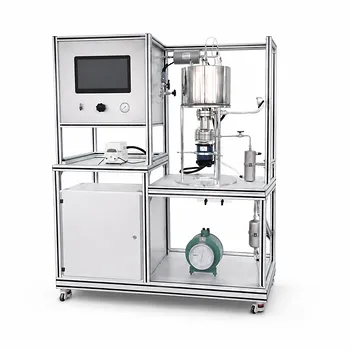
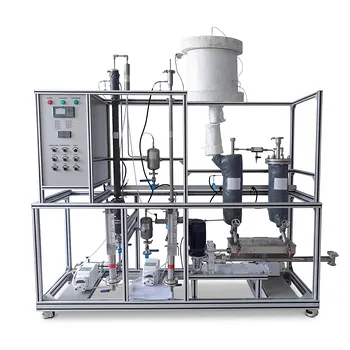
The relationship between reflux ratio and the number of theoretical stages fundamentally breaks down in a reactive distillation pilot plant. Unlike a conventional column, where increasing the reflux ratio can compensate for having too few stages to hit a purity target, this trade-off vanishes in reactive distillation. The reflux ratio controls not just separation, but also the liquid residence time on the catalyst. This dual function creates a non-linear system with a narrow, specific operating window, where your goal shifts from finding a simple operational balance to hunting for an exact, optimal reflux ratio that maximizes conversion.
The core challenge is a loss of degrees of freedom. In a standard column, reflux ratio and stages compensate for each other. In a reactive distillation column, the kinetics of the reaction impose a hard chemical constraint. You are not just moving mass; you are making product. The reflux ratio becomes the primary knob controlling both catalyst contact time and separation, meaning there is often no simple minimum reflux ratio, but rather a single peak performance point you must find experimentally.
Why the Classical Compromise Collapses
The fundamental rule you learn for a conventional pilot column—that operating cost (reflux ratio) and capital cost (number of stages) are interchangeable—is your first piece of baggage to drop. In a reactive column, the liquid flowing down the trays is your reaction medium.
The Kinetic Constraint on Degrees of Freedom
In a non-reactive column, the system's job is purely thermodynamic: separate components A and B. If your column has fewer theoretical stages than ideal, you simply increase the reflux ratio. You push more liquid down, improving the operating line and achieving the separation, albeit at a higher energy cost.
Reactive distillation adds a kinetic master. The reaction converting A and B into C requires time on the catalyst. When you increase the reflux ratio, you change the liquid composition on every tray. This alters the vapor-liquid equilibrium, but critically, it also changes the contact condition and the residence time of the liquid within the reactive zone. The system can no longer be optimized for separation alone; it must first satisfy the reaction. This added constraint consumes a degree of freedom, destroying the flexible trade-off you rely on in standard distillation.
The Hunt for the Optimum, Not the Minimum
Because of this kinetic constraint, the concept of a simple "minimum reflux ratio" often ceases to exist. You are not looking for the lowest energy input that achieves a purity spec. You are searching for a specific, optimal reflux ratio that delivers the highest reactant conversion and product yield.
- Too low a reflux: The liquid holdup drops, reducing residence time and starving the reaction. Conversion crashes, even if some separation is occurring.
- Too high a reflux: The internal flow rates surge. While this might improve separation, it can flood the catalyst packing, fail to provide the required activation energy, or simply dilute the reactants so much that the reaction rate drops.
Operating in this system means hunting for a performance peak, not just staying above a threshold. This is why an educational or research pilot plant must be an instrument of discovery, not just a production unit.
Translating Theory to the Pilot Plant
Your theoretical preparation for a reactive distillation run must be fundamentally different. The McCabe-Thiele method, Fenske equation, and constant HETP assumptions are tools for understanding, but they are not direct design prescriptions.
The Trap of Conventional Tools
A standard approach uses total reflux (R=infinity) to find the minimum number of theoretical stages (N_min) via the Fenske equation. This is a baseline performance metric for a conventional column. In a reactive system, this baseline is misleading. At total reflux, the column is in a state of zero production with infinite internal flows, a condition that bears no resemblance to the reactive steady state you need.
Similarly, standard stage-by-step calculations using rectifying line ($y_{n+1} = \frac{R}{R+1}x_n + \frac{x_D}{R+1}$) and stripping line equations assume a fixed separation problem. They cannot predict the composition profile when a reaction is actively consuming and generating species on each stage. You must treat these calculations as a starting hypothesis, not an operating manual. The real profile will be shifted by the reaction's thermal and compositional effects.
Designing the Pilot Plant Run
Your pilot plant must be configured to reveal the true interacting dynamics. The column hardware itself is your primary analytical tool.
Temperature sensors are no longer just indicators of separation. An exothermic reaction will create a thermal peak in the reactive zone, and near-isothermal operation is a key indicator that the heat of reaction is being effectively used for vaporization. Tracking this thermal profile at every stage shows you exactly where the reaction is occurring and whether it's coupled correctly with the separation.
Determining HETP also becomes complex. For a conventional column, a smaller HETP consistently means better separation per unit height. In a reactive column, the "best" HETP for a packed catalyst section is the one that balances separation efficiency with adequate liquid holdup and resistance to flooding. You are not minimizing HETP, but optimizing it for an integrated physical and chemical process.
Understanding the Trade-offs
Experimenting with a reactive distillation pilot plant means managing a new set of conflicts that don't exist in standard unit operations.
The Purity vs. Yield Paradox
In a conventional column, a higher reflux ratio reliably improves distillate purity at the cost of energy and a lower product flow rate. In a reactive column, a higher reflux ratio to chase purity can backfire catastrophically by reducing liquid residence time on the catalyst and destroying conversion. You must be willing to accept a different purity spec or a different column configuration to satisfy the reaction's kinetic need. The goal is not the purest possible distillate, but the most efficient production of the target chemical.
The Catalyst Packing Dilemma
The physical structure of your catalyst packing embodies the central trade-off. The catalyst must have a high surface area for liquid-catalyst contact and sufficient void fraction for vapor to rise. Pack it too tightly, and the liquid holdup is high, potentially causing column flooding. Use a loose, open structure, and the liquid flows through too quickly, reducing residence time and starving the reaction. Watch for signs of flooding or channeling, as this indicates the hydraulic limit of your reactive section has been reached, overriding your carefully set reflux ratio.
Data Overload During Optimization
When systematically varying the reflux ratio to find the optimum, you will generate a flood of data: flow rates, temperatures, and compositions at every stage. The pitfall is focusing on a single variable. You must correlate the reflux ratio change with the shift in the entire temperature profile, the pressure drop across the catalyst zone, and the final conversion. A seemingly stable reflux ratio can mask a migrating temperature front inside the packing, indicating a slow drift away from the optimal kinetic window.
Making the Right Choice for Your Pilot Plant Goal
Your operating strategy must align with whether you are characterizing a reaction or teaching a principle.
- If your primary focus is mapping the kinetic optimum: Plan a systematic sweep of reflux ratios at a constant feed rate and composition. Do not chase peak separation efficiency. Monitor conversion and the thermal profile across the reactive zone meticulously with stage-by-stage sensors to pinpoint the exact reflux ratio that yields the highest conversion, even if separation is not perfect. This ratio is your single most important finding.
- If your primary focus is demonstrating process intensification to students: Start the column at total reflux to establish a known, stable vapor-liquid equilibrium. Then, lower the reflux ratio in steps toward the reactive optimum, having students log how the operating lines on a McCabe-Thiele diagram begin to deviate from the theoretical line due to reaction effects. The lesson is the loss of the flexible compensatory relationship.
- If your primary focus is catalyst or packing evaluation: Keep the reflux ratio fixed at a known non-optimal but stable point. Then, swap the catalyst packing and compare pressure drops, liquid holdup estimates, and conversion at that fixed hydraulic condition. This isolates the catalyst's performance from the column's complex dynamic response function.
The reactive distillation column is not a scaled-down production unit but a precision instrument for discovery. By respecting its non-linear nature and using precise, stage-by-stage sensing, you move from simply operating equipment to uncovering the single point where chemistry and separation truly work together.
Summary Table:
| Operational Parameter | Conventional Distillation Column | Reactive Distillation Pilot Plant |
|---|---|---|
| Role of Reflux Ratio | Controls separation efficiency and product purity. | Controls separation and liquid residence time on the catalyst. |
| Reflux vs. Stages Trade-off | Flexible; higher reflux can compensate for fewer stages. | Collapses; kinetics impose a hard constraint on degrees of freedom. |
| Optimization Goal | Find the minimum reflux ratio to reduce energy costs. | Hunt for a single, optimal reflux ratio to maximize chemical conversion. |
| HETP Objective | Minimize HETP to maximize stages per unit height. | Optimize HETP to balance separation with required liquid holdup. |
Optimize Your Chemical Engineering Research with LABPARK
Mastering complex unit operations like reactive distillation requires highly precise and adaptable equipment. LABPARK provides premium Educational and Vocational Unit Operations Pilot Plants across chemical engineering, bioprocess & biotech, and environmental & water treatment.
Specially designed for universities, research institutes, and enterprises, our pilot plants feature advanced stage-by-stage sensing and robust control systems to help you accurately map reaction kinetics and optimize process efficiency.
Ready to elevate your lab's capabilities? Contact us today to discuss your custom pilot plant requirements!
Related Products
- Multi-Functional Special Distillation Educational Pilot Plant
- Continuous Sieve-Plate Distillation Pilot Plant for Unit Operations Laboratory Education
- Electrolyte Distillation Purification and Formulation Educational Pilot Plant
- Green Anhydrous Ethanol Purification Extractive Distillation Unit Operations Training Pilot Plant
- Dual-Mode Rectification Pilot Plant for Practical Training Unit Operations
People Also Ask
- Why does simple distillation yield higher efficiency than flash distillation? Key thermodynamic differences.
- How does double temperature difference control improve distillation pilot plants? Stabilize purity.
- How to Verify Distillation Boundary Lines & Composition Regions with Pilot Plants
- How Batch vs Continuous Configuration Affects Distillation Pilot Plant Versatility & Footprint
- How to Estimate Distillation Pilot Plant Tray Efficiency? O'Connell's Correlation Guide