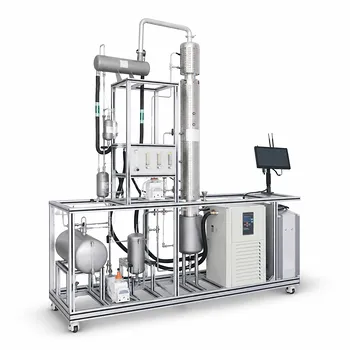
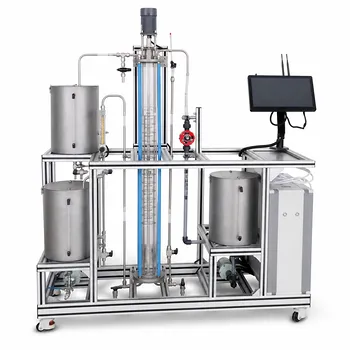
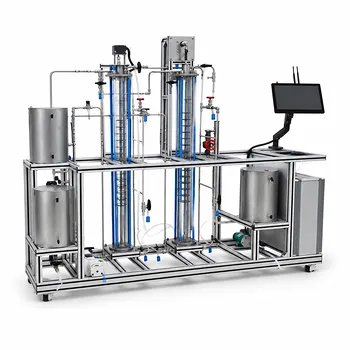
For an operational fractional distillation column, the non-negotiable goals of selecting and sizing internals are to maintain stable hydraulics, prevent damaging conditions like flooding, and achieve the required separation. The process starts by defining the column's mechanical dimensions and matching the internal type—trays or packing—to your specific mass transfer needs, whether that's visual stage-by-stage learning or maximizing contact area in a small footprint. The operating vapor velocity then dictates the column's diameter, and the required separation difficulty dictates its height, creating a delicate balance between performance and cost.
The critical decision hinges on a fundamental trade-off: trayed columns offer operational flexibility and clear visualization of hydraulics, while packed columns excel at reducing pressure drop and liquid holdup in small-diameter systems. Sizing them correctly means translating your process goal—be it educational demonstration or specific chemical separation—into precise hydraulic calculations, primarily determining diameter by managing gas velocity just below the flooding point.
Solving the First Challenge: Selecting the Right Internals
Your choice of internal device fundamentally shapes the column's behavior, cost, and suitability for an application. The selection is almost never about a "better" universal option but about the right fit for purpose.
Matching the Technology to Your Primary Objective
Trayed columns contain horizontal plates where liquid and vapor contact in discrete stages. This design is the gold standard for teaching fundamental chemical engineering principles. Students can directly observe phenomena like weeping, where liquid drips through the vapor holes, or flooding, where the column essentially chokes with liquid. Visually, the step-by-step contact is intuitive; mathematically, it translates directly to plate efficiency and stage-by-stage calculations. For pilot-scale operations, trays also provide practical advantages: they are easier to clean when handling solids or fouling liquids, and they readily accommodate side-stream withdrawals or internal cooling coils.
In contrast, packed columns use a continuous bed of material—either randomly dumped shapes like Raschig rings or structured corrugated sheets—to facilitate contact. Their defining characteristic is a significantly lower pressure drop per theoretical stage. This makes them the primary choice for vacuum distillation, where you cannot afford to lose driving force. They also have lower liquid holdup, meaning less process material is held up in the unit, a critical safety consideration with hazardous or expensive chemicals. The performance metric here is HETP (Height Equivalent to a Theoretical Plate), which connects the continuous contact reality to the familiar stage-wise model.
The Deciding Factor: Column Diameter
While both can work on a pilot scale, practicality often becomes the final decision-maker. For small-diameter columns, especially those under 0.6 meters, packed columns are generally more cost-effective and simpler to install correctly. Designing a functional and easy-to-fabricate tray layout for a very small cross-section is challenging and expensive. Therefore, in many research and small-scale teaching units, packing becomes the default sensible option unless the educational goal specifically requires a tray demonstration.
Solving the Second Challenge: Sizing the Column
Once the internal type is chosen, you must determine the column's two key dimensions: diameter and height. Sizing is not a guess; it is a hydraulic calculation rooted in managing vapor flow.
Sizing for Diameter: The Velocity Constraint
The column’s internal diameter is a direct function of the volumetric gas flow rate and the targeted operating gas velocity. The fundamental sizing equation is D = sqrt(4*Vs / (π*u)), where Vs is the vapor flow rate and u is the operating velocity. The art and science lie in choosing u. You don't pick an arbitrary number; you tie it to the system's physical limit—the flooding velocity (u_max)—the point where the vapor is moving so fast it physically prevents liquid from descending.
Standard practice is to set the operating velocity u as a fraction of the flooding velocity, typically between 50% and 85%. The specific fraction is a risk assessment:
- For systems prone to foaming, you must be conservative, selecting a low factor of 50% or less to maintain stable operation.
- For high-efficiency structured packing or pressurized systems, you can confidently push to a higher ratio, such as 60–80%, to maximize throughput.
In practical terms for pilot plants, this operating velocity generally falls within a range of 0.5 to 1.2 m/s. A second critical rule for packed columns specifically involves the ratio of column diameter to packing element size. To prevent liquids from finding a preferential path down the column wall—a phenomenon called channeling—you must maintain this ratio at 8 or above. Mismatching these sizes is a common cause of failed pilot-plant experiments.
Sizing for Height: The Efficiency Target
Column height is determined by the number of equilibrium stages needed, multiplied by either the tray spacing or the HETP. A standard starting point for tray spacing is 609.6 mm (24 inches). From there, this height is optimized. Tighter tray spacing reduces the total column shell height but at the expense of potentially more difficult maintenance and higher sensitivity to operational instability.
For packed columns, a taller bed of packing provides more theoretical stages but also introduces the risk of maldistribution. You can't simply stack packing to an infinite height and expect linear performance; redistribution systems must be built in at intervals to collect the liquid, mix it, and evenly distribute it back onto the next bed of packing.
Understanding the Trade-offs and Cost Drivers
An objective technical assessment requires a frank discussion of limitations and economics. The "best" technical solution can become the worst financial decision if not carefully evaluated.
Hydraulic Performance vs. Operational Flexibility
Trays provide a wide stable operating range. A valve tray, for instance, can adjust to a significant swing in vapor loads. The trade-off is a higher pressure drop. Packing offers the opposite: extremely low pressure drop and high efficiency at its design point, but with a much tighter operating range. A turndown in rate that a tray column handles easily might cause severe liquid maldistribution in a packed column, collapsing its efficiency. The frequent claim that one is "easier to install" than the other is contextual. Fabricating and installing a multi-pass tray array inside a vessel requires skilled labor, while dumping random packing is straightforward but can fail catastrophically if not wetted properly during commissioning.
Decoding the Cost Equation
Estimating internals cost is not a single-line item; models use power-law relationships and multiplicative factors that reveal hidden cost drivers. For trays, the cost scales with diameter to an exponent n (Cc = a + b*D^n). This exponent is higher for bubble cap and valve trays (around 1.9) than for simple sieve trays (around 1.8), quantifying the added manufacturing complexity of moving parts or complex risers.
More useful for a design choice are the adjustment factors for tray design:
- Tray Spacing Factor (
Fs): This is a direct multiplier on cost. Reducing the spacing from 24 inches to 12 inches doubles the factor from 1.0 to 2.0, effectively doubling the cost of the entire tray stack because you now need twice as many trays for the same separation. - Tray Type Factor (
Ft): Starting with a simple sieve plate as a baseline, upgrading to a valve tray incurs a cost factor addition, and choosing a bubble cap tray adds a massive 1.6 to the multiplier. - Material Factor (
Fm): This is often the most significant single cost driver. Moving from carbon steel to stainless steel multiplies the cost. Choosing a high-performance alloy like Monel for corrosion resistance can increase the cost by a staggering factor of 8.5 or more.
For packed columns, cost is calculated by the unit volume. The pricing factor per cubic meter varies linearly with material and specific surface area. For instance, a high-surface-area, 304 stainless steel structured packing will command a premium over simple ceramic random packing, representing a direct trade-off between mass transfer efficiency and capital expenditure.
Making the Right Choice for Your Goal
Your final design path must resolve the surface-level question of "what to pick" by answering the deep-level question of "what problem are you solving." Here is how to apply these principles based on different primary objectives.
- If your primary focus is hands-on chemical engineering education: Select a modular pilot plant with interchangeable internals. Prioritize a dual tray/packed unit to visually demonstrate flooding and weeping on a sieve tray while quantifying low pressure drop with structured packing. Absorb the higher cost for the unmatched teaching value.
- If your primary focus is cost-effective vacuum distillation research: Choose a packed column. The lower pressure drop is a process necessity, not a preference. Carefully calculate the diameter using a conservative flooding velocity to manage foaming risk, and rigorously maintain the 8:1 diameter-to-packing-size ratio to prevent channeling in your small-bore column.
- If your primary focus is scaling a process with corrosive chemicals: Start your design by defining the material of construction. Recognize that selecting Monel over carbon steel for bubble cap trays will increase that component's cost by a factor of nearly ten, making a sieve tray or a packed bed in a matching alloy a potentially more capital-efficient option.
- If your primary focus is maximizing throughput in an existing column shell: By replacing a standard tray stack with high-efficiency internals, you must re-validate the entire hydraulic profile. The bottleneck will likely move from tray capacity to downcomer backup or entrainment flooding, requiring a full re-rate study rather than a simple parts swap.
Sizing and selecting your column internals is the direct translation of a paper-based separation goal into a functional piece of equipment—mastering the hydraulic limits and cost levers is what turns a design concept into a successful, operable unit.
Summary Table:
| Feature / Parameter | Trayed Columns | Packed Columns |
|---|---|---|
| Contact Type | Discrete stages (horizontal plates) | Continuous bed (random or structured) |
| Pressure Drop | Higher pressure drop per stage | Significantly lower pressure drop (ideal for vacuum) |
| Liquid Holdup | Higher liquid holdup | Lower liquid holdup (safer for hazardous chemicals) |
| Key Performance Metric | Plate efficiency | HETP (Height Equivalent to a Theoretical Plate) |
| Best Suited For | Educational visualization, fouling liquids, wide operating ranges | Small diameters (<0.6m), vacuum systems, low pressure drop |
Optimize Your Chemical Engineering Lab with LABPARK
Selecting the right distillation column internals is critical for both academic clarity and research accuracy. LABPARK provides state-of-the-art Educational and Vocational Unit Operations Pilot Plants in chemical engineering, bioprocess & biotech, and environmental & water treatment.
Designed specifically for universities, research institutes, and enterprises, our pilot plants offer the flexibility to compare trayed and packed column hydraulics in real-time. Whether you need to demonstrate weeping and flooding phenomena to students or optimize vacuum distillation parameters for research, we deliver the precise hardware you need.
Ready to elevate your department's practical training and research capabilities? Contact LABPARK today to discuss your custom pilot plant configuration with our engineering team!
Related Products
- Multi-Modal Distillation Unit Operations Training Pilot Plant
- Multi-Functional Special Distillation Educational Pilot Plant
- Continuous Sieve-Plate Distillation Pilot Plant for Unit Operations Laboratory Education
- Continuous Batch Extractive Distillation Educational Pilot Plant
- Dual-Mode Rectification Pilot Plant for Practical Training Unit Operations
People Also Ask
- How can energy balance equations for condensers & reboilers be validated experimentally? Guide
- Why is vacuum operation capability an essential feature for a distillation unit operations pilot plant? Unlock Efficiency
- What are the primary reflux ratio control strategies? Master Distillation Unit Operations
- How does catalyst water concentration affect distillation pilot plant design? Key separation train choices.
- How can real-time carbon number prediction improve distillation pilot plants? Optimize control.