The key advantage of FTIR spectroscopy for kinetic and transient studies is its ability to acquire a complete infrared spectrum orders of magnitude faster than a traditional dispersive instrument, while simultaneously delivering a significantly higher signal-to-noise ratio.
This dual capability, known as the Felgett (multiplex) and Jacquinot (throughput) advantages, transforms the study of catalytic reactions. Instead of measuring one wavelength at a time and missing fast chemical events, an FTIR captures the entire molecular fingerprint in a fraction of a second, revealing the short-lived surface intermediates that define reaction pathways.
FTIR’s multiplex and throughput advantages deliver an order-of-magnitude improvement in spectral acquisition speed and signal-to-noise ratio, making it indispensable for capturing transient reaction intermediates and monitoring rapid concentration changes in real time.
The Multiplex Advantage: Measuring All Wavelengths at Once
A traditional dispersive IR spectrometer scans wavelengths sequentially, a bottleneck that makes it blind to rapid changes. The FTIR’s interferometer solves this with a fundamentally different approach.
How a Dispersive Spectrometer Limits Your Experiment
A dispersive instrument uses a monochromator to isolate one narrow wavelength band at a time.
The detector only sees a tiny fraction of the total light at any moment. Scanning the entire mid-IR region takes tens of seconds or even minutes. In a transient kinetic study, the reaction’s most revealing chemical state may exist for mere milliseconds.
The FTIR Interferometer: A Parallel Detection System
An FTIR replaces the monochromator with a Michelson interferometer.
It modulates the infrared beam so that all wavelengths reach the detector simultaneously. The detector records an interferogram—a complex signal encoding every spectral frequency at once. A mathematical Fourier transform then decodes this data into a conventional spectrum.
The Result: Drastically Faster Spectra
Because all resolution elements are observed for the entire measurement time, an FTIR completes a full scan in seconds or less.
This multiplexing means you spend no wasted time scanning empty spectral regions. For a catalysis lab, this directly translates to the ability to resolve kinetic events that occur on a sub-second timescale.
The Throughput Advantage: More Light, Better Signal
Speed alone is not enough; a weak signal buried in noise is useless. Here, the optical design of an FTIR provides a critical second edge.
Why Optical Throughput Matters in Transient Studies
Transient species often exist at vanishingly low concentrations.
To detect them, you need a high signal-to-noise ratio (SNR). Dispersive instruments lose most of their source energy because the narrow entrance slit of the monochromator acts as a severe bottleneck.
Jacquinot's Edge Over Slit-Based Systems
An FTIR uses a circular aperture, not a restrictive slit.
This larger, radially symmetric opening allows a much higher optical throughput—often 100 times greater than a dispersive system at the same resolution. More photons reach the detector, dramatically improving SNR. When combined with the multiplex advantage, this means you can record high-quality spectra of fleeting intermediates that a dispersive instrument would simply miss.
Why These Advantages are Critical for Catalysis Kinetics
These two performance leaps aren’t just theoretical metrics; they solve physical problems specific to catalytic unit operations.
Capturing Elusive Surface Intermediates
Catalytic reactions proceed through short-lived species bound to the catalyst surface.
With a dispersive scanner, you’d record the stable reactants and products but miss the intermediate that governs selectivity. FTIR’s speed lets you freeze the action. You can identify formate, methoxy, or other critical surface groups the moment they appear, directly testing your proposed mechanism.
Resolving Rapid Concentration Changes
During a transient pulse experiment, gas-phase concentrations can spike and decay in seconds.
A slow scan would distort this time profile, averaging over the entire event. FTIR monitoring provides real-time quantification of species concentrations without disturbing the process flow, enabling accurate calculation of rate constants and turnover frequencies.
Understanding the Practical Challenges
While FTIR is overwhelmingly superior for transient work, no technique is without its considerations. Acknowledging these builds a robust experimental design.
The Water Problem and How ATR Solves It
Water is a notoriously strong IR absorber, often obscuring critical signals in aqueous-phase catalysis or humid gas streams.
A traditional transmission FTIR cell would have an impossibly short pathlength. The solution lies in an integrated Attenuated Total Reflection (ATR) silicon crystal. This microfabricated element confines the evanescent wave to a few microns, bypassing the bulk liquid and yielding clear spectra even in highly absorbing solvents.
Optical Component Selection Matters
The high throughput of an FTIR places demands on your optical materials.
For in-situ reactor integration, silicon is highly suitable because it is transparent across a wide mid-IR range (4000–800 cm⁻¹). To further enhance chemical compatibility in harsh catalytic environments, components often use thin dielectric coatings like silicon oxide or nitride, which reduce reflections and improve long-term transmission stability.
Making the Right Choice for Your Kinetic Setup
Your decision to implement FTIR should map directly to your experimental goals. The superiority is clear, but the specific configuration matters.
- If your primary focus is capturing millisecond-duration intermediates: Choose a rapid-scan FTIR and a sensitive MCT detector. The speed of multiplexing is your non-negotiable asset.
- If your primary focus is monitoring low-concentration species in a noisy process stream: The throughput advantage is your greatest ally. Prioritize the system’s optical aperture and source brightness.
- If your primary focus is aqueous-phase or highly absorbing reaction chemistry: Abandon transmission flow cells. Implement an ATR-FTIR setup with a silicon crystal to overcome pathlength barriers and get usable data.
- If your primary focus is long-term catalyst stability studies in a harsh cell: Ensure your optical windows and ATR elements use appropriate dielectric coatings to maintain a stable spectral baseline over hundreds of hours.
Ultimately, switching from a dispersive scanner to an interferometric FTIR system turns your spectrometer from a slow chemical camera into a high-speed diagnostic tool, giving you the power to directly watch the catalytic engine at work.
Summary Table:
| Feature | Dispersive IR | FTIR Spectroscopy |
|---|---|---|
| Detection Method | Sequential (one wavelength at a time) | Parallel (all wavelengths simultaneously) |
| Scan Speed | Slow (seconds to minutes) | Rapid (sub-second scans) |
| Optical Throughput | Low (restricted by narrow slit) | High (uses circular aperture) |
| Transient Studies | Poor (misses short-lived intermediates) | Excellent (captures transient surface states) |
Bring Advanced Catalysis Engineering to Your Lab
Are you looking to upgrade your chemical engineering laboratory with state-of-the-art pilot plants? LABPARK provides premium Educational and Vocational Unit Operations Pilot Plants in chemical engineering, bioprocess & biotech, and environmental & water treatment.
Specifically designed for universities, research institutes, and enterprises, our systems support advanced integration like FTIR to help you capture real-time kinetics and transient reactions accurately.
Contact LABPARK today to discuss your laboratory requirements and get a customized solution!
Related Products
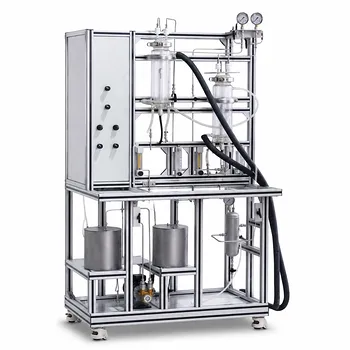
- Photocatalytic Membrane Separation and Degradation Unit Operations Pilot Plant
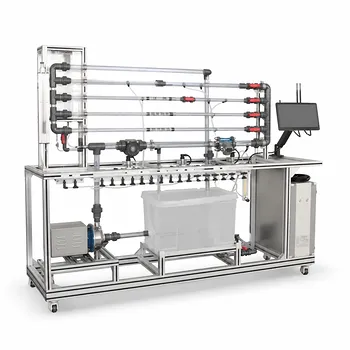
- Fluid Friction Resistance Determination Educational Unit Operations Pilot Plant
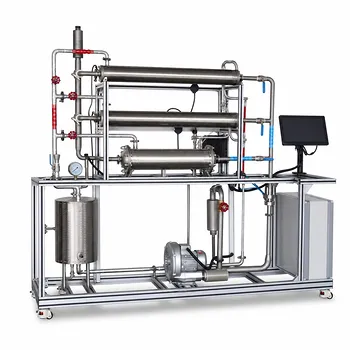
- Comprehensive Heat Transfer Coefficient Determination Educational Unit Operations Pilot Plant
People Also Ask
- What are the key differences in membrane configurations? Choose the Right Unit Operations Pilot Plant
- How Do Pervaporation, Vapor, and Gas Permeation Differ in Pilot Plants? Key Comparison
- What are the structural & performance trade-offs of flat-sheet, spiral-wound, & hollow-fiber membrane modules?
- How do PEI, PVDF, and PSU membranes compare in pilot plants? Find the best fit.
- Pervaporation vs. Vapor Permeation: Handling Suspended Solids in Membrane Pilot Plants