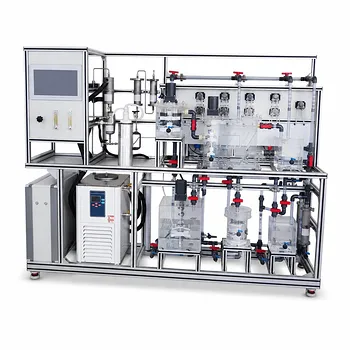
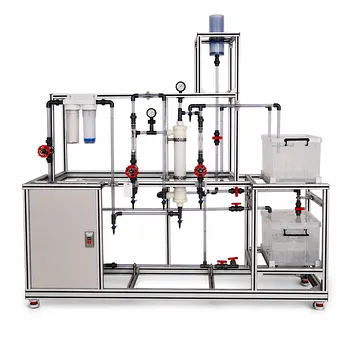
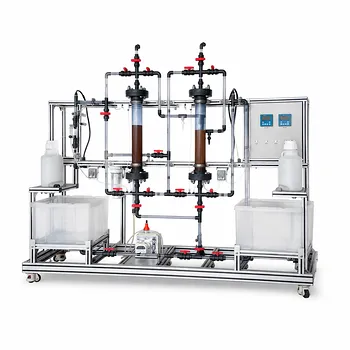
Forget the high-pressure pump—start with an electric field. An electrodialysis (ED) pilot plant offers distinct advantages over reverse osmosis (RO) in educational and research settings because it enables targeted ionic separations rather than bulk water removal. Its superior fouling resistance and minimal pretreatment requirements allow students to work with diverse, real-world feedstocks without constant system downtime. While RO efficiently produces pure water, ED transforms a lab into a hands-on electrochemical platform for studying ion transport, electrode reactions, and membrane science under stable, forgiving conditions.
While RO teaches how to make water, ED teaches the science of separation. The electrically-driven nature of ED provides a robust, low-pressure environment where students can safely manipulate and visualize ionic migration, making it an unmatched tool for vocational training and process research.
Understanding the Core Difference: Pressure vs. Potential
The fundamental operating principle of each system defines what a student can learn. One uses brute hydraulic force, the other uses a tunable electric field.
The Driving Force Defines the Learning Scope
RO is a pressure-driven process that forces water through a dense membrane, rejecting virtually all solutes—including monovalent ions. It is a binary separation: you get permeate or concentrate. ED, in contrast, uses a direct current electric field to pull ions selectively through ion-exchange membranes. This gives users a control knob (voltage/current) to modulate separation in real time, turning the pilot plant into a live demonstration of mass transfer kinetics, limiting current density, and concentration polarization—concepts that remain hidden inside an RO pressure vessel.
Separation Selectivity as a Teaching Tool
RO acts as a universal barrier, which is excellent for desalination but offers little discrimination. ED membranes are charge-selective: cation-exchange membranes only let positive ions pass, and anion-exchange membranes only let negative ions pass. This allows students to isolate specific electrolytes, study the selective removal of hardness ions, or recover valuable salts—experiments that are simply impossible with a non-selective RO membrane. ED also leaves non-ionic organics unaffected, providing a clear visual that separation is governed by charge, not size.
Educational Advantages: Robustness and Experiment Flexibility
A pilot plant in a teaching lab must survive curiosity-driven misuse and variable feedstocks. ED is inherently more forgiving.
Superior Fouling Resistance Reduces Downtime
ED membrane modules demonstrate superior fouling resistance compared to RO membranes. Because the driving force is electrical rather than hydraulic, there is no compaction of a foulant layer under high pressure. ED systems also require less intensive feed pretreatment, so students can run experiments with turbid surface water, brackish groundwater, or even industrial brine without immediately destroying the membranes. This robustness maximizes hands-on time and minimizes the frustration of system shutdowns.
Hands-On Electrochemistry at a Pilot Scale
ED directly exposes electrode reactions: hydrogen evolution, oxygen generation, or metal deposition can be observed and measured. Students can map current-voltage curves, calculate current efficiency, and witness the onset of water splitting. These are core electrochemical engineering concepts, and ED makes them tangible. RO, being purely physical, offers no window into these phenomena.
Research Advantages: Beyond Simple Desalination
For chemical process research, an ED pilot plant unlocks investigations that RO cannot support.
Targeted Ionic Separations for Specialized Studies
ED’s ability to selectively migrate small-molecule electrolytes enables researchers to study nutrient recovery (separating ammonium or phosphate from wastewater), brine valorization (concentrating lithium or other valuable ions), or ion-specific membrane development. RO’s “reject everything” strategy is a blunt instrument; ED is a scalpel. This precision allows for experiments on selective transport, membrane permselectivity, and the design of cascading separation sequences.
Connecting Theory to Practice in Process Control
Integrating both technologies in a pilot plant lets students directly compare power consumption profiles, rejection rates, and scaling behaviors of pressure-driven versus electrically-driven systems. ED’s electrical parameters (voltage, current) are inherently easier to automate and log than high-pressure hydraulics, making it ideal for process control research and algorithm development. The comparison itself becomes a rich data source for systems-level thinking.
Understanding the Trade-offs
While ED is a superior teaching and research tool for ionic processes, it is not a universal solution. Objectivity demands a clear-eyed view of its limitations.
Limited Effectiveness for Non-Ionic Solutes
ED will not remove uncharged contaminants such as dissolved silica, bacteria, or large organic molecules. For studies on total organic carbon removal, advanced oxidation polishing, or producing ultra-pure water from organics-laden feed, an RO unit or a combined RO-ED system remains essential. ED ignores what RO captures.
The Complexity of a Multi-Membrane Stack
An ED stack contains dozens of alternating cation- and anion-exchange membranes, spacers, and electrodes. While individual membranes resist fouling, assembly and maintenance require careful alignment and gasket integrity. This introduces a logistical layer of complexity that a simple RO spiral-wound module avoids. However, the learning curve of managing that stack is itself a valuable curriculum point.
Making the Right Choice for Your Lab’s Goals
The decision hinges on whether you want to teach water production or separation science.
- If your primary focus is basic desalination and water purification: Choose an RO pilot plant. It is the industry standard and will directly train students for the largest membrane market.
- If your primary focus is advanced chemical process research and electrochemical training: An ED pilot plant wins decisively. It turns abstract electrochemistry into a tangible, controllable system.
- If your primary focus is exploring a wide range of dirty or variable feedstocks without extensive pretreatment: ED’s fouling resistance and low-intensity preprocessing give it a decisive uptime advantage.
- If your primary focus is selective ion recovery, nutrient management, or mass transfer kinetics: Only ED provides the charge-based selectivity needed to run those non-trivial, publishable experiments.
Equip your students not just with the ability to make pure water, but with the deep understanding of how to separate anything ion by ion.
Summary Table:
| Feature | Electrodialysis (ED) Pilot Plant | Reverse Osmosis (RO) Pilot Plant |
|---|---|---|
| Driving Force | Direct current (DC) electric field | High hydraulic pressure |
| Separation Type | Charge-selective ion separation | Bulk water removal (non-selective) |
| Fouling Resistance | High (forgiving under variable feeds) | Low (prone to membrane compaction) |
| Core Learning Value | Mass transfer, kinetics, & electrochemistry | Industrial desalination & water purification |
Elevate Your Engineering Lab with Custom Pilot Plants
To bridge the gap between textbook theory and hands-on industrial expertise, you need robust, reliable, and pedagogically designed systems.
LABPARK provides premium Educational and Vocational Unit Operations Pilot Plants in chemical engineering, bioprocess & biotech, and environmental & water treatment. Specifically built for universities, research institutes, and enterprises, our systems—ranging from electrodialysis to reverse osmosis pilot plants—are engineered to foster innovation, withstand student operations, and deliver precise research data.
Ready to upgrade your laboratory capabilities? Contact LABPARK today to receive a tailored solution for your department!
Related Products
- Electrolytic Hydrogen Production Educational Unit Operations Pilot Plant
- Electrolyte Distillation Purification and Formulation Educational Pilot Plant
- Water Electrolysis Hydrogen Production and Storage Educational Pilot Plant
- Alkaline Membrane Water Electrolysis Educational Pilot Plant Unit Operations Training System
- Electrochemical Water Treatment Educational Unit Operations Pilot Plant
People Also Ask
- How do educational unit operations pilot plants address safety and waste management when scaling up?
- How do educational unit operations pilot plants bridge theory and design? Bridge the Engineering Gap
- Why is the chemical plant startup schedule crucial? De-risk scale-up with pilot plants.
- When to transition from PID to adaptive control in pilot plants? Key process indicators.
- Why Compare Predicted and Experimental Excess Enthalpy? Key to Accurate Pilot Plant Scale-up